Categories
Sermons

Connection is the Goal; Openness is the Path – Naso / Pride Shabbat 5776

The bloodbath in Orlando has made this Shabbat particularly relevant.

I said something briefly about it on both days of Shavuot. After services on Monday morning, the second day, one person who had been in attendance, a man who has a long family association with this congregation, came forward to speak with me. He told me that as an American, a Jew, and a gay man, he was tremendously grateful for my having said a brief word during services, acknowledging the pain of loss, the grieving that we should all feel after such horrific news, about the pain it has caused to the LGBT community, and particularly the Latino component thereof.

In a different conversation that I had a few months back, a member of this congregation told me that her son, now a young adult, is gay, and that he never comes to Beth Shalom anymore when he is home. Why? Because, when he was a teenager, he heard other members of this congregation make disparaging remarks about gay people, and he no longer felt welcome here.

Ladies and gentlemen, hevreh (as they say in Israel), we are riding a wave of great change in our society not only with respect to gender issues, but also with many types of “otherness.” Millennials, that mystical category of young people, do not see lines that separate people the way that their parents and grandparents do. They think in universal terms.

Here is something that might be easy to say, but not quite as easy to make happen:

All are welcome here. Not only that, but all who want to be a part of our congregation must be not merely welcomed, but also included into the fabric of who we are, encouraged to connect with the Beth Shalom community. Not to do so, especially in the wake of last weekend’s shooting, is simply wrong.
PrideShabbat2016_logo

That’s not so easy. Traditionally speaking, Judaism, and particularly synagogues, are accustomed to drawing lines. Boundaries that divide us. Who’s in, who’s out, who is pious, who’s a sinner, who’s a big donor, who has a dues arrangement, who’s a member, who’s not, who is Jewish, who isn’t, etc. And it’s not just internal – one of the classic stories about synagogues is that even a Jew stranded alone on a desert island needs two: one he davens in, and the other one he wouldn’t go into if you paid him.

Synagogues like to think of themselves as places where halakhic distinctions are rigorously maintained. That is, the lines within our tradition, how we divide people, apply in ritual matters. Even in egalitarian congregations like this one, there are still lines.

And let’s be honest here: there are times when we need some lines. What allows Judaism to be effective in our lives is the boundaries it creates: boundaries between what is holy and what is not, between making the right interpersonal choice and the wrong one, between taking or not taking an opportunity for holiness. These are essential to allowing our ancient tradition to infuse our lives and provide guidance and personal benefit.

But we should work to eliminate lines between us as people. Anybody who wants to come pray with us, celebrate with us, grieve with us, learn with us, they are welcome! I don’t ask any questions about what you do when you leave the building, on Shabbat or any other day. All who come are included.

The key to the Jewish future is being open.

And not merely open; we have to almost drag people in off of the street. Nothing brings people in like personal invitation. And nothing shoos them away more quickly than being told that they are somehow deficient. And we all have the potential to be ambassadors for Judaism, and for Beth Shalom.

The Talmud (Yoma 35b) tells us a revealing story about Hillel the Elder. He would come to the beit midrash / house of study every day, spending half of his daily earnings on the entrance fee. One Friday in winter, he could not find work, and had no money in his pocket, so the guard at the entrance to beit midrash would not let him in. He still wanted to learn, so Hillel climbed up to the roof and sat on the skylight to listen to what was being taught.

As Shabbat fell, it began to snow. On Shabbat morning at dawn, those gathered in the beit midrash wondered what was blocking the light from above. They go up to the roof and find Hillel buried in the snow. They bring him inside, bathe him, anoint him, and warm him up by the fire (all things that would be traditionally forbidden on Shabbat). One teacher makes the observation, “This man deserves to have the Shabbat laws violated on his behalf.”

The message is not necessarily about money, but rather all the obstacles that might prevent somebody from accessing our tradition. We, those on the inside, have to work hard to make Judaism and the synagogue experience available to all who want to learn, pray, celebrate, and grieve. Sometimes, we have to move beyond our comfort zone, and even have to violate some of our core principles to do so.

Many of you know that I, as a Conservative rabbi, may not officiate at weddings if either the bride or groom is not Jewish. That is a policy that will not likely change soon.

But here’s the funny part: I will do everything in my (limited) range to welcome that couple into our congregation. I will be happy to meet with them before the wedding, and I will of course welcome them as members if they choose to join.

A couple of decades ago, when mixed marriages were becoming much more common, the Committee on Jewish Law and Standards (CJLS) of the Rabbinical Assembly laid down the law, or so they thought. They forbid acknowledging such a wedding, of course. They forbid an aufruf or congratulating the Jewish family or accepting donations for a non-Jewish child born to such a family. They forbid allowing an intermarried Jewish person to be called to the Torah.

Did these measures lower the rate of intermarriage? No. Do you think that any Jewish person considered, before getting into a relationship with a non-Jew, that his/her rabbi would not officiate at or attend their wedding, if they were to get married? Probably not.

All they did was to annoy the parties involved, and send them to Reform congregations, where they of course were welcomed, or out of the Jewish world entirely.

(The CJLS has come a long way; it has been nearly a decade since they voted to ordain openly-gay rabbis and allow rabbis to perform same-sex weddings; and in April of this year, they passed a teshuvahnullifying any provisions in Jewish civil law that are discriminatory against non-Jews.” So that is something.)

But if we really believe in what we do, in a Judaism that is traditional and still progressive, shouldn’t we want all of those families to be welcome here?
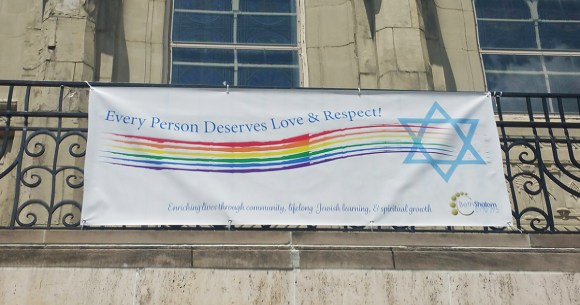
PrideShabbatBanner_2016_live

You should be pleased to know that among those who are completing my conversion course this summer, three of them are already married to Jews, and already have children. We’re going to get 7 new Jews out of just those three families.

The greater point here is that if we are open and inclusive, we will gain new members, new families. We will even make more Jews! We will be stronger as a community. We will teach and learn more, engage and raise our holiness quotient to new heights. We will thrive in our interconnectedness.

In the wake of a senseless tragedy that took the lives of so many in the name of hatred and intolerance, Beth Shalom and other faith communities should be standing up for compassion, for love, for tearing down walls, for eliminating not just the mehitzah of the traditional synagogue that separates women from men, but all the lines. We have to include those who are peering in from the skylight. We have to acknowledge the divinity in each of us.

The early 20th-century English novelist E. M. Forster, in his novel Howard’s End, pointed to the power of connection in a well-worn passage:

“Only connect!” he said. “Only connect the prose and the passion, and both will be exalted, and human love will be seen at its height. Live in fragments no longer. Only connect, and the beast and the monk, robbed of the isolation that is life to either, will die.”

20160620_095719_resized

The goal is connection; the path is openness. We have to be committed to both.

May the families of those who lost loved ones be comforted; we grieve with those who suffer from loss. May our openness and interconnectedness prevent such tragedy from striking ever again. Shabbat shalom.


~

Rabbi Seth Adelson

(Originally delivered at Congregation Beth Shalom, Shabbat morning, 6/18/2016.)
Categories
Sermons

The Value of Life and the Jewish Triangle – Bemidbar 5776

I was struck by a curious item in the news two weeks ago: the gorilla that was shot and killed at the Cincinnati Zoo. (In case you didn’t hear: a 3-year-old boy fell into the moat surrounding the gorilla pen; the silverback, a 17-year-old, 420-pound western lowlands gorilla named Harambe, while not attacking the boy, did drag him around the pen, injuring the boy seriously.)

There were vigils, criticism by various groups, defense of the killing by the zoo spokespeople, and plenty of news articles and opinion pieces for and against. Social media exploded.

I am not in a position to judge whether killing the gorilla was justified or not. The zoo’s “dangerous animal response team” made a quick decision, and they opted for shooting to kill over using a tranquilizer dart, to ensure that the child would survive.

Harambe’s cousins in Africa are critically endangered, and zoos like the one in Cincinnati have attempted to remediate this situation by breeding gorillas in captivity. It is certainly unfortunate that Harambe had to die because of this boy. There is no question that this was a hard decision for the zoo, and that their choice would be scrutinized and criticized. We will never know what would have happened had they gone with the tranquilizer dart, or some other solution.

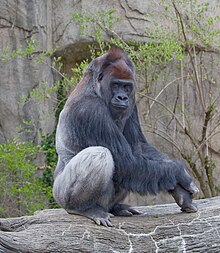
WesternLowlandGorilla03.jpg
Western lowland gorilla

But what actually struck me about this story was its context in the news. Around the same time there was a shooting with multiple fatalities in a neighborhood in Houston where I used to live. It has also emerged in recent weeks that the homicide rates in both Chicago and Toronto are up by over 50% this year over last. And of course there is the ongoing terror activity in Israel, which claimed four more lives in Tel Aviv this week.

And those stories are dwarfed by the largest humanitarian catastrophe of the last few years – that is, the Syrian civil war. Estimates vary, but perhaps 400,000 people have been killed in Syria in the last five years. And we all know about the refugee crisis here and abroad, driven largely by displaced Syrians.

What emerges when you juxtapose the flap surrounding the gorilla with those other stories is this curious situation where people – actual people – are being killed and driven from their homes, and yet the reaction to Harambe’s death somehow floated to the top of the news, at least on Internet portals.

It is fascinating to me that have become so inured to daily killing and human suffering in our own contexts, outside of the tightly-controlled environment of the metropolitan zoo, in the wild streets of Chicago or Baltimore or even suburban St. Louis, that we seem to have lost a sense for the value of human life.

Of course, it’s hard to wrap our brains around the killing of many; it’s much easier to be outraged by the murder of a single, rare primate in a single, tragic situation.

But it’s worth noting that our tradition teaches us about both.

All lives – the lives of all creatures – are endowed with a spark of the Divine.

We learn from the Torah in multiple places, and it is expanded upon in the Talmud, that we are forbidden from causing animals unnecessary suffering. This principle is known as, “tza’ar ba’alei hayyim,” (and I learned this week that the SPCA in Israel is called, Agudat tza’ar ba’alei hayyim – the association of [fulfilling the mitzvah of preventing] cruelty to animals).

But qal vahomer / all the more so, human life too is sacred, and one of our duties here on Earth is to alleviate human suffering wherever we can. Lo ta’amod al dam re’ekha, says the Torah (Lev. 19:16). Do not stand idly by the blood of your fellow person. We have fundamental obligations to the people around us. And if Syria is too far away, we might consider just the people in our immediate environs.

Where, ladies and gentlemen, is the outcry? Where are the vigils for the victims of authoritarian regimes around the world? Where are the politicians calling for change on America’s streets? Where are the nations who are jumping over each other to take in those who have fled the Syrian chaos? Chancellor Angela Merkel of Germany was the only head of state of the G-7 nations to attend the UN’s World Humanitarian Summit at the end of May, something which UN Secretary General Ban Ki-Moon went out of his way to point out.

And where, indeed, are the Jews, marching to help ensure that everybody gets a fair break in life, a decent education, neighborhoods free of the scourges of crime and drugs and guns?

***

We celebrate today with two young women who have stepped forward into direct relationship with the Torah and its framework of holiness. And not only that, but we continue our celebration of that framework tonight as we usher in the festival of Shavuot.

We call benei mitzvah to the Torah in the synagogue, surrounded not only by family and friends because we are making a public statement: this child is now one of us; she has inherited the mantle of Torah, the set of holy opportunities to fulfill our mitzvot. It is, by definition, a public display of the stepping up of this child.

The most fundamental statement of bar/bat mitzvah is communal; it is that this child is now one essential vertex in the triangle of individual, community, and Torah.

A sizeable chunk of that triangle is dedicated to the acknowledgement that this is an imperfect world, one which routinely tramples idealism and continues to thwart dreams, but that we have an obligation, as individuals and communities in sacred relationship with Torah, to right wrongs, to uplift the oppressed and give a hand to the needy. Lo alekha hammelakha ligmor, velo attah ben horin lehibbatel mimmena. It is not up to you to finish the task, neither may you give up on it (Pirqei Avot 2:21). That holy work is never done.

One neat trick of the Jewish calendar is that Parashat Bemidbar is always read adjacent to Shavuot, a reminder that the Torah was given and received in the desert. It was not given in Jerusalem, or even in Israel! The message is that the Torah does not belong to a particular place or even (!) a particular people. The Torah, and the holy opportunities it gives us, are for everybody.

As we prepare ourselves to celebrate Torah tonight on Shavuot, we should remember that our opportunities for holiness extend far beyond our interconnected Jewish circle here in Squirrel Hill, and much further beyond the Jewish world. The triangle that unites us with Torah demands that we seek justice for all of God’s creatures, as we said on Shabbat morning in the Prayer for Our Country, “lemiqtanam ve’ad gedolam,” from the least of them to the greatest (Jer. 31:33).


~

Rabbi Seth Adelson

(Originally delivered at Congregation Beth Shalom, Shabbat morning, 6/11/2016.)

Categories
Festivals Sermons Yizkor

The Memory Machine – Second Day Shavuot, 5776

Remembrance of those who have passed from this world is a universal human desire; we all feel the need to recall our family members and friends who are no longer with us.

Two decades ago, when I was an undergraduate at Cornell, I recall reading a statement about memory that has stuck with me.  It appeared in the campus newspaper, the Cornell Daily Sun, in the middle of a tongue-in-cheek article about something that I can’t remember.  But the statement that struck me read as follows:

“[So-and-so] is still trying to cope with the realization that he is a function of every person he has ever met and every book he has ever read.”

I remember thinking, hey, that’s me too.  I am also a function of every person I’ve ever met and every book I’ve ever read.  And here, the word “function” is used in its mathematical sense.  Perhaps some of you recall from junior high school algebra:

f(x)

or the diagram of the function machine:

function can be visualized as a "machine" that takes an input x and ...

A function is a box that performs some kind of action on data that is entered, such that what comes out is modified in a particular way.  So if f(x) is x-squared, then if I put in 2, the function turns it into 4.  If I put in 3, it becomes 9.  And so forth.

To say that we are functions of our life experience is a vast oversimplification, of course.  Our own function machines would have to be very, very complicated.  But on some level, this is not far off.  We are shaped by our experiences, from the moment we emerge from the womb, through schooling and relationships and work and success and failure and loss and happiness and sadness.

Perhaps a better way of understanding ourselves, then, is that we are  memory machines — sacks full of memory — that not only process our experiences through those memories, but also allow us to dig into our past, to re-examine, to think of the beautiful moments as well as the awkward ones that we wish had never happened. What we carry with us is invaluable; it is in fact who we are.

And it is really hard to wrap our brains around that.  We often measure people by the superficial stuff: how they appear, what car they drive, where they go to synagogue, when they go to synagogue, and so forth.

But what really makes us who we are is our own, personal, individual sack of memory. And in particular on a day like today, when we reflect back on how our lives were touched by those whom we remember.

The proper name from Yizkor, by the way, is Hazkarat Neshamot, the recalling of souls. What we do on this day is to attempt to bring up those shards of memory of those who have left us: who they were, what they stood for, what they taught us.

Perhaps this endeavor serves as a reminder on an ongoing basis of our obligation to treat others well, to remember that every interaction that we have with other people is logged in somebody’s memory.  And not only that, but also that many little actions can add up to a tidal wave of memories, memories that cross over from individuals to peoples.  Memory shapes not only individuals, but also cultures, politics, and nations.

I’m going to share with you a few examples from my own memory machine, memories that have shaped me as a contemporary Jew, as an American, and as a rabbi.

When I was in cantorial school, and before I had a cantorial position that required me to be at the same synagogue every Shabbat and holiday, I used to do a lot of “shul-hopping.”  That is, I would walk to different synagogue in Manhattan to listen to different hazzanim, to hear them practice their art.  One year on Shemini Atzeret, I walked to Fifth Avenue Synagogue, an Orthodox congregation on the East Side, to hear Cantor Joseph Malovany.  Unfortunately, he was not there that day, and his substitute was unremarkable.  But I was treated to something else that day: the author Elie Wiesel was there, sitting quietly in the front row on the rabbi’s side.  I did something that day that I was not accustomed to doing at the time: I stayed in the sanctuary for Yizkor, mostly so I could watch Elie Wiesel as he stood up to recite his own personal Yizkor prayers, recalling, I imagined, all of the things that he had recounted in his books: the loss of his family, his Romanian village, the loss of his faith upon arrival in Auschwitz.  He stood with his eyes closed, gently rocking side to side, his head cast slightly upward.  Where is he?  I wondered.  Where is he right now?

A different story: The summer of my seventeenth year I visited Israel for the first time.  I spent eight weeks there on an academic program called the Alexander Muss High School in Israel, where we learned Jewish history from ancient times until present day, and visited relevant sites all over Israel to put it in context.  It was amazing — much of what I learned that summer I have carried with me and used again and again.

Of course, when you have 40 seventeen-year-olds living together in a dorm for eight weeks, you learn a whole lot about the complexity of human relationships as well.  One thing that I remember from that summer was learning about how mean one Jew can be to another for the sake of one interpretation of Judaism.  One weekend, we had some free time in Jerusalem, and one of my female friends was caught inadvertently among a mob of Haredim (so-called ultra-Orthodox Jews, although I prefer not to use that misleading term) who were protesting the opening of certain cinemas on Shabbat.  She was wearing something that someone in that crowd deemed inappropriate, and so he spat upon her.  She was, as you can imagine, more than taken aback; the Jews among whom she had grown up and lived with and traveled around Israel with did not behave that way.

That was a memory that I am sure that she carries with her to this day, and so do I by proxy (even though I was not there when it happened).

Ladies and gentlemen, as a people we came through the Shoah together, laden with horrible memories, with martyrdom an essential feature of the modern Jewish psyche.  We established a Jewish state in our historical homeland.  We have empowered women to participate fully in Jewish life and mitzvot.  Many of us in this room remember all of these things personally, because you were there.  Our memories have shaped us as a people. And they will continue to help us move forward as a people into the bold, inchoate Jewish future.

Many of you have been to parlor meetings with me over the past year, and you know that part of the process is to tell a story about a Jewish memory, a meaningful Jewish experience. My goal in asking you to do so is not so that the others in the room might simply say, “Now that’s nice.” Rather, it is to (a) remind us of the power of memory, (b) create a sense of community through shared stories, and (c) try to connect who we are and how we live today as Jews with our past experiences. We fire up those memory machines to connect them with each other, and then with Congregation Beth Shalom.

On this second day of Shavuot, this day of remembering, it is upon us to look back not only on the people that have created deep personal memories for us, our parents, our siblings, our teachers, our friends, but also those among our people who have created salient cultural memories for us as Jews, and the community that we have inherited.

Memory makes us collectively stronger as individuals and as a qehillah. Turn on those memory machines; now is the time to actively remember.


~

Rabbi Seth Adelson

(Originally delivered at Congregation Beth Shalom, second day of Shavuot, 6/13/2016.)

Categories
Sermons

Holy Adhesion (Mitzvah, Part 2 of 2) – Behar 5776

I went back to school last week. More accurately, I went to the convention of the Rabbinical Assembly – the professional organization of Conservative rabbis. I of course saw many old friends and colleagues, and we caught each other up on our lives and work, our successes and challenges and so forth.

And of course, what do rabbis do when they get together? Why, play poker and smoke cigars, of course!

They learn. Actually, in an ideal world, that’s what all Jews should do when they get together: Pirqei Avot tells us (3:3) that when two people meet and exchange divrei Torah (words of Jewish learning), the Shekhinah, God’s presence, hovers between them. (And I don’t know about you, but I could use a lot more Shekhinah in my life.)

You see, it’s not just 12-year-olds preparing to become bar / bat mitzvah that learn the words of Jewish tradition. On the contrary: the highest ideal in Judaism is lifelong learning. Why? Because study leads to action, and the lessons of the Jewish bookshelf continue to speak to us from across the ages.

Some of you may know that there was a movement in the first half of the 20th century to eliminate bar mitzvah at age 13 from Jewish life, and replace it with confirmation at age 16. (I’m told that Rodef Shalom Congregation stood by that policy deep into the 20th century (one of the current members of Beth Shalom is, in fact, the first person to have celebrated a bar mitzvah at 13 at Rodef Shalom.) And there was a good reason for it: a 16-year-old is better equipped to approach learning with more sophistication and nuance, and more ready to be launched into the Jewish world as an adult. There is a certain wisdom in delaying the major life-cycle event marking the transition from childhood to adulthood to a time when the candidate has a better sense of his/her relation to our tradition and to the world. (Plug: we will be celebrating the conclusion of our confirmation class in two weeks on the first day of Shavuot, Sunday, June 12th. Be there!)

But the larger point is that Jewish adulthood is not merely about receiving the traditions and mitzvot of Jewish life, but also about striving to understanding why Jewish tradition is relevant to us and how it frames our lives in holiness. I continue to answer that question for myself every day. It’s an ongoing project for me, and one that I hope you will join with me in furthering.

An essential part of that picture, of course, is Torah study. Not “the Torah,” the Five Books of Moses found on the scroll we just returned to the aron haqodesh, the ark, but “Torah” – the collective writings and brain power that yielded two millennia of commentary, interpretation, re-interpretation, and so forth; the halakhic codes, the midrashim, the liturgy, the poetry, even the music that comprise the entire Jewish body of text-based learning and transmission of our heritage from generation to generation.

We are still part of that transmission. We are each links in the chain that connects us back to Mt. Sinai, and the celebration of a bat mitzvah is merely a reminder that we continue to fashion the links that follow us.

I spoke last week about re-envisioning the idea of mitzvah as “holy opportunity.” This is, of course, an essential concept on a day that we celebrate the stepping forward of a young member of our qehillah, our community, into a complete, sacred relationship with the 613 mitzvot of Jewish tradition. The fulfillment of each mitzvah, which has been traditionally understood to be a commandment from God, is a potential gift to yourself and others, an opportunity to elevate our individual selves and the collective community by performing a traditional action. Examples are wearing a tallit, lighting Shabbat candles, sanctifying the holidays with family meals and abstaining from mundane activities, honoring your parents, and so forth.

So it happens that while I was at the convention, between cigars and counting my poker winnings, one of the learning sessions that I attended spoke exactly to that point. It was taught by Dr. Eitan Fishbane, a professor of Jewish Thought at the Jewish Theological Seminary. Dr. Fishbane’s research area is Jewish mysticism and Hasidic thought, and this particular session was (serendipitously) about the concept of mitzvah as described by a couple of medieval rabbis.

And one of these rabbis, a pre-Hasidic commentator from the turn of the 17th century known as (curiously) the Sh”lah (that’s an abbreviation for Shenei Luhot Haberit, suggests that every mitzvah has greater meaning than the action itself; mitzvot have a higher goal – the goal of devequt, cleaving to God.

Megan's Bio Blog: The Properties of Water

Devequt is one of those mystical words that is hard to translate. While it literally suggests “adhesion,” as in, what glue or tape does. (The modern Hebrew word for glue is deveq.) But the image is a mystical one rather than physical. By acting on those holy opportunities, by taking the metaphysical gifts presented before us at the appropriate time, we are cleaving to the Divine, and thereby bathed in God’s love and light. Devequt is a kind of emotional journey attached to the physical fulfillment of mitzvot, and an essential piece of the Hasidic, kabbalistic understanding of Judaism. It’s an elevated state that we all strive for.

So, for example, let’s consider the mitzvah of the shemittah year, the sabbatical year identified in Parashat Behar today. The idea is that every seventh year in the land of Israel, the ground is left uncultivated. You can eat what grows naturally, from last year’s seeds, but otherwise you cannot till and tend the land and the plants.

Seems like an obscure concept, right? Especially to sophisticated urbanites like ourselves, who do not cultivate any significant amount of land, and even if we own patches of lawn do not really grow food for our own sustenance.

And yet, there are deeper meanings here, found in the mitzvah of shemittah, of not working your fields every seventh year.

One is the sense of respect for the land, for Creation. Just as we humans get a break from everyday business every seventh day, so too does the Earth get a break every seventh year. This heightens our relationship with what has been trusted to us for only a short time. But of course, for our agricultural ancestors, that must have been a very anxious year indeed. Today, we are mostly insulated from the vagaries of subsistence farming.

File:Barley field-2007-02-22(large).jpg - Wikimedia Commons

The Slonimer Rebbe regards shemittah as a challenge of faith and trust. By letting the land go untended for a year, we train ourselves to have some faith that we will still be provided for, that the Divine forces of nature will make sure that we will not go hungry. Unlike in the other corners of our lives, when more work, more development, yields greater profit, with the sabbatical year the reverse is true. Refraining from that development yields a spiritual harvest that brings us back to God. That is devequt. Our human experience is heightened by our trusting relationship with Creation, and we are drawn closer to the Qadosh Barukh Hu.

Shemittah (sabbatical year) and yovel (jubilee, when all the land that has been sold is returned to its original owner) may seem irrelevant to us today. But they help us cleave to God. They increase our sensitivity to the land, to society, and to our individual spiritual needs. We all benefit. And so we are elevated personally and collectively.

And with a little bit of study and reinterpretation of the curious laws of the Torah, we can be drawn closer in holiness through the performance of any mitzvah, the big ones and the small ones.

We need to strive for that devequt. We need to reach higher, however we understand God, or God’s role in our lives. And the mitzvot are a framework of holy opportunities to do exactly that.

In a rather well-known episode, the early 20th-century Jewish philosopher Franz Rosenzweig was asked if he was putting on tefillin every morning, a particularly holy opportunity found in our tradition. “Not yet,” said Herr Rosenzweig. Not yet, because he was still on a journey, or because he was not ready, or because he had not found the motivation to act, or because he was afraid it would mess up his hair. We do not know why.

Franz Rosenzweig | Great Thoughts Treasury

But we all have that sense of “not yet” about us. We just have to dig a little deeper to find the meaning, so that we may strive for devequt, cleaving to God. That will ultimately bring our relationship with Judaism and the mitzvot, those holy opportunities, into focus.


~

Rabbi Seth Adelson

(Originally delivered at Congregation Beth Shalom, Shabbat morning, 5/28/16.)


Categories
Sermons

Choice vs. Obligation: How Might We Relate to Judaism Today? (Mitzvah, Part 1 of 2)- Emor 5776

I had a couple of very relevant conversations last week surrounding Judaism and choice.

The first was at Community Day School this past Monday morning. I was there for what seemed to me a very curious thing: to promote the wearing of tefillin. Now this might seem totally normal – after all, I promote Jewish observance every day of my life. I in fact promote that particular mitzvah quite often during our weekday morning minyan – when there are men who enter to worship and do not have tefillin, I offer it to them. They rarely take me up on the offer, and I do not push. There is, it seems, something particularly alien about putting on tefillin for those for whom it is not a regular mitzvah.

And just to be clear, the mitzvah of tefillin is on par with all of the other positive, time-bound mitzvot, like the observance of Shabbat, wearing a tallit, sitting in the sukkah, eating matzah and maror on the first nights of Pesah, studying Torah, daily prayer, etc. There is nothing that distinguishes this one as compared with any other particular mitzvot – that is, it is just as valid, and still applies to Jewish adults.

Opinions Vary on Women and Tefillin Question

But what was challenging for me about this discussion was not the promotion of a mitzvah, but rather the assumption that it is a choice for post-benei-mitzvah kids in a Jewish day school whether or not to wear them, particularly while it is not a choice for them to fulfill the mitzvah of daily prayer.

Now, it is not my intent to criticize CDS – I think that they are doing a wonderful job endowing our children with Jewish learning. My intent is to examine where we are today as Jews, a subject that many of you know is exceedingly important to me.

The second conversation was here at the Religious Services Committee meeting on Thursday evening. Among the topics discussed that evening was the question of whether women in our congregation be required to wear kippah, tallit, and tefillin during our services. Now, I do not need to go into the halakhic / Jewish law issues surrounding this question – we’ll save that for another day. (Suffice it so say that it is a very interesting question, but of course we know that traditionally women have not been considered “obligated” to wear these ritual items, but the Conservative movement has said that they may take them upon themselves if they desire.)

What emerged during the conversation is the question of those men who come to weekday morning minyanim and wear a tallit, but no tefillin, to which they are clearly obligated under Jewish law. Generally, we do not force anybody to do anything. So if we were to insist that women were to put on these ritual items, we would have to insist that these men do as well.

The question upon which I am focused is not tefillin, per se, but the idea of choice. Because the way that Judaism has traditionally been understood, we do not really have a choice. God has placed the mitzvot in front of us (613, as you may know, although this is a debatable figure), and it is our obligation to fulfill them. “Kol asher dibber YHWH na’aseh ve-nishma,” said our ancestors back in Parashat Mispatim. “Everything that God has spoken we will do and we will obey.” (Ex. 24:7) That’s what the covenant, the berit, with God is all about. God gives us good things – rain, abundant harvests, fertile livestock, etc. – and we perform the mitzvot. (Why do we call circumcision a berit millah? Because millah / circumcision is the sign of that covenant, that berit with Avraham, Yitzhaq, and Ya’aqov and every Israelite who came after them.)

The traditional way of thinking in Jewish life is that if we choose not to fulfill our side of the covenant, God’s expectations of us, we have clearly transgressed.

Now, it is DEFINITELY NOT my intent to make anybody feel guilty about what they do or do not do. I don’t believe in guilt – it’s not a part of my religion.

Nonetheless, I think we do need to feel out this concept of choice. We are not living, after all, in the second century CE, when the early rabbis were codifying these principles, or even the 19th century, when the modern movements (Reform, Conservative, and Orthodox) are beginning to crystallize. Today we are in a very different place, both in our relationship to Jewish tradition, and the wider society’s relationship to religion. And, as we all know, the Jews are just like everybody else, only more so.

So the question comes down to this: Do we, in fact, feel “obligated” to the mitzvot of Jewish life? Do we feel compelled to fulfill our end of that berit, that covenant? Can we even understand God in such a way that makes the whole idea of berit work?

I have been a lifelong Conservative Jew, and mitzvot such as tefillin have never been presented as optional. On the contrary, it was clear that although many Conservative Jews clearly did not keep kashrut or Shabbat in a traditional way, there was always the expectation that, at least in the synagogue and other public Jewish contexts, the communal standard of observance was higher. To this day, of course, we mandate that food served in the building is kosher, that tefillot are recited thrice daily, that hilkhot Shabbat, the laws of Shabbat observance, are observed, and so forth. In short, we offer an environment in which it is clearly possible to fulfill the mitzvot. And we encourage people to do so, regardless of what they do once they leave.

When I was a camper at Camp Ramah, an arm of the Conservative movement, boys who were post-benei mitzvah were required to wear tefillin at morning services. There was no choice. I did not mind this – as you may imagine, I’ve always enjoyed putting on tefillin. It is likely that not everybody was where I was.

But when I was not at camp, I only rarely put on tefillin as a teenager, and only when I was at a weekday morning service, which happened perhaps three times in high school (the morning of Purim, since I was a regular megillah reader).

Let’s face it: the highest value in American society today is choice. Have you purchased any toothpaste lately? While it used to be that there were about four toothpastes available to the American consumer, today there must be hundreds. What could possibly justify so many choices?

I once heard Rabbi Ed Feinstein of Valley Beth Shalom in LA describe America as, “Choice on steroids.” And all that choice has transmogrified our brains. We expect it in all corners of our lives.

Is this good for the Jews? When we have seemingly infinite choice, isn’t it natural to assume that we will have it in our relationship with Judaism as well? Ours is not really a tradition of choice. It is a tradition of mitzvah, of commandment.

The reality, of course, is that we have choice in Judaism, and I don’t merely mean davening at Rodef Shalom, Beth Shalom, or Poalei Zedek. There was a brief period in American Jewish life when converts to Judaism were referred to by the politically-correct-sounding, “Jews by choice.” But today we have to acknowledge that we are ALL Jews by choice, even those of us born to a Jewish mother and steeped in tradition.

So how, then, may we understand mitzvah? This is a particularly relevant question today, when we celebrate a member of our community becoming bar mitzvah, i. e. one who is now endowed with the opportunity for complete spiritual fulfillment of the 613 mitzvot of Jewish life.

There is no question in my mind that the mitzvot are an obligation; some rabbinic writings refer to them as a “yoke,” (ol malkut shamayim – the yoke of the kingdom of Heaven, the Empire of God). The very word mitzvah means commandment – something that God has effectively ordered us to do. But these are all alienating terms. Perhaps those of us in the know should refer to the mitzvah as a holy opportunity.

With every potential fulfillment of a mitzvah, with every available holy choice, we have the opportunity to raise our own personal holiness quotient. When you wrap yourself up in a tallit, when you bind the words of the Shema to your arm and your head, when you place a mezuzah on your door frame, when you avoid certain foods or avoid spending money on Shabbat or have a holiday meal with family, you raise your holiness quotient. Whenever you take an opportunity to fulfill a traditional ritual, you elevate yourself and your community just a little bit.

Here are five possible reasons for continuing to take those holy opportunities. Perhaps one of them speaks to you.

  1. Mitzvah. Berit / covenant. The traditional conception of obligation.
  2. Tradition. My ancestors have done this for millennia. Perhaps I should too.
  3. Boundaries. Healthy living requires limits.
  4. Physicality. We need daily reminders of being Jewish to connect us to our tradition, and physical acts (eating, wrapping tefillin, etc.) are the best reminders.
  5. Qedushah .It makes you feel holy.

Ultimately, even though it’s not a choice, many of us perceive it to be. But it’s the right choice, the set of choices our people have been making for perhaps as long as 2,000 years. And maybe, just maybe the reason we are still here, thousands of years after the Roman Empire, the Babylonians Empire, the Persian Empire, even the Ottoman Empire (OK, so it’s only been a century since that one fell), is because we have continued to pursue this path of holiness, because we have continued to make the holy choice when it has been presented to us, to act on those sacred opportunities. The Empire of God, malkhut shamayim, is still here.

(To read part 2 in this series on the concept of mitzvah, click here.)

~

Rabbi Seth Adelson

(Originally delivered at Congregation Beth Shalom, Shabbat morning, 5/21/2016.)

Categories
Sermons

The Holiness of Being Together – Qedoshim 5776

Last weekend, my family and I were on the first annual Beth Shalom Family Retreat, which was targeted at member families that will be celebrating a bar/bat mitzvah in the coming year or two (that is, with children in the 5th and 6th grade). Altogether, we were 49 people: eleven families (including my own), plus JJEP Director Liron Lipinsky, Youth Director Yasha Rayzberg, and JLine Director Carolyn Gerecht, on loan from the JCC, which also supported the trip with a generous Partner in Teen Engagement grant.

From Friday afternoon until Sunday morning, we were together. We held Shabbat and Rosh Hodesh services together. We dined together. We played together, sang together, went for a nature walk in the woods together, recited the Amidah for Shabbat minhah under a lean-to in the rain together, learned Torah and discussed mitzvot and parenting and the future of Judaism together, and so forth. And, not only this, but we also managed to find some moments of down-time, doing nothing but hanging around and schmoozing and enjoying each other’s company. (We were at Camp Guyasuta, a Boy Scout camp just over the Highland Park Bridge.)

As far as I can tell, it has been a very long time since Beth Shalom has done something like this, if ever. The goals of this retreat were as follows:

  • To connect benei mitzvah families to each other and to their synagogue by creating opportunities to engage with Jewish life together
  • To discuss issues important to families surrounding bat and bar mitzvah, like the meaning of mitzvah, and how we might understand Judaism in relation to our lives today
  • To reinforce the sense that Jewish learning goes on in formal and informal settings
  • To create a sense of continuity in Jewish education before and after benei mitzvah
  • To promote post-benei mitzvah opportunities for Jewish learning, particularly JLine
  • To give the participants a traditional Shabbat experience
  • To expose them to Jewish learning in age cohorts as well as inter-generational
  • To break down social boundaries between children in day school and those in supplementary religious school (about half of our families were JJEP, and half were CDS)

And, of course, the overarching goal amidst all of this was for everybody to come away thinking, “That was awesome.” To create positive memories of Jewish involvement, of Shabbat, of Beth Shalom, and so forth.

And I think that we achieved all of those goals.

Perhaps one of the most telling pieces of feedback that we received, when we solicited the participants for reactions to the weekend, was that it was a pleasure for these families to spend time together, in simple surroundings, not watching the clock (well, they weren’t, but I can assure you that we, the staff, were), enjoying the qedushah, holiness of Shabbat, and the time that we spent together.

Parashat Qedoshim, which is really one of my handful of favorite parashiyyot (and not just because it happens to be my bar mitzvah parashah), is notable for many reasons. It features a portion of the book of Leviticus known as “the Holiness Code,” an echo of the Decalogue, aka the Ten Commandments. But the mitzvot included here are more about interpersonal holiness then the Decalogue (i.e. 10 commandments) . While the passage in Exodus speaks of the big commandments, not killing, stealing, coveting, etc., stated in the cold abstract, the Holiness Code tends to speak about mitzvot in the context of human relationships.

Just a few examples: judging people fairly (Lev. 19:15), not bearing a grudge (19:18), leaving portions of one’s field and produce for the poor among us (19:9-10). And while the Decalogue says simply, Lo tignov / do not steal (Ex. 20:13), Parashat Qedoshim says, Lo ta’ashoq et rai’akha, do not defraud your fellow; do not commit robbery, and do not keep the wages of a day laborer overnight. (Lev. 19:14), all forms of theft, but continually referring back to the other.

And the effect is that these statements in Qedoshim are much more human. They are about the people we love, the people we work with or employ, the people who live next door, the people we encounter in the marketplace or gleaning sheaves of wheat in the field. The mitzvot of the Holiness Code are as much about the people as they are about the actions.

When I read this parashah, I think about society. I think about making a human environment in which people understand and appreciate the others around them, and about how we see ourselves through the lens that focuses on the other.

The reason that retreats work well is because they take us all out of our regular environment, the context of all the craziness and busy-ness that fills our lives: sports leagues, playdates, homework, texting, ballet lessons, saxophone lessons, math lessons, cleaning, shopping, fixing the house, and so forth. Because all 49 of us were in such close quarters, with limited options and no appointments and no constant interruption, we were simply able to enjoy Shabbat, and each other’s company. Adults schmoozed while kids played nearby. It was blissful. And then there were s’mores.

What you can easily create in a 40-hour retreat that is much harder to create in, say, the synagogue, is the sense of togetherness. This is a good feeling, one to which we used to be accustomed. Today, the sense of togetherness often seems quaint, because each of us is so wrapped up in doing our own thing, getting through our own to-do list, dealing with our own problems.

We are living in a zealously independent age. Unlike our ancestors, most of whom lived in poor, cramped environments in which (a) you had to depend on others for help, and (b) you could not avoid sharing space and food and life with other people. Today we live far more comfortable and isolated lives. If we want to shut ourselves off from others, we can. Given the digital innovations of today, it’s not hard to go through life without actually speaking to anybody, let alone relying on them for all manner of assistance.

We are all, in the words of sociologist Robert Putnam, bowling alone. There are more single people today, on a percentage basis, than there have ever been in history. There are fewer bridge games and adult softball leagues. All forms of civic engagement are down, from voting to going to club meetings to, of course, membership in synagogues and churches. The “social capital” (Putnam’s term) that once infused American life, drawing people together, has diminished dramatically in the past half-century, and nobody knows why.

But qedushah, holiness, flows not only from our relationship with God, but also through our relationships with each other. Why do we require minyan, a quorum of 10 people for services and for weddings? Why do we build synagogues (batei kenesset, houses of gathering) for group prayer and learning and socializing? Why do we call 13-year-olds to the Torah in front of the entire community? Why do we have rituals to mark any lifecycle event in synagogues?  Why do we publicly mark the passing of our beloved friends and relatives multiple times a year as a community with Yizkor? Because community is the essence of what it means to be Jewish. And our sense of qedushah flows through that gathering together.

Togetherness yields holiness. And we need more of both.

So how do we achieve togetherness? We have to make room for it in multiple dimensions: time, space, in our minds and hearts.  We have to set aside a piece of our lives to be with other people.

Convincing ten families to come with us on this retreat was the hard part; people had to accept that they would be giving up a whole lot of other things to commit to this. But when they came to the end, the participants appreciated the value of setting aside that time for the pursuit of holiness in being together.

Communicating with friends and family with your electronic devices does not satisfy this need for togetherness. Texting, WhatsApp, Skype, Facebook, etc. may keep you informed (perhaps too much so!), but they do not create the feeling that human contact creates. And they certainly do not allow us to be fully present, enjoying personal moments with others.

You have heard me speak many times over the last nine months in various ways about re-thinking what we do here at Beth Shalom, re-orienting our relationship with Judaism to be more engaging, more connective. The retreat is just one way of doing this. I think we need more retreats, organized by cohort: empty nesters, families with young children, seniors, singles, and so forth. But we also need to create other opportunities for people to gather and satisfy that human need for togetherness: the trip to Israel, the social action project, the discussion group for parents, the kosher wine tasting night, and so forth.

We have grown accustomed to “Jewish” being something that we do when in the synagogue. But it’s not at all. On the contrary: Judaism should infuse our lives with holiness. Not just for the few minutes that we are gathered here. Not just for the six-and-a-half hours per week that our children spend in Hebrew school. Not just for the moments that we celebrate or grieve at lifecycle events.

Rather, every interaction we have with friends, family, strangers, loved ones should be marked by a reminder that our relationships are holy, that God expects us to uphold that holiness with everybody. And that is the whole point of the Holiness Code of Parashat Qedoshim. And it is also the whole point of seeking qedushah / holiness through togetherness. And that’s why we took a retreat last weekend.

I hope you’ll be on the next one. Shabbat shalom!


~

Rabbi Seth Adelson

(Originally delivered at Congregation Beth Shalom, Shabbat morning, 5/14/2016.)

Categories
Uncategorized

The Persistence of Memory, or, Our Future Must Be Rooted in Our Past – Eighth Day Pesah, 5776

Back in February, I spent two days in Florida, visiting members of Beth Shalom on both the east and west coasts. I was on the ground for less than 48 hours, but managed to visit a whole bunch of our “snowbird” members and bring them a little bit of Pittsburgh and Beth Shalom warmth.

My parents are also snowbirds, and in-between I managed to squeeze in a brief visit with them in the St. Petersburg area, including a stop at the Salvador Dalí museum in St. Pete. Dalí, one of the most familiar artists of the 20th century, may be best known his work, “The Persistence of Memory,” which you all know as the desert landscape featuring what appear to be melting clocks. It is an iconic painting, among the most familiar images of 20th-century art. But I have often wondered how Dalí squared the title with the painting’s content.

The Persistence Of Memory Salvador Dali - Wallpaper, High Definition ...

I bring this to your attention because today is one of the handful of days of memory of the Jewish calendar, a Yizkor day. Today is a day when we focus on the persistence of memory, when we recall those who have passed from this world and actively remember what they gave us. But memory is not merely something we exercise when we recite the Yizkor liturgy – it is an essential part of who we are as Jews. Memory keeps us connected not only to our deceased loved ones, but also to our past, to our stories, to our bookshelf, to our families. And it will also be the cornerstone of our future.

I spend a lot of my time thinking about the Jewish future, and in particular how to ensure that my children and grandchildren, should they choose to embrace their heritage, will have the option of participating in Jewish rituals that count men and women as equals, of being part of communities that celebrate the diversity of the Jewish world in the context of our wider society, of studying Torah and rabbinic literature in an environment that is not only open to all who want to participate but also incorporates contemporary ideas and theological approaches as well as academic scholarship. We have the ability to guarantee that kind of Jewish world, but we have to act now.

As a part of this thought process, I also consider the tremendous challenge we are facing today in the progressive Jewish world: the vast indifference of many Jews to what goes on within the synagogue walls, the tremendous gap in understanding between what you and I know to be the value of Judaism in today’s world vs. what most not-yet-engaged Jews understand or appreciate.

I have been listening to a new podcast about the future of Judaism, called “Judaism Unbound,” which is a product of the Institute for the Next Jewish Future, of which I had never heard until last week. This podcast features discussions by Jews who are willing to think outside the box about Judaism. I wanted to share with you something that these discussions have taken as a sort of postulate: that Jewish life as we know it, particularly the form of Jewish involvement fostered by established Jewish institutions (like this one), is barely alive.

On what basis do they make this assessment? Surely, you say, there are plenty of Jews for whom Jewish life as we have known it throughout our lives is thriving! Look at how many people there are here today! Look at how many families have joined Congregation Beth Shalom in the past year! Look at how many outwardly-traditional Jews you see walking down Murray Avenue!

Yes, it is true that there are many people who are still committed to our classic model of Judaism. But recent demographic data clearly paints a different picture: The overall trend that we see, even as there is new growth and development and activity among traditionally-inclined Jews, is a gradual decrease in involvement in Jewish life by most of American Jewry. We all know this anecdotally, but every demographic study of American Jews of the last several decades (see, e.g. the Pew Research Center’s 2013 study) has confirmed that, even as virtually all Jews profess to be proud of being Jewish, fewer and fewer are practicing traditional forms of Judaism.

Rabbi Benay Lappe, a fellow Conservative rabbi and alumna of the Jewish Theological Seminary, is a guest on one of their podcasts. She discusses her theory of the Judaism of the future (largely drawn from her ELI Talk), framing the challenge of today’s Jewish world in the context of Jewish history: in terms of response to a cataclysm in Jewish life (a “crash”), there are only three options: (1) Cling to the past; (2) Reject the past; or (3) Create a new paradigm. She cites the destruction of the Second Temple at the hands of the Romans in the year 70 CE as one significant crash in Jewish history. Some Jews (particularly the Kohanim / priests) wanted to retain the old order (i.e. Option 1). Some (sources say 90%) moved on without the Temple, but with nothing with which to replace it (Option 2).  A very small, fringe group, to whom we today refer as “the Rabbis,” created a new order: study and prayer, and wrote down their ideas in a new set of books that came to be known as the Talmud. That’s Option 3.  And guess what? That’s what we call Judaism today.

There have been other such crashes in the last two millennia, among them the Expulsion from Spain, the Haskalah (Jewish Enlightenment of the late 18th and 19th centuries), the Shoah. And we have responded. And here we are again – though there has been no one particular event to which we can point, Rabbi Lappe points out that when statistics say that far more people have rejected the current offerings of Judaism (that is, they are going with Option 2) than continue to embrace it (Option 1 – that’s us), we have reached the point of crash. And one can read the statistics that way. 73% of American Jews say that “Remembering the Holocaust” is an essential part of what being Jewish means to them. Only 19% say that about “Observing Jewish law.”

I present this to you neither to cause you to grieve or lament what is past, nor to make you feel guilty for what you may or may not be doing, but rather to create the positive from the negative. If something is not working, ladies and gentlemen, we have to find the collective will to change it. We have to craft that new paradigm, even as we continue functioning and doing what we traditionally do. And I hope that we can do that in partnership.

And the challenge to institutions like this, and to us as individuals, is that we are still working under the old paradigm. And that makes sense, because our individual and our collective memories are powerful and connective. That is, of course, the persistence of memory.

To return for a moment to Salvador Dalí’s painting, the landscape is Dalí’s native Catalonia. It is familiar, ancestral, brimming with history and culture and heritage. But the other features of the painting are altered and dream-like.

To me, the persistence of memory suggests the moment of paradigm shift. The clocks, representing the regimented time of the past, are no longer functioning in a linear way. One of them is in the process of decay, swarmed with ants who are busy consuming it. The figure in the middle is often thought to be a self-portrait – Dalí himself, warped and oozing, saddled with time that is weighing on him and perhaps holding him down, even as it melts.

But, call me crazy, but I see this as an optimistic portrait. This is at dawn! Look at the light – the sun is rising. The clocks are all between 6 and 7, a time when we wake up and move into a new day. Dalí himself is sleeping, ready to rise and face the world, the old clocks disfigured and perhaps ready to be discarded as life continues. Some see stagnation here; I see hope.

I see in this painting where we are today: on the cusp of a new day.

Rabbi Steve Wernick, CEO of the United Synagogue of Conservative Judaism, was here two weekends ago not only to install me as your rabbi, but also to bring the message of change in the Conservative movement here to Pittsburgh. He reminded us that while many Conservative synagogues have continued to do what they have always done, the Jews have voted with their feet to go elsewhere, or nowhere at all. But he also pointed out that there will always be a need for synagogues to play the traditional role of helping people through their lives, in sanctifying holy moments and creating a space for people to rejoice and grieve and share stories and learning together. So we have to build on the latter while perhaps re-considering some of the things we have been doing forever.

We are going to work to envision that Option 3. We are going to adapt. But we must remain rooted in the past. Our history, our culture, our literature and liturgy and rituals must be a part of the Jewish future.

My own vision of the Jewish future is in small-group experiences: learning the words of our tradition in intimate settings to glean from them wisdom for how to live in today’s world. Gatherings like our monthly lunch & learns, or like the Melton class on Jewish parenting that was team-taught by our member Danielle Kranjec and myself, which is now continuing as a self-run program by the parents involved.

Wouldn’t it be wonderful if, on every single Shabbat and Yom Tov, there were eighteen families hosting Shabbat meals for other members of the community? Wouldn’t it be wonderful if there were a monthly passage of Talmud or some other rabbinic text, curated by yours truly, and there were thirty-six study groups of 5-10 people each meeting over the course of the month to study the same passage? Wouldn’t it be fantastic if there were a series of regular social action activities coordinated by members of the congregation in various places all over Pittsburgh? These experiences could be much more powerful, engaging, and popular than what we are currently doing. But we’ll have to think even further outside the box than that.

There will always be, as I said, a need for synagogues, but in order to adapt we will have to think of ways to foster these small groups by providing space and materials and organization, even as we continue to offer traditional services.

Some of us will surely mourn for the kind of Jewish life that we grew up with, the memories of the day when Yizkor days saw the sanctuary packed to the rafters. Some of us will take refuge in other spheres of Judaism. But we will move forward as a people. And we do not really have a choice – the time is now.

So, as we take a moment now to recall those who have left this world, we should also remember how they lived their lives as Jews, and how they would also want their grandchildren and great-grandchildren to continue to live as Jews, and what we can do to make that happen not just tomorrow, but today as well.

Shabbat shalom, and hag sameah.

~

Rabbi Seth Adelson

(Originally delivered at Congregation Beth Shalom, Shabbat morning and the eighth day of Pesah, 4/30/2016.)

Categories
Festivals Sermons

Who Are We? – Pesah 5776

Pesah is about identity in a way that no other holiday is. It is the festival that tells us who we are, and that is the essential Jewish question of our time.

Not too long ago, there were very specific cultural and tribal definitions of what defines a Jew. We knew who we were, the non-Jews knew who we were, and there were very clear lines. There was no liminality, no ambiguity around the borders of the tribe.

All of that began to change with Jewish emancipation. From the time that Napoleon first granted French Jews the rights and privileges of French citizenship in 1789, the gradual inclusion of Jews into the wider, non-Jewish society has yielded the situation in which we find ourselves today. Now there are all kinds of Jews in the mix: black, white, Asian, openly gay, straight, transgender, secular, not-so-secular, of course, but also all sorts of combinations that are the product of interfaith relationships. The Jewish world is no longer demarcated by simple, clear lines.

Add into this melange our changing concept of personal identity in 21st-century America. The idea of “Who are we?” in the wider culture is far more fluid than it has ever been. One need not look too far beyond the very-current struggles over who can relieve themselves in a public bathroom to understand this. Are we who we were at birth? Or can we become something else entirely?

Fortunately, for Jews, we have some common themes of identity, and some of the most important aspects of Jewish identity are invoked in the Pesah seder. For one thing, some of our most fundamental, personal Jewish memories involve the seder table – a home ritual that brings friends and family together.

It’s worth noting that, after the lighting of Hanukkah candles, the seder is the second-most observed ritual of the Jewish year: about 70% of American Jews (according to the Pew study of 2013) show up for a seder. That’s a pretty impressive number, especially since only 22% of us have kosher homes and 13% avoid spending money on Shabbat. It is therefore a very strong identity-building ritual, even if it’s just dinner with matzah. Think of your own seminal sedarim: how you may recall your silly uncle’s embarrassingly-loud, horribly off-tune singing, or that time your teenage cousin actually drank four full cups of wine, or checking to see if the wine in Eliyahu’s cup had actually gone down when you opened the door. Think of the lessons learned, how proud you may have felt being invited to engage in serious discussion of tough questions with grown-ups, the sense of community engendered by making your first seder on your own for your friends when you couldn’t get back home, the feeling of togetherness created by having all the people you love together, and so forth. Even the implicit messages — who are we? We are the people that gather to eat traditional foods and to discuss their history.

Passover 1946 - the Seder Table at the Elinoff home, with Joel's great-grandparents, grandparents, and extended family.
Pesah in Pittsburgh, 1946.

And all the more so for those of us who spend some time at the seder discussing the themes of the holiday. If you dwell at length on the text of the traditional haggadah, then you have most likely encountered the most relevant statement about what it means to be Jewish. It’s quoted straight out of the Mishnah (Pesahim 10:5):

בְּכָל דּוֹר וָדוֹר חַיָּב אָדָם לִרְאוֹת אֶת עַצְמוֹ כְּאִלּוּ הוּא יָצָא מִמִּצְרַיִם, שֶׁנֶּאֱמַר (שמות יג), וְהִגַּדְתָּ לְבִנְךָ בַּיּוֹם הַהוּא לֵאמֹר, בַּעֲבוּר זֶה עָשָׂה ה’ לִי בְּצֵאתִי מִמִּצְרָיִם

Bekhol dor vador hayyav adam lir’ot et atzmo ke-ilu hu yatza miMitzrayim, shene-emar: “Vehigadta levinkha bayom hahu lemor, ba’avur zeh asa Adonai li betzeti miMitzrayim.”

In every generation, one must see oneself as having personally come forth from Egypt, as it is written (Ex. 13:8), “And you shall explain to your son on that day, ‘It is because of what the Lord did for me when I went free from Egypt.’”

When I was growing up, we used to read through the haggadah in English, full-speed ahead, do not pass Go, do not collect 200 sheqels. So I never really paid much attention to this line until I was in my 30s.

But this is in fact the whole reason that we gather and tell the story on the first night of Pesah : to make it personal. To put ourselves into the story. To walk a mile in the shoes of our ancestors, to connect with their struggles. To re-live the formation of the Israelite nation, conceived in slavery and delivered at Mt. Sinai. We went down into Egypt as a family and emerged as a people, as Am Yisrael. And as much as we celebrate our freedom on Pesah, we also celebrate our identity as members of the tribe that left Egypt together and received the Torah together.

And so it is our duty to reinforce that message at the seder, not only to dine as free people in the style of the Greek symposium, reclining and dipping and telling weighty stories, but also to connect ourselves with slavery, and to tell our children about it.

And how do we do that? How do we teach our children, who are mostly, thankfully, being raised sheltered from even the strife and hardships that our grandparents knew, what it’s like to be a slave? While we are reclining in our safe, comfortable homes, in an environment in which food is always plentiful, where debts are mostly politely confined to paperwork, where manual labor is generally an option, how do we continue the generational transmission of understanding oppression?

Here are a few ideas:

  1. Ask those gathered to discuss what we are “slaves” to (job, mortgage, alarm clock, etc.). Are we really “free?”
  2. If you have any Shoah survivors at the table, ask them if they were ever slaves, and perhaps to describe their experiences.
  3. Find some information in advance about slaves in the world today. Estimates vary, but there are many millions. Consider our economic habits and how they may keep people enslaved in distant lands (see, for example, slaveryfootprint.org). Consider what that means in the context of our heritage.
  4. Consider another essential line in the haggadah, the preamble to the Maggid (storytelling) section of the seder: Kol dikhfin yeitei veyeikhul. Let all who are hungry come and eat. Discuss how our understanding of / history of slavery require us to act in this world?
  5. Consider that the Torah invokes our having been slaves many times, and uses that statement of our history to justify our not mistreating strangers, because we were strangers in the land of Egypt. Talk about how that obligation affects our relationships with others.

Your creativity at the seder should not go only into the food! On the contrary! The more that you put into making your first nights of Pesah engaging, informative, and reflective, helping those around the table enter into our tradition, the greater chance that they will carry on that tradition, creating new memories and new opportunities for our collective spiritual growth.

Why have Jews always been at the forefront of issues of social justice? Why did Rabbi Abraham Joshua Heschel, and many other Jews, march with Dr. Martin Luther King? Why was the American Federation of Labor founded by Samuel Gompers, a member of our tribe? Why did so many American Jews advocate to help free our Soviet cousins in the 1980s? Why did the Zionist movement ultimately succeed in building a Jewish state? Why did Sigmund Freud seek to liberate the unconscious mind? Why did Jonas Salk work to rid the world of polio?

Because of the identity formed around the seder table, where we see ourselves as slaves and learn about the imperative to help all those who are suffering from persecution and oppression of all forms to gain their freedom. That is who we are, regardless of all of the other ways in which we differ.

And the very foundation upon which this identity has been forged, the one thing that we all have in common, is the Torah. Yes, we interpret it differently. Yes, we disagree over its meaning. But that is simply the way that Jews have always related to our tradition, and it is, in fact, ours. The Pesah tale, the story of our nation’s departure from Egypt, is the seminal moment of identity formation, and it connects directly to Shavuot, seven weeks later, when we celebrate the giving of the Torah. That is the cornerstone of what it means to be Jewish, and perhaps that is why we keep coming back to the seder table every year.

So when you gather with your family and friends tonight, look around the table at the young people there, and ask yourself, “Have I engaged them? Have they learned something? Have I helped them fashion their identities? Have I enhanced that multi-generational connection?

That is what Pesah is all about. Not necessarily the food, not the karpas, not even the Pesah-Matzah-Maror or the four retellings of the story. It’s about identity. It’s about who we are.

Shabbat shalom and hag sameah!


~

Rabbi Seth Adelson

(Originally delivered at Congregation Beth Shalom, First Day of Pesah 5776, 4/23/16.) 


Categories
Uncategorized

Why We Don’t Edit the Torah – A thought for Parashat Tazria

Don’t you wish you could edit out the things in your life that you don’t like? Wouldn’t it be nice to go back and somehow erase that fantastically embarrassing incident that happened in eighth grade, or to flick a switch that would make your spouse put his/her dishes in the dishwasher instead of in the sink, or to resolve that intractable family dispute? Wouldn’t it be wonderful to have exactly the existence that you want, surrounded by exactly the right people in exactly the right circumstances?

This desire is, of course, heightened by our digital tools today: we read only the news we want to read, listen to only the songs we want to hear, friend only the acquaintances we want to friend. But that is not real. Life is not sterile, and it is far more all-encompassing. We take the good with the not-so-good, the satisfying with the bothersome, the pleasurable with the painful.

While there are many things in the Torah with which I struggle, I must confess that Parashat Tazria is among the most challenging. Most of it (Leviticus chap. 13) is about an unidentifiable skin disease (although some older translations, most notably the venerable Hertz humash, translated the Hebrew term “tzara’at” as “leprosy,” it is quite clear that the affliction described is not what is today known as Hansen’s disease). The brief part of the parashah that does not concern tzara’at (Lev. 12) is hardly better; it specifies that a woman who gives birth to a girl has a period of ritual impurity that is twice as long as the one who gives birth to a boy. Ouch.

We can respond by throwing up our hands in disgust, or by perhaps indulging in apologetics. Or maybe we can look past the inherent sexism of the Torah (an unfortunate given, although clearly related to the time in which the text of the Torah unfolded) to see if we can uncover something meaningful to us.

Every such challenge is an opportunity. We are, after all, Yisrael – the people who struggle with God; it is the name given to Jacob following his encounter with the angel in Genesis 32. And we struggle not only with God, but with our holy texts. It is this struggle, the ongoing interpretation and re-interpretation and argument and dissent and quest for meaning in every generation that are integral to Talmud Torah, Jewish learning, that has maintained us as Jews since the Romans destroyed the Second Temple in 70 CE.

Jacob’s Struggle With the Angel - The New Yorker

Perhaps what we might learn from Parashat Tazria is completely outside the text itself. Perhaps the message is that is our duty to keep reading it, and to keep thinking, “Ouch.” Thank God that we do not live in a world in which we think that a baby girl brings twice as much tum’ah, impurity; thank God that we live in a society in which being a woman does not disqualify one from being President of the United States or called to the Torah and counted equally under Jewish law.

Pulling back the lens, we might acknowledge that to appreciate the good things in our lives, we must have the unpleasant experiences with which to compare them. That horrible, painful rejection by the object of your affection in high school makes you love your spouse that much more today. The crushing loss of a departed relative, given some time and distance, enriches your life by urging you to recall the wisdom, love, and support she/he gave you, and that you in turn share with your children and grandchildren.

And so we continue to re-read, struggle with and re-interpret not only the challenging parts of our ancient texts, but also the texts of our lives. That is what makes us feel complete, reminding us of what is truly valuable.

~

Rabbi Seth Adelson

(A version of this post appeared in The Jewish Chronicle, 4/7/2016.)

Categories
Uncategorized

Listening to Silence – Shemini 5776

When I arrived in Pittsburgh last summer, my family and I took one of the duck-boat tours of downtown. At one point, the tour guide was interrupted by an excessively noisy truck that was passing by, so he diverted momentarily from his canned speech to remark, “We have very loud trucks here in Pittsburgh.” The engineer in me began to wonder if the trucks here were louder than they were anywhere else, and if so, why would that be? Is it because of the air? The confluence of two rivers somehow metaphysically amplifying the sound waves? Echoes from nearby coal mines?

We live in a world that is blessed with much noise, and I am pretty certain that it’s getting noisier, perhaps mostly because of our digital devices. The various notifications, the constant ringtones, people talking at full volume in public places, and so on. Add to this all the noisy things that are vying for our attention: advertisers, celebrities, politicians are all trying to steal our focus. I suspect that the noise is as cacophonous in our heads as it is in our work and play spaces; considering the way that life has been accelerated by the Information Age, the constant interruption makes for difficulty in concentration.

When might we enjoy a wee bit of quiet? I find that it’s increasingly difficult to find respite.

John Cage, excerpt from 4’33” (1952)
Excerpt from 4’33”, by composer John Cage

Silence makes a rather dramatic appearance in Parashat Shemini. Following the mysterious, sudden deaths of Nadav and Avihu, sons of Aharon, the Kohen Gadol (High Priest), the Torah states, in a terse, removed voice (Leviticus 10:3, Etz Hayim p. 634):

וַיִּדֹּם אַהֲרֹן

Vayiddom Aharon.

Aharon was silent.

He has just witnessed the brutal death of his two sons, and he is struck dumb. The Torah doesn’t usually make note of silence; Avraham and Yitzhaq walk together for three days, barely speaking, on the way to the mountain where the father has been instructed to offer up his son, but the Torah never says “Vayiddom Avraham.”

So why here is Aharon silent? What could be going through his head? What does he hear in that painful, absolute quiet?

There are, of course, many possibilities. Rashi says that he receives a reward for his silence: a private word from God; a communication for his ears only.

I like that idea – it is in silence that we might hear God’s voice, the qol demamah daqqah described in the haftarah we read for Parashat Pinehas (I Kings 19:12), the still, small voice (so King James) that the prophet Eliyahu hears only after the mighty wind, the shattering rocks, the earthquake and the fire have all passed by. It is only when we can tune out all of the tremendous noise all around us, not only that which our ears can detect, but all of the other noises of life, the messiness of all the relational challenges we face, the barrage of promotional messages with which we are constantly assaulted, that we can hear that qol demamah daqqah.


Last year, there was a wonderful article in Harper’s Magazine about silence. Well, actually, the article was about the search for neutrinos, which are a type of subatomic particle that is particularly hard to pin down. (I have actually been waiting for a whole year for Parashat Shemini to show up again to use this!) Neutrinos pass through all types of matter without apparently affecting it. The Sun produces many, many neutrinos and sends them our way – we are all constantly being bathed in them – 65 billion per square centimeter per second. That’s an awful lot of extraordinarily tiny particles flowing right through us at all times.

And scientists have an interest in learning more about neutrinos, particularly because they are believed to be a component of so-called dark matter. But it’s kind of hard to learn anything about them when they pass through everything virtually unaffected. How do you measure something that you can’t isolate, and doesn’t interact with anything? One must concede that this is an essential question, not only about neutrinos, but also about how we understand God.

Now here’s the interesting part. In order to understand neutrinos, physicists have created listening stations, with the goal being to create an environment that is as “quiet” as possible. Not just the kind of silence you find in a recording studio, say, or deep in the stacks of a large library, but silence from all of the forms of energy that surround us at all times: radio waves and light waves and all forms of electromagnetic radiation and particles and rays and so forth. Utter, complete silence.

To do this, the neutrino detectors have to be located deep in the Earth, far away from all that noise. The article in Harper’s told of one such listening station, called the Sanford Underground Research Facility (SURF), in Lead, South Dakota.

Almost one mile underground, SURF is a good place to detect neutrinos because it is shielded from all the other noise of the universe. The author of the article in Harper’s, Kent Meyers, describes what this search evoked for him:

I began to think of neutrinos and dark matter as whispers: the most intimate messages of the universe’s voice, carrying its closest secrets to ears that are all but deaf — or, perhaps more accurately, immune, because so other-natured.

Meyers speaks of the voice of dark matter in almost Divine terms.

With Earth itself as part of the instrument, underground labs simply receive. Designed into them is the knowledge that everything floats on a sea. And then there is the tank of water, and deep within it, the core of transparent xenon. The method of an underground lab is less-from-too-much. One feels that lovely lessening in spite of all the money invested — science as introversion and withdrawal, setting up the conditions of silence and waiting for the smallest voice of the universe, the voice of its conception. It’s this poetry I appreciate, the womb of the universe in its dark bigness, its amniotic sea of particles touching that smaller womb we have recognized our tiny Earth to be.

He stops short of using explicit God language. Nonetheless, Meyers casts the Earth as cosmic shield, a protective envelope to which we might retreat in order to find answers to the seminal questions of what we are, the fundamental nature of the universe and ultimately life. To understand Creation, we must return, in some sense, to the first day, in the dark, a quiet that the universe has not known since the Qadosh Barukh Hu, the Holy, Blessed One, said, “Yehi or.” Let there be light (Gen. 1:3).

The Large Underground Xenon dark matter experiment at SURF

What I find so compelling about Meyers’ piece is the idea of blocking everything out so that one might only “hear” that qol demamah daqqah, a still, small voice. The voice of the neutrino must be something similar to that of God – passing through us at all times, and yet nearly impossible to hear.

And as if that were not enough, the article takes it one step further into the theological realm:

What if we have arrived at knowledge that we cannot mine or turn into something — arsenic, dynamite, trucks — that helps us mine something else and in so doing produces, always, another thing we cannot get our minds around? What if dark matter and neutrinos are so out of reach that all we can do is think about them, not manipulate or change them or mix them into new combinations? Of the many revolutions science has offered us — and challenged us with — that could be the quietest and the largest and the most interesting of all.

When I read this article a year ago, my mind immediately went to our yearning to conceive God. Perhaps this is Rabbi Abraham Joshua Heschel’s sense of wonder, that is, how we react to God in awe, struck by the grandeur of the Divine nature and ascending higher in holiness as we contemplate the Infinite. Or perhaps Martin Buber’s Unconditional Thou. We may have intimate knowledge of a Presence that affects us deeply and personally, and yet we cannot manipulate it or even acknowledge it in human terms, because it is constantly, immediately there.

The search for dark matter evokes our natural desire to listen for and express the ineffable, to uncover the quiet layer of Shekhinah, the lowest emanation of the Kabbalistic Godhead, but we can only do so when it is set against the completely black backdrop of nothingness.

To some today, perhaps the inclination is to give up listening. Why spend the time and money and energy looking for something that may never be heard. To others among us, though, we still hope that a neutrino-like-voice will continue to offer us guidance and hope, love and reassurance.

Perhaps we’ll eventually hear that private message from God, the one that will only come when we have successfully blocked out all the other noise. Meanwhile, keep listening.

Shabbat shalom!


~

Rabbi Seth Adelson

(Originally delivered at Congregation Beth Shalom, Shabbat morning, 4/2/2016.)