Categories
Festivals Sermons Yizkor

Joy and Grief – Eighth Day of Pesah, 5777

As I was preparing for the first few days of Pesah, I happened upon a thought-provoking piece of commentary in the Rabbinical Assembly haggadah, Feast of Freedom. It was a quote from the venerable Hertz humash (Pentateuch and Haftorahs: Hebrew Text English Translation and Commentary, edited by Dr. J H Hertz, 2nd ed., p. 397) about what set the Israelites apart from the Egyptians. The source of our ancestors’ faith was the Tree of Life (Etz Hayyim), while the Egyptians emphasized the cult of death:

When we compare the Egyptian attitude towards death with that of the Torah, we see in the latter what appears to be a deliberate aim to wean the Israelites from Egyptian superstition. On the one hand, there is not a word concerning reward and punishment in the Hereafter; on the other hand, there is rigorous proscription of all magic and sorcery, of sacrificing to the dead, as well as every form of alleged intercourse with the world of spirits. Israel’s faith is a religion of life, not of death; a religion that declares man’s [sic] humanity to man as the most acceptable form of adoration of the One God.

The Torah sets up the expectation that we should dwell on life, not on death; that what counts is not what comes next, but what happens here on Earth. We do not, as the ancient Egyptians did, bury people with all their material possessions in array around them. On the contrary, we expect that we will take nothing with us when we leave this life.

And, unlike certain parts of Christianity, our goal is not to behave well in this world so that we may enjoy the next. Our goal is to live a good life right now because that is good for ourselves and good for those around us to do so.

Of course, Judaism has its own framework for mourning. Consider these things: many Jews who are not so rigorous with respect to many of the daily aspects of Jewish practice (kashrut / dietary laws, Shabbat, Talmud Torah / studying the texts of our tradition, etc.) are suddenly very traditional in the context of death and bereavement. People who do not show up for Sukkot or Shavuot will come to say the Mourner’s Qaddish on a Tuesday evening for yahrzeit. As may be obvious today, the Yizkor service still draws a crowd. (I’m told that there was a time in New York’s Garment District when there were back-to-back Yizkor services all day long on the last Yom Tov / festival day, so people in the neighborhood could pop in and then go right back to work.)

But of course there is a reason for it. Grief requires a framework. It’s a powerful motivator to reach out: to tradition, to ritual, to customs that our ancestors have practiced for hundreds, if not thousands of years.

And yet, one might make the case that the larger framework of this day is still that Tree of Life: we read the Torah today, we recited words of gratitude and praise and acknowledgment of the holiness of this day, and all of that is about life, not death or mourning.

redwood stump

Here is a relevant question for this day, for this moment:

Today is a Yom Tov, literally, a “good day.” It is a festival celebrating a joyous moment in our national story. And yet it is also a day on which we remember those whom we have lost, who have departed from this world. Is this a day to rejoice, or to grieve? Can we be happy today? Can we recall with sadness those who have left this world?

As Rabbi Jeremy Markiz, our Director of Youth Tefillah, is fond of saying, it’s a “both-and.” We are joyful, and we grieve. And, of course, our entire reality incorporates happy and sad moments, and everything else on the spectrum of human emotion. Sometimes these emotions bump right up against each other. That’s how life goes.

Even within the context of bereavement, we remember our departed loved ones with both sadness AND joy. We miss the good moments AND the painful moments that we shared. (I always remind families that humorous stories about the deceased are completely appropriate at a funeral; the laughter helps us to work through our grief.)

Rabbi Nahman of Bratzlav, the founder of the Bratzlaver hasidic movement, is somewhat famous for emphasizing the joy in life. If you have been in Israel lately, and you happened to be in a public place where an outrageously-decorated van with huge speakers on top suddenly pulled up, and a bunch of guys in tye-dye shirts and peyes (sidecurls) jumped out and started dancing around to the music, you’ll know what I’m talking about. Those are the Bratzlavers. One of Rabbi Nahman’s most famous quotes is:

מצווה גדולה להיות בשמחה תמיד

Mitzvah gedolah lihyot besimhah tamid.

It is a great mitzvah to be joyful all the time.

Now of course, that’s ridiculous. Nobody can be always happy. You cannot even force yourself to do so. Even though the Mishnah advises us (Pirqei Avot 1:15) to greet everybody with “sever panim yafot,” a cheerful countenance, we occasionally have to smile with gritted teeth.

There was a fascinating article in the New Yorker last summer about happiness. It was about the Aristotelian theory of happiness and how research into the human genome suggests that this approach to happiness is more effective than hedonism, that is, pursuing physical pleasure for its own sake.

In his Nicomachean Ethics, [Aristotle] described the idea of eudaemonic happiness, which said, essentially, that happiness was not merely a feeling, or a golden promise, but a practice. ‘It’s living in a way that fulfills our purpose,’ [said] Helen Morales, a classicist at the University of California, Santa Barbara…

The researchers determined that the expression of some genes was affected by our moods, and specifically that misery and loneliness were likely to yield negative health effects. So they tested for the expression of these genes in people who pursued either hedonistic or eudaemonic happiness, and found that only Aristotle’s way was the true way to stave off the expression of the undesirable genes.

Aristotle2

The study indicated that people high in eudaemonic happiness were more likely to show the opposite gene profile of those suffering from social isolation: inflammation was down, while antiviral response was up.

Hedonistic happiness yielded nothing.

So how do we achieve that eudaemonic happiness? What is the magic formula to living a healthy life?

For Aristotle, it required a combination of rationality and arete—a kind of virtue, although that concept has since been polluted by Christian moralizing. “It did mean goodness, but it was also about pursuing excellence,” Morales told [the author]. “For Usain Bolt, some of the training it takes to be a great athlete is not pleasurable, but fulfilling your purpose as a great runner brings happiness.” Fredrickson, meanwhile, believes that a key facet of eudaemonia is connection. “It refers to those aspects of well-being that transcend immediate self-gratification and connect people to something larger,” she said.

In other words, connection, community, and qedushah / holiness, the magic formula that the Etz Hayyim, the Tree of Life offers us. Eudaemonic happiness comes from living within the framework of our tradition, which emphasizes life over death, of meaningful joy derived from the holy opportunities offered here at Beth Shalom in the context of Jewish practice and wisdom.

Jewish life gives us purpose; it is a practice that inherently brings us happiness and health. The joy comes from that framework, from pursuing connection, community, and qedushah / holiness.

Recalling those who gave us life, who brought us smiles and loved us and supported us and taught us and nourished us, that can be a joyous thing when it is part of our eudaemonic practice. Yes, it’s solemn. Yes, it’s a weighty matter. But it is, nonetheless, joyful.

Meaning. Purpose. That’s what ultimately makes us happy, and enables us to contend with grief. And that meaning must depend on our embracing today, to find meaning in our everyday interactions, to frame them in holiness, to seek out the opportunities to improve our relationships with others and with the world.

So yes, even as we recall those whom we have lost, we derive meaning and hence happiness in doing so. This is healthy and leads to better outcomes for all of us.

So yes, today is in fact a joyful day, one on which we allow ourselves space to grieve as well. It’s a “both-and.”


~

Rabbi Seth Adelson

(Originally delivered at Congregation Beth Shalom, end of Pesah, 4/18/2017.)

Categories
Festivals Sermons

Slavery Is Not an Ancient Abstraction – First Day of Pesah 5777

There is a certain amount of debate in the pages of Jewish commentary about a verse that appeared in today’s Torah reading, Shemot / Exodus 12:42:

לֵיל שִׁמֻּרִים הוּא לַה’, לְהוֹצִיאָם מֵאֶרֶץ מִצְרָיִם:  הוּא-הַלַּיְלָה הַזֶּה לַה’, שִׁמֻּרִים לְכָל-בְּנֵי יִשְׂרָאֵל לְדֹרֹתָם

That was for the Lord a night of vigil to bring them out of the land of Egypt; that same night is the Lord’s, one of vigil for all the children of Israel throughout the ages. (JPS)

I have also seen “leil shimmurim” translated as, “a night of watchfulness,” playing on the apparent connection to the simple form of the verb, lishmor, to guard or keep.*

The debate in interpretation is regarding the watchfulness. Who is being watchful? Is it, as Ibn Ezra suggests, that God was watching/guarding the Israelites in Egypt on the night of the 14th of Nisan, when the Angel of Death swept through, to see them depart safely? Or is it, as Ramban states, that the Israelites are to be watchful on this night when we commemorate our departure from Egypt, as we did last night?

watcher

The Etz Hayim commentary (p. 389), by the way, splits the difference: it is a night of vigil both for God and for us. Regardless, Pesah is unquestionably meant to be a holiday of awareness. Awareness of ourselves, of God, of our freedom, of spring. Pesah is about paying attention, about guarding, about being ready to act.

*****

I remember leading a seder at my home a few years back, and leading a discussion (yes, I lead discussions at home as well with my family – I am, after all, their rabbi. They pretend to listen and occasionally participate as well). We were talking about the passage that I think is the most essential line in the entire haggadah (Mishnah Pesahim 10:5):

בְּכָל דּוֹר וָדוֹר חַיָּב אָדָם לִרְאוֹת אֶת עַצְמוֹ כְּאִלּוּ הוּא יָצָא מִמִּצְרַיִם

Bekhol dor vador hayyav adam lir’ot et atzmo ke-ilu hu yatza miMitzrayim.

In every generation, each of us must see him- or herself as having personally come forth from Egypt.

It is a direct quote from the Mishnah (Pesahim 10:5), and the imperative to me seems clear: the whole point of Pesah is not to speak about the journey from slavery to freedom in the abstract, but rather to understand it as our current reality. We are all former slaves. We have all earned our freedom, with God’s help. And we must actively recall that redemption every day of our lives.

So there we were, talking about the import of this statement, when it suddenly occurred to me that we had, sitting at the table with us, a person who had actually been a slave. So I asked, has anybody here ever been a slave? And my father-in-law, Judy’s father, who spent seven months in a labor camp in the Auschwitz/Birkenau complex, said yes. And that very moment was so powerful that no more questions were required. He had lived that very journey. He had survived the Exodus.

I mention this because slavery is not something that is only in the past. It has always existed, and still exists today. In fact, estimates vary widely, but despite the fact that it is illegal in every country in the world, there are between 20 million and 36 million slaves on this planet. That’s somewhere between the population of New York State and California. About three-quarters of them are located in India, China, Pakistan, Nigeria, Ethiopia, Russia, Thailand, Congo, Myanmar, and Bangladesh. India alone has about 14 million slaves, around one percent of the population of that country, and more than the number of people living in Pennsylvania.

slavery

There are different types of slaves, among them bonded labor, where people take loans under the condition that they work off the debt, but are never successful in doing so; sexual slavery, including forced prostitution and the like; and child labor, which is the predominant category in India.

Now, you may make the case that challenging circumstances (war, economic hardship, and so forth) create slaves, and that is surely true. But this is what is more troubling is this: however slaves came to be enslaved, we keep them enslaved. Many of the products that we buy – food, clothing, electronics – have slaves involved somewhere along the production line. Just as the Nazis used my father-in-law and perhaps millions of others to keep their balance sheet in the black, so too do the economic engines of today’s global marketplace. You can read all about it on the Internet – simply type “contemporary slavery” into your favorite search engine. And it’s not just products, of course. The US State Department estimates that about 50,000 people, mostly women and girls, are trafficked into the United States each year to be forced into prostitution.

child slavery

So when we discuss slavery as free people around the seder table, we should be aware that it is not an ancient abstraction. Slavery is very real, and still an ongoing scourge. It is even in our midst. And hence we need to be watchful. We need to pay attention to where our money goes, who it benefits, and who it punishes.

OK, Rabbi, thanks for the bad news. Now what can we do?

First, be aware. On this holiday of awareness, when we decrease our joy by removing drops of wine from our cups while mentioning the ten plagues, when we only recite a partial Hallel to account for the suffering of the Egyptians, when we stay up late at the ready, when we make it a point to teach our children about freedom, we need to remind ourselves that there are oppressed people in horrible circumstances in the world, even as we recline as free people at the seder table. And we should know  how our spending habits affect the lives of others.

Second, act. The Torah exhorts us over and over to recall that we are slaves, and to behave accordingly. I recently counted these instances; there are at least ten times in the Torah (there may be more) where it says a variation on the following, “Do not oppress the stranger/poor/slave among you, because you were slaves in Egypt.”** And add to that the Torah’s imperative, also recurring in many places and forms, to care actively for the poor, the widow, the orphan, the stranger in your midst. We’ll read one such example in tomorrow’s Torah reading (Vayiqra / Leviticus 23:22 – identifies the mitzvot / commandments of Pe’ah / leaving the corners of your fields un-harvested, and Leqet / leaving gleanings for the poor). Our tradition requires us to act. And action can take the following forms:

  1. Donate to organizations that work to free slaves, end human trafficking, and work for human rights all over the world. Here are a few: (I can’t make any claim as to whether or not these are good charities)

Made in a Free World

Free the Slaves

Anti-Slavery

It may be just a drop in the bucket, but every life that is reclaimed from slavery brings our own redemption one step closer. Think of it as a mitzvah in the category of piqquah nefesh, saving a life, which takes precedence over all other mitzvot.

  1. Consider buying “fair trade” products when possible. This is not necessarily a cure-all, but may have an impact, particularly if many of us do it. The most visible fair trade products of late are coffee and chocolate, but certification labels are now appearing on textiles and other products. Look for them. We have the potential to change the world merely by altering slightly our spending patterns.
  2. You may want to consider submitting a suggestion to the companies that supply the goods that keep us fed, clothed, and digitally connected. Some of the websites listed above allow you to do this directly from the website.

Our obligations in this season go beyond recalling the Exodus. Pesah is a festival of freedom for the entire world, but it is also a journey of awareness. Be watchful; be aware, but don’t forget that ours is a tradition of action.

Hag sameah!

~Rabbi Seth Adelson

(Delivered at Congregation Beth Shalom, First day of Pesah 5777, Tuesday morning, 4/11/2017.)


* Back in cantorial school, they taught us a melody, a “mi-sinai” tune (not actually from Mt. Sinai, but so old that it might as well be) for the series of piyyutim that begin with “leil shimmurim,” recited on the first two nights of Pesah, inserted into ma’ariv service. I’ve never actually used that melody in a synagogue, and the piyyutim do not appear in our siddur, but they are still bouncing around in my head.


** The ones I found, using a concordance, were:

Shemot / Exodus 22:20, 23:9

Vayiqra / Leviticus 19:34

Devarim / Deuteronomy 5:15, 10:19, 15:15, 16:12, 23:8, 24:18, 24:22


Categories
Sermons

Be the Alef: Unity Against Hatred – Vayaqhel-Pekudei 5777

Rabbis have curious schedules. No day is the same as any other. The range and varied nature of my work is such that it’s never dull. However, the week before last was especially interesting, and particularly challenging.

I went to two training sessions. One, called “Stop the Bleed,” is part of a national effort to train law enforcement officers and people who work in schools how to prevent the unnecessary loss of life in the context of what is now called a “mass casualty incident,” that is, a shooting or stabbing of multiple people in a public place. This training session, run by the FBI, was sponsored by UPMC, the Jewish Federation of Greater Pittsburgh, and the Jewish Healthcare Foundation, and so there were not only cops there, but also an assortment of employees of Jewish institutions. We learned how to apply direct pressure, to pack wounds and to tie tourniquets, all ways to prevent the injured from dying of blood loss. (Not only did I receive a certificate from the FBI, but they also gave me my very own tourniquet! I hope I never have to use it, but it will live in my tallit bag.)

The other training was held here at Beth Shalom, run by the Federation’s new Director of Jewish Community Security, Brad Orsini, and this one was “active shooter” training. You can imagine what that’s about: 1. Run! 2. Hide! 3. Fight!

It is exceptionally tragic that we have to be prepared for these things. But it is today’s unfortunate reality. I don’t want anybody to be concerned – we of course are hoping that we will never have to face such a situation. But it is certainly better to be prepared. (You should know that we are also revamping our current security plan here at Beth Shalom.)

I must say that I was quite surprised and dismayed by the news, which broke on Thursday, that the perpetrator of at least some of the threatening calls to JCCs and day schools was a Jewish teen living in Israel, a 19-year-old with dual citizenship, some apparent emotional challenges, and a phalanx of fancy technology. While I am relieved that this activity was not committed by a hate group, I am utterly devastated that one of our own would cause so much chaos in our community.

Nonetheless, there is no question that anti-Jewish activity is on the rise. We do not know where it is coming from or why, but the increase is unmistakable. The organizations that keep track of these things (the ADL, the Southern Poverty Law Center, etc.) have reported a rise in anti-Jewish incidents in the last few years, independent of the current political climate.

About a month ago on Shabbat afternoon, one of our families was yelled at in Squirrel Hill, walking home from Beth Shalom after services. (“Hitler did nothing wrong!” was screamed from a car window.) While Brad Orsini told us that local law enforcement has not seen a significant increase in such incidents, we have to be aware that they do happen, and that it’s very upsetting and frightening to experience these things.

If something like this happens to you, please report the incident! Call Brad at Federation. Call me. Get a license plate number if you can. This information is truly valuable to law enforcement.

As I have said here before, I grew up in an America almost completely un-molested by open anti-Semitism. Almost all of my friends, growing up in small-town New England, were Christian, and none of them seemed to harbor any anti-Jewish attitudes. Yes, a high school friend once used the expression “to Jew me down” in my presence, not knowing what it meant and why it might be offensive. And, when I was in 6th grade, I started wearing a kippah on a daily basis to my public school, where there were very few other Jewish kids. I was teased for it, but in my mind that was kids making fun of difference rather than gentiles targeting a Jew. Aside from these things, the America in which I grew up has always seemed to me not only welcoming to Jews, but more or less religion-blind.

But that was not true for my parents’ generation. I think that, prior to the middle of the 20th century, Jewish life was marked by fear and mistrust of the non-Jew, and with good reason. Rabbi Jonathan Sacks, former chief rabbi of the British Empire, once remarked, “We used to think of ourselves as beloved by God. Now we think of ourselves as hated by the gentiles.” The bread-and-butter elements of rabbis’ sermons, deep into the 20th century, were the Holocaust and Israel, resonating with a palpable fear and its perceived antidote.

So it is all the more shocking that anti-Semitism is on the rise again. How do we respond to these disturbing trends? What can we do as individuals and as a community to ensure not only our physical well-being, but also our spiritual wholeness?

The essential response is one of qehillah, which you might translate as “community.”

It’s an interesting word, qehillah. (You all know by now how much I love words!) It’s the term that is currently in fashion at United Synagogue for how to refer to a synagogue community. Perhaps a better translation of qehillah would be “gathering” or “assembly.” A choir is a “maqhelah;” the book that we call Ecclesiastes in English (well, Latin) is Qohelet, the one who gathers people to distribute his wisdom.

And, of course, the first word (and title) of our parashah this morning was “Vayaqhel,” meaning, Moshe “gathered” the the whole Israelite community to tell them about a range of important laws, among them explicit instructions regarding the building of the mishkan (the portable sanctuary that the Israelites used in the desert to make sacrifices).

One suggestion that we might read from this is that the mishkan is a tool of assembly. It is a focal point that brings people together for a holy purpose.

We have no mishkan today, or anything like it. Buildings are not holy; it what takes place within them that creates qedushah, holiness. And what we do to create that virtual mishkan today is to gather as a community, to come together for holy purposes. One such purpose is what we are engaged in right now: tefillah / prayer and talmud torah / learning, and of course there’s the eating and schmoozing after.

Another such gathering of Jews as a community for a sacred task was the communal vigil that was held last motza’ei Shabbat (Saturday night) on behalf of immigrants and refugees. As a qehillah / community, we have the potential to stand up in defense of the gerim, the resident aliens among us, whom the Torah exhorts us to treat with dignity 36 times.

Another such gathering of Jews for a holy purpose was the communal Purimshpil at the JCC two weeks ago. The story of one righteous woman who triumphed over the forces of Amaleq was told in song and dance and theatrical frivolity, as is appropriate for Purim.

And we will gather as a community in a few weeks for a communal seder, at which we will tell the story of liberation from slavery and dine as free people who understand that our obligation is to free all the slaves in this world.

And just a few weeks after that, we will gather to celebrate Yom Ha’Atzma’ut, and remember that the State of Israel, its people, its culture, and yes, even its political balagan (mess) are an essential part of who we are, even seven time zones away.

Our strength is in our togetherness. When we stand together, we show the world and ourselves what we can do as a qehillah, as a people gathered for a holy purpose.

When we at Beth Shalom stood together a few weeks back to receive the Aseret HaDibberot, the Decalogue (aka the “Ten Commandments”) in Parashat Yitro, just as our ancestors did at Mt. Sinai, we rose together to hear God’s introductory line: I am the one who brought you out of Egypt. Anokhi, says God. “I”.

The early Hasidic sage, Rabbi Menahem Mendel of Rymanov (1745-1815), said that all that the Israelites heard at Sinai, gathered at the foot of the mountain, was the alef, the first letter of anokhi. This is, of course, paradoxical; the alef itself makes no sound. It is a simple glottal stop, the absence of consonant or vowel. But contained within that silent alef was all of the content of Jewish life, a unity of revelation in apparent nothingness.

That unity is the numerical value of alef; one. And, perhaps not coincidentally, the alef is also the first word of the Hebrew word for unity: ahdut (from ehad, one).

What the Israelites heard, assembled together as a qehillah at Sinai, was unity. Oneness. Togetherness. And when we stand together today, we are one in a way that has kept us as a distinct people 2,000 years after the Romans destroyed the Second Temple, 900 years after the Crusades, 500 years after the Expulsion from Spain, and 72 years after the end of the Nazi reign of terror.

That alef has enabled us to stand up to fear and hatred in our midst. All kinds of fear and hatred.

What can we do to combat hatred? We can stand together. We can be a qehillah. We are the alef.

Shabbat shalom.


~

(Originally delivered at Congregation Beth Shalom, Shabbat morning, 3/25/2017.)

Categories
Sermons

Be a Sanctuary – Terumah 5777

I was in Baltimore last week, at the annual convention of the Rabbinical Assembly. It was an opportunity to reconnect with colleagues, to learn from each, to share best practices, to daven together and sing together and break bread together.

Perhaps my favorite session from the three-day convention was when we gathered in small groups to share our favorite texts from the Jewish bookshelf. In my group, we had some great pieces, including the classic line about this Jewish month: משנכנס אדר מרבין בשמחה – Mishenikhnas Adar marbim besimhah – From the time that we enter the month of Adar, our joy increases (Babylonian Talmud, Tractate Ta’anit 29a) It’s a statement not only of the joy of Purim (and Lord knows this world needs a little more joy!), but also how the absence of joy makes us appreciate it that much more.

Another colleague spoke about a different piece from the Talmud (Yoma 35b), one that we recently learned as a group at Beth Shalom’s Sulam for Emerging Leaders seminar, about how the great sage Hillel doesn’t have enough money to get into the ancient beit midrash on Friday afternoon to learn the words of our tradition, so he climbs up on the roof and tries to listen through the skylight, and then it snows, and they find him buried in 4 feet of snow on the roof, and light a fire on Shabbat to save him, a gross violation of Shabbat. But the rabbis acknowledge that somebody who wanted so desperately to learn should not have been excluded from the beit midrash, and therefore deserved to have the Shabbat violated on his account.

Good material, indeed.

The piece of text that I cited as my favorite is the one that just keeps coming back to me, over and over, as what you might call a central theme of my work as a rabbi. It’s from Parashat Qedoshim, which we will not read until May.

קְדֹשִׁים תִּהְיוּ, כִּי קָדוֹשׁ אֲנִי ה’ אֱ-לֹהֵיכֶם

Qedoshim tihyu, ki qadosh ani Adonai Eloheikhem

Be holy, because I, your God, am holy. (Leviticus 19:2)

If there is one thing that I want every person that I encounter in my work as a rabbi, Jewish, non-Jewish, whatever, to know and understand, it is that we all have the potential to seek qedushah / holiness, to raise the holiness quotient in this very broken world. That joy, learning, synagogues, prayer, singing, bar mitzvah, communal engagement, etc. are all attempts to infuse our lives with holiness, and to remind us that we should zealously seek holiness in all our relationships, and to remind us that there is a spark of the Divine within every single human being.

That is what our tradition is for. That is the lesson that Judaism brings to the world. All the rest, to borrow from another classic piece of text, is commentary. And every other elaboration, every other story or custom or law from our tradition, somehow relates back to that fundamental bottom line of qedushah.

Our bar mitzvah spoke a little earlier about the mishkan, the portable sanctuary that our ancestors used while wandering in the desert to perform the sacrifices commanded by God. Building the mishkan, it seems, was the Israelites’ initial path to qedushah. Right up front, before all the layers upon layers of detail that the Torah gives in order to build this glorified tent, there is a statement about the reason that God commands them to build it:

וְעָשׂוּ לִי מִקְדָּשׁ, וְשָׁכַנְתִּי בְּתוֹכָם

Ve’asu li miqdash, veshakhanti betokham.

Make me a sanctuary, and I shall dwell among them. (Ex. 25:8)

Build this sanctuary, says the Qadosh Barukh Hu, the Holy Blessed One, and I’ll come and actually take up residence among you.

iu[1]

Moshe must be thinking, “What? After taking 2,000,000 enslaved people out of Egypt with no army, THIS is what you want me to do?” And the Torah devotes almost as much time and space to describing the mishkan as it does to telling the tale of the Exodus.

But there is a reason for it: this sanctuary is the source of holiness. It was not enough merely to take themselves out of the house of bondage, but rather to seek something higher – to be in holy relationship. And that required building a fancy dwelling-place for God, a place from which Divine blessing and guidance and reassurance and strength would emanate.

Every day, we need to remind ourselves that we draw that strength from the depth and breadth of our tradition, and that ultimately the mishkan, that ancient sanctuary, becomes a metaphor for the dwelling of God’s holy presence among and within us. Just as our bar mitzvah said, courtesy of the Malbim, we each need to build that sanctuary in our hearts.

Every morning at the convention, there were multiple tefillah / prayer options. There was, of course, the “traditional” service, more or less what we do in the weekday morning service here at Beth Shalom. Then there were two non-traditional options: a meditation service and a singing service, where virtually all parts were sung to niggunim. And one morning there was a service led by our colleague Rabbi Amichai Lau-Lavie in the style of his experimental, floating NYC congregation, LAB/SHUL. It was a vastly abbreviated service, with words projected on a screen, snippets of ordinary weekday tefillot, mixed in with other songs and chants drawn from our tradition.

These are the things the RA is doing now to help Conservative rabbis expand their sources of inspiration for tefillah / prayer: This is where we are today, since there is a disconnect between our traditional form of tefillah and where most Jews are today, a disconnect that mandates our re-imagining how we access God and our tradition. I did meditate one day, but on other days I went to the singing services, and a melody that was repeated endlessly became, it seemed, the unofficial anthem of the convention, drawing on the sanctuary theme of Terumah:

Lord, prepare me to be a sanctuary

Pure and holy, tried and true

With thanksgiving, I’ll be a living

Sanctuary for You.

One could read “Ve’asu li miqdash” as, “Build a sanctuary for Me,” which is the traditional reading, or you could read it along the lines of the Malbim: “Turn me into a sanctuary.” Make of me a holy vessel. Make me a vehicle for delivering qedushah to the world.

And there is even more. A little later in Terumah, we read the following (Lev. 25:22):

וְנוֹעַדְתִּי לְךָ שָׁם, וְדִבַּרְתִּי אִתְּךָ מֵעַל הַכַּפֹּרֶת מִבֵּין שְׁנֵי הַכְּרֻבִים אֲשֶׁר עַל-אֲרוֹן הָעֵדֻת–אֵת כָּל-אֲשֶׁר אֲצַוֶּה אוֹתְךָ, אֶל-בְּנֵי יִשְׂרָאֵל.

There I will meet with you, and I will impart to you from above the cover, from between the two keruvim [i.e. cherubim, depictions of angels] that are on top of the Ark of the Pact, all that I will command you concerning the Israelite people.

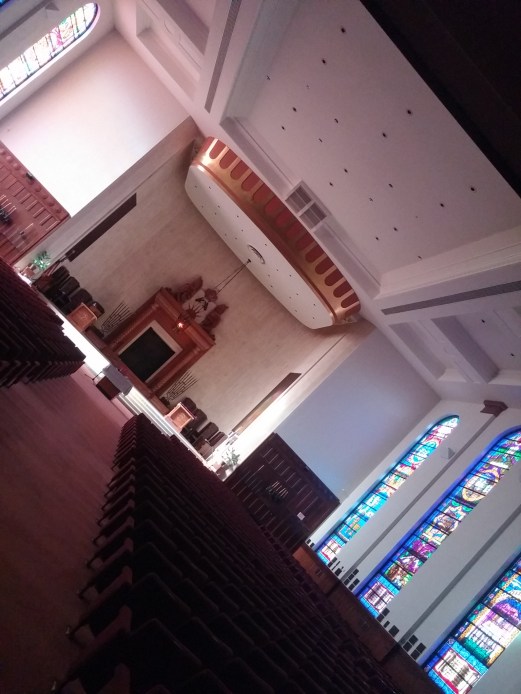
Picture this for a minute. This is a great visual. Look up there, above the aron ha-qodesh. You’ll see the wings of the keruvim, reaching to each other backwards over the top of the Ark of the Covenant.

20170303_165008

Right between the wings of the keruvim. That’s where God will meet us and speak to us. That’s the originating point for all the qedushah that comes to us. That is the point of emanation.

But since the mishkan has not been in use for 3,000 years, all we have left is the portable, metaphorical sanctuary within ourselves. And that we have to build.

We have to create the space. We have to stretch ourselves upward and forward like keruvim / angels, so that our wings touch. It’s not so easy to make that magical place where God will dwell within and without us.

So how do we do that? How do we build that inner sanctuary? How do we infuse our lives and the lives of all others around us with holiness?

By heightening our awareness. By listening. By acting on the Jewish values drawn from our tradition: being grateful, humble, compassionate, loving, joyous, greeting everybody with a cheerful face, dedicating ourselves to ridding this world of all forms of persecution, oppression, hatred, bigotry, and fear.

By dedicating ourselves to our community.

By making Jewish ritual our own, so that we can use it to access those moments of qedushah.

By reinforcing the message of radical inclusion into our midst.

By protecting the unprotected.

By seeking peace.

By being sanctuaries. And by offering sanctuary where needed.

By singing together:

Turn yourself into a sanctuary. Make a space for holiness within you and around you.

Shabbat shalom.


~

Rabbi Seth Adelson

(Originally delivered at Congregation Beth Shalom, Shabbat morning, 3/4/2017.)

Categories
Sermons

Standing Together – Yitro 5777

There are days, maybe once a week, when I feel like, “Ah. That was a good day. I accomplished a lot. I engaged with lots of people. I taught some Torah. I helped move this institution forward.”

There are days when I feel like, “Wow. I spent the whole day in meetings and handling logistics and didn’t get anything of significance done. Ouch.”

On the whole, I would say, I feel pretty good about the direction of Beth Shalom, about my work here, about our trajectory as a community. We are building slowly, making connections between people, reaching members and non-members in new and different ways, perhaps raising the bar of qedushah, holiness, in the context of our community.

Every now and then, it’s a good idea to count your successes and acknowledge challenges. Among the successes, I would count the following:

  • Our membership has grown by more than 10% in the past year and a half
  • We have already raised over $700,000 in pledges from members
  • We are halfway through the SULAM for Emerging Leaders program, training 14 members of the community for greater effectiveness as lay leaders
  • We are about to embark on a congregational learning process and re-envisioning of our tefillah, our services, in an attempt to make sure that our tefillah offerings meet our goals in that regard
  • The Shababababa and Shabbat Haverim services, which happened again last night, regularly draw 120 or more participants for joyous family davening in two services and a laid-back Shabbat dinner
  • Our other youth tefillah offerings have been improved dramatically, thanks to the hard work of Rabbi Jeremy Markiz
  • JJEP and the ELC are bursting with kids, energy, and innovation
  • We are launching the Derekh program this summer with a Jewish learning retreat aimed at young adults that will be held in August, and we received a $5000 grant from the Federation’s SteelTree program to run it
  • We have just established a team of volunteers to take responsibility for the sifrei Torah – where they are, to what parashah they are rolled, etc.
  • We are training new gabbaim
  • After more than a year of work and consideration, we are just about to put out a new version of the Benei Mitzvah Handbook with revised policies and information
  • We now have a streamlined, contemporary mission statement

And there are more. I think we can cautiously say that things are going well.

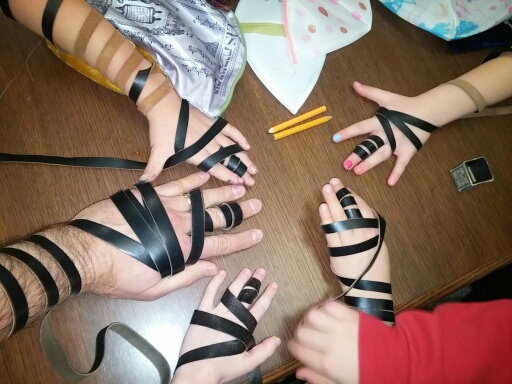
tefillin-hands-jjep

But of course there are also challenges. In particular, there are many things that we just haven’t gotten to yet, perhaps because nobody has stepped forward to help make them happen:

  • We still have no social action committee
  • We still have not been able to plan a congregational trip to Israel
  • We still have no official greeting team
  • There are still daily services when we lack coverage and/or a minyan of attendees
  • Our signage in the building is still, at best, confusing, and I continue to hear reports from people who have difficulty finding their way into the building
  • We are far from implementing an Earth-friendly policy to guide us in use, reuse and recycling in the building

Anybody who would like to help us take on these challenges is welcome!

But in addition to these programming needs, there is a special kind of challenge that we face, a more thorny difficulty that often afflicts synagogues, and that is disagreement.

Not that disagreement is bad! On the contrary, it is healthy and normal. In fact, one might make the case that it is due to disagreement that we are still here as Jews. You see, when the Romans destroyed the Second Temple in Jerusalem in the year 70 CE, they effectively began the process of “democratizing” Judaism – no more would the priesthood and the Sanhedrin hold all the power. Study and prayer, more personal routes to God and tradition, became the central communal features of Judaism.

But what allowed Judaism to endure and enabled it to survive to this very day, is the ability to maintain civil disagreement.

An oft-quoted Talmudic example of this comes from the two major schools of rabbinic opinion, those of the great rabbis Hillel and Shammai. Yet, despite the fact that their followers disagreed on many points of law and practice, they still married each other’s daughters (Babylonian Talmud Yevamot 14a). They maintained a sense of community and togetherness in the face of argument.

Disagreement is fundamental to who we are. But disagreement can be healthy or destructive, and I am more concerned about the latter.

We read in Pirqei Avot (5:19) about the mahloqet leshem shamayim – a controversy for the sake of heaven. The disagreement which furthers the goals of community, connection and qedushah / holiness is a Divine argument that will last forever. The dispute that seeks to self-aggrandize or consolidate power or disrupt the community is NOT leshem shamayim, for the sake of heaven. This is the destructive form of disagreement.

One of my most beloved teachers at the Jewish Theological Seminary, Rabbi Bill Lebeau, taught us that synagogue politics are good. They indicate a thriving organization that consists of engaged members who care. The absence of political disagreements, the shul in which everybody agrees about everything, he said, is a dying shul.

20160620_095719_resized

I have been here now a year and a half. During the first year or so, I was aware of very little in the way of disagreements with my style or my choices or my halakhic opinions. There’s a name for that grace period that new rabbis are usually afforded: the honeymoon.

But now the honeymoon is over.  And just as in any marriage it’s not a bad thing.  It just signals the start of getting down to brass tacks, the sharper points of living in holy matrimony.

So I have to confess something at this point – something which I have not owned up to until now: I am not perfect. (My wife liked that line best.) While I try very hard indeed to make sure that I am serving this community as best I can, I have occasionally let myself and others down. And that is hard, because I’m a bit of a perfectionist – I want things to be right.

And yet, as the old maxim goes, you cannot please all the people all the time. And that also applies to rabbis.

It even applies, by the way, to our greatest teacher. Moshe Rabbeinu, you might say, was at the peak of his career in Parashat Yitro. He ascends Mt. Sinai to confer face-to-face with the Qodesh Barukh Hu, and takes dictation, beginning with the Aseret HaDibberot / Ten Utterances (usually referred to as the “Ten Commandments”).

And yet, Moshe fails. What happens while he’s up on the mountain, acquiring a radiant glow in the presence of God? The people doubt him. They worry. They think he’s never coming back. “This Moshe guy,” they say, “we don’t know where he went!” (Ex. 32:1, roughly). And then they build an idol. So not only has Moshe failed to deliver the monotheistic goods, but he also fails so badly that the Israelites actually do the opposite of what Moshe is about to teach them when he comes down the mountain.

And, to make matters worse, when he finds out, Moshe loses his cool. He “goes ballistic” as he smashes the tablets.

I am certain that many of us have had that Molten Calf moment, when we think things are going so well, and then everything seems to come crashing down around us. I find this passage consoling when facing my own moments of doubt.

After a year and a half of progress, I feel that together we have made Beth Shalom a more inclusive environment, a more friendly and civil place. And we have accomplished many community-building initiatives.

And yet, we still have to avoid getting sucked into that Molten Calf dynamic as a congregation. We have to agree to disagree respectfully when there are complex political issues. We have to work together to prevent rumors and anxiety from dragging us down, and instead focus on seeking the greater benefit to the community. We have to continue to work together, understanding that none of us is perfect, that we will occasionally fail to meet our objectives, that although the overall trajectory has been positive, there will sometimes be temporary setbacks.

Rather than smashing the tablets, we have to instead do what we did this morning as we read the Aseret HaDibberot: stand together as a community in solidarity, as if gathered at Mt. Sinai.

There will be contentious issues in committees and on the Board level. There will be arguments over finances. There will be personality clashes between members. And I might occasionally make a decision with which you disagree, or fail to meet your expectations. At these moments especially, we must give each other the benefit of the doubt and trust in good intentions.

These are the challenges that keep rabbis up at night. But we will face them all together, and as long as we keep before us the sense of community, connection, and qedushah, we will continue to build.  It is in remembering what unites us that we will find the holiness of our intentions, illuminating the respectful way forward as we stand together.

Shabbat shalom!

~

Rabbi Seth Adelson

(Originally delivered at Congregation Beth Shalom, Shabbat morning, 2/19/2017.)


Categories
Sermons

Open up the Kotel – Va’era 5777

In 1987, on my first visit to Israel with the Alexander Muss High School in Israel program*, I visited the Kotel, the Western Wall, as every Israel tour group does. And out of nowhere, it seems, tears welled up from deep within me, from some ancient place in which Jewish history and theological yearnings meet and tap into our collective grief and our enduring optimism. I bawled as I leaned against the warm, ancient stones. So did everybody else in my group, including the one guy out of the 80 or so of us who was not Jewish. I was seventeen.

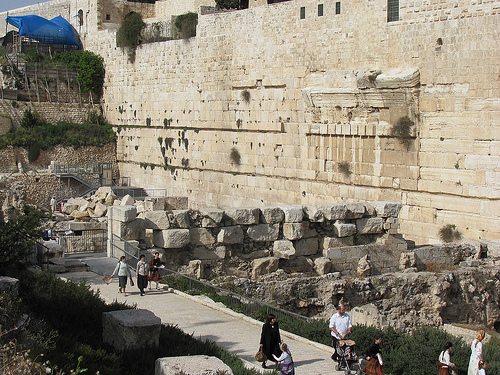
Fast forward thirteen years to 2000, when I was in cantorial school at Machon Schechter in Jerusalem, I experienced an unusual thing that at the time seemed quite avant-garde, even slightly illicit: an egalitarian shaharit / morning service at the Kotel, the Western Wall of the Temple Mount complex. At the time, there was no proper area for such a service – it was just a spot on the ancient Roman roadway at the base of the wall, under a rocky outcropping referred to as Robinson’s Arch, within the archaeological park that covers the southern vicinity of the Temple Mount. I don’t think there was even a table; just a few cantorial and rabbinical students with tallit and tefillin and our own siddurim.

robinsons-arch
Robinson’s Arch

What seemed like a covert operation at the time, a solution arrived at to allow egalitarian groups to daven / pray in the style that is customary for 85% of North American Jews, was a compromise – an attempt to allow mixed groups to do it their way without upsetting the more traditional, men-and-women-separate prayer that goes on in the plaza that is often thought of as the Western Wall (even though that portion of the outer retaining wall is really only a small fraction of Herod’s rebuilt, 2000-year-old plaza). Our ability to meet there was granted by the Israeli government to solve the problem of Haredi groups harassing egalitarian daveners (people who are praying) and throwing chairs and even human feces at them.

For more than a decade afterwards, that Roman road under Robinson’s Arch became a well-known location for egalitarian groups, and particularly for destination benei mitzvah services conducted by Jerusalem-based Conservative and Reform rabbis who were grateful for the business. The road was uneven, and there were no chairs, and portions were roped off because it is an active archaeological dig, but it was a special and unique experience to don tallit and tefillin and read Torah among the ancient rocks.

But struggles continued at the traditional Kotel plaza, where (in particular) a group known as Women of the Wall gathered regularly on Rosh Hodesh (the first day of each Jewish, lunar month) to attempt to hold services in the women’s section, wearing tallit and tefillin (according to the various customs of the individual participants) and reading from a sefer Torah. These Rosh Hodesh gatherings became a focal point for many shocking confrontations between more traditional worshippers, the police, and the Women of the Wall participants, who were verbally abused and physically harassed and occasionally arrested.

For the last three years, there has been a solid, yet temporary and somewhat inelegant platform in the Robinson’s Arch area, just south of and out of sight of the “traditional” Kotel plaza, and this platform has made the area seem a little bit more official. About a year ago, the Israeli government agreed to complete the “upgrade” to the Robinson’s Arch area to make it a fully-functioning option for egalitarian groups.

But, Israeli politics being what they are, promises made by the Netanyahu administration were never quite fulfilled. Activity was stalled. Feet were dragged. Religious parties threatened. Nothing happened.

And the groups that had been advocating for change pressed charges, bringing their case to the Israeli Supreme Court. Just a few weeks ago, the Court handed down a verdict which said that the prohibitions against mixed tefillah, against women wearing tallit and tefillin and reading Torah were all the Israeli equivalent of “unconstitutional” (although Israel has no constitution and no principle of separation of church and state), and that the religious leadership of the Kotel (Rabbi Shemuel Rabinowitz and the Western Wall Heritage Foundation) would have 30 days to demonstrate why all people could not pray according to their own customs.

According to the JTA article on the verdict:

[The Israeli Supreme Cout] also declared that women should not be subjected to body searches before entering the plaza. The Western Wall Heritage Foundation, the Orthodox-run body that oversees activity at the site, has authorized such searches to prevent worshippers from entering the women’s side with Torah scrolls, prayer shawls, tefillin and menorahs…

The [administrative] parties “must explain why the petitioners  should not be allowed to pray in accordance with their custom at the traditional plaza, or alternatively allow them to pray in accordance with their custom at a place which has access to the Western Wall similar to [the access] at the traditional site,” the court said.

Kol hakavod to the Supreme Court for standing up for what is right here, and against the forces of fundamentalism in our midst. It is truly ironic that religious protection seems to exist for non-Orthodox Jews in every democratic country in the world except Israel.

It is worth pointing out that religious restrictions such as these are not limited only to the Kotel. In 2011, I took 37 teenagers to Israel, and we stayed one night at Kibbutz Shefayim, a secular kibbutz just north of Tel Aviv. It so happened that the following morning was Monday, a Torah-reading day, and as we gathered in the hotel’s synagogue for shaharit / the morning service, we were told by the hotel staff, secular Israelis, that we were forbidden from using the hotel’s sefer Torah by the local religious authorities because we were an egalitarian group.

In the weekly cycle of parashat hashavua, the weekly reading of the Torah, we are right now in the middle of reading the Exodus story, arguably the most powerful and moving narrative of the Torah, and certainly the one that has spawned the best biblical films. It is a tale of the struggle against oppression, against hatred and fear, and of overcoming authoritarian rule. But it is also a tale about egalitarianism, about equality between men and women. Let me explain.

Some of you may have heard (from some others in the Jewish world) that the only positive, time-bound mitzvot / commandments to which women are obligated are lighting Shabbat candles, separating a piece of hallah when making it, and immersion in the miqveh (ritual bath) following the menstrual cycle. But that is not true. Those are, you might say, “alternative facts.”

In actuality, there are many other positive, time-bound mitzvot that are identified in the Talmud to which women are obligated, and one of them is drinking four cups of wine at the Pesah seder (God’s promises to the Israelites that serve as a basis for these four cups were found in today’s parashah, Ex. 6:6-8). The Talmud’s reasoning for this is (Talmud Bavli Pesahim 108a-b):

ואמר רבי יהושע בן לוי: נשים חייבות בארבעה כוסות הללו, שאף הן היו באותו הנס

Said R. Yehoshua ben Levi: Women are obligated to drink these four cups, because they too were part of the miracle [of deliverance].

In other words, the Exodus was not just for men; all of the Israelites were saved. And we all are obligated to celebrate this egalitarian deliverance today. That statement for freedom and against oppression continues to resonate in every corner of the Jewish world, not only on one side of the mehitzah. And given the centrality of the image of our people’s redemption from Egypt as a justification for treating all people with equity, the poor, the widow, the immigrant and refugee among us, it is undeniably an imperative to ensure that all of us have access to God and our tradition, that none of us are excluded due to gender or any other status.

And there is plenty more material here – the idea of a mehitzah (separation barrier between men and women) is actually medieval; it may only date for certain to the 13th century. And never mind the fact that there was no official mehitzah  at the Kotel until 1967.

old-kotel-1
The Kotel in the 1920s

So I am waiting with great excitement to see how the anti-egalitarian forces of the Israeli religious right will justify denying adherents of the progressive movements to daven in our customary way. The Talmud tells us that Michal, the daughter of King Saul, was permitted by ancient authorities to wear tefillin (Talmud Bavli Eruvin 96a). Would our contemporary zealots challenge their authority?

jews_at_western_wall_by_felix_bonfils_1870s
The Kotel in the 1870s

By way of conclusion, it is worth pointing out that there are really no holy places in Judaism. Once the Temple was destroyed for the second and final time by the Romans in 70 CE, our understanding is that the Shekhinah, God’s presence, departed from the Qodesh HaQodashim, the Holy of Holies, and has not returned. We have sanctified time, not space or objects, for two thousand years. While there is no question that the Kotel is a place of great sentimental significance – a central connection to our history, the focal point of our prayer, the physical remains of the ancient epicenter of the Jewish world – our tefillah is just as valid right here in Pittsburgh as it is in Jerusalem.

But since the Kotel has been elevated to an unprecedented level in the contemporary world, that spot should be emblematic of all of the different paths we have through our tradition. It’s not a synagogue; it’s just a very moving, very powerful location. And it should be open to all.

Let’s hope that by the time that we take our congregational trip to Israel (coming your way soon! Let me know if you’re interested!) that we will proudly be able to gather there for a meaningful service the same way we are doing right now – acknowledging that we are all equal before God.

Shabbat shalom!

* AMHSI is now offering free scholarships to a few lucky teens from Pittsburgh. Please see me for details.

~

Rabbi Seth Adelson

(Originally delivered at Congregation Beth Shalom, Shabbat morning, 1/28/2017.)

Categories
Sermons

Be an Upstander – Shemot 5777

You know the old joke about how I went to a fight the other night and a hockey game broke out? There is a related Jewish story. It’s an old fable about two brothers (Zev Vilnay, Legends of Jerusalem, JPS 1973, pp. 77-78):

One brother had a wife and children, the other did not. They lived together in one house – happy, quiet, and satisfied with the portions which they inherited from their father. Together they worked the fields with the sweat of their brows.

And the harvest came. The brothers bound their sheaves and brought them to the threshing floor. There they divided the crops of the field in two parts equally between them, and left them.

That night, the brother who had no family lay on his bed and thought: I am alone, but my brother has a wife and children. Why should my share be equal to his? And he rose from his bed, went stealthily out into the threshing floor, took from the stalks of his own sheaf, and added them to the sheaf of his brother.

That same night, the other brother turned to his wife and said: “It is not right that we have divided the crop into two equal parts, one for me and one for my brother. He is alone and has no other joy or happiness, only the yield of the field. Therefore, come with me, my wife, and we will secretly take from our share and add to his.” And they did so.

In the morning, the brothers went out into the threshing floor, and they wondered that the sheaves were still equal. Each one decided to himself to investigate. During the night each one rose from his bed to repeat his deed. And they met each other in the threshing floor, each with his sheaves in his arms. Thus the mystery was explained. The brothers embraced, and kissed each other.

And the Lord looked with favor on this threshing floor where the two brothers conceived their good thoughts… and the children of Israel chose it for the site of their Holy Temple.

An Israeli variant is about two other brothers who lived on a nearby hill, and did exactly the opposite: each stole from the other in the middle of the night. And that was where the Israelis chose to build the Knesset. (#Rimshot!)

I have become very concerned about the state of our society. I think that something that we have lost is a tangible sense of togetherness. On the contrary: the level of mistrust seems to me higher than it has been in my lifetime. And a related contemporary challenge about which I am particularly concerned is the lack of civility in our public discourse.

On Monday, as part of Community Day School‘s celebration of Dr. Martin Luther King Jr., one of the themes invoked was the principle of being an “upstander.” To be an upstander means, according to the website of the educational and professional development organization Facing History and Ourselves:

“A person who speaks or acts in support of an individual or cause, particularly someone who intervenes on behalf of a person being attacked or bullied.”

This word was just added to the Oxford Dictionaries in 2016.

Given our history and our tradition, we Jews have a special obligation to be upstanders: to speak out against that which we know is wrong, to intervene on behalf of those who are being persecuted, to call out hatred and racism and anti-Semitism when we see it.

Martin Luther King Day is always an opportunity for us to recall that Jews were there when the civil rights movement in this country was forged. It is a reminder that one of the greatest Jewish philosophers of the 20th century, Rabbi Abraham Joshua Heschel, walked with Dr. King on the latter’s 1965 march from Selma to Montgomery, Alabama. Afterwards, Rabbi Heschel declared, “I felt as though my legs were praying.”

DR. MARTIN LUTHER KING JR.; DR. RALPH BUNCHE;  Rabbi Abraham Joshua Heschel;  Rev. Fred Shuttlesworth
Dr. Martin Luther King Jr. links arms with other civil rights leaders as they begin the march to the state capitol in Montgomery from Selma, Ala. on March 21, 1965. The demonstrators are marching for voter registration rights for blacks. Accompanying Dr. Martin Luther King Jr. (fourth from right), are on his left Ralph Bunche, undersecretary of the United Nations, Rabbi Abraham Joshua Heschel, and Rev. Fred Shuttlesworth. They are wearing leis given by a Hawaiian group. (AP Photo)

When Rabbi Heschel marched with Dr. King, the level of mistrust in America was also quite high. Society was changing. The established orders were being upended. People who had been historically oppressed were throwing off their yoke.

And people were angry. The civil rights movement inspired many Americans, including many Jewish volunteers, to do some really wonderful, holy work. But it also caused many others to behave badly in public, to scream and burn and even murder to try to prevent change.

In 1965, there was no Internet. No Facebook. No Twitter. So people actually had to confront each other in person. Not so today.

One can hardly read an article of any sort on the Internet without being assaulted by a blast of name-calling, hyperbolic accusations, and general disregard for others. And whether we are participating in these troll-fests or not, even those of us who read the comments sections on popular news sites are somehow metaphorically guilty of standing idly by the blood of our neighbors (from Parashat Qedoshim, Leviticus 19:16).

The relative anonymity of the online environment makes it far easier for us to cut each other down, to trade insults, to grandstand with impunity. And our online behavior is ultimately reflected in our feelings for one another offline.

We read this morning about how the new pharaoh “did not know Yosef.” (אשר לא ידע את יוסף – Ex. 1:8) Rashi points to a disagreement in the Talmud between Rav and Shemuel about whether this was, in fact, a new king or not. And if it was, in fact, the old king, then suddenly he was pretending not to know Yosef.

It is perfectly normal, perfectly human, and definitely Jewish to disagree with each other. And it is completely appropriate for us to stand up for the principles in which we believe. But a functional society depends on our willingness to be able to disagree with each other and continue to talk to each other and work with each other. We are, as I have mentioned in this space before, faced by many contemporary challenges; we will never solve them by demeaning each other.

And, indeed, we cannot be like the pharaoh who pretended not to know Yosef. We cannot pretend not to know our fellow Americans. We cannot dismiss the people with whom we disagree, as if their feelings and opinions cancel our ability to perceive any and all traces of decency.

On the contrary, says the Torah. Ve’ahavta lereiakha kamokha (Lev. 19:18). Love your neighbor as yourself. Even if they believe things that you find absolutely odious. The Torah clearly does not say, love your neighbor as yourself, but only if she thinks like you do. We, the Jews, must lead by example; we must continue to be or lagoyim, a light unto the nations.

I offer you the following piece from the Talmud for your consideration:

ת”ר: לא יסקל אדם מרשותו לרה”ר. מעשה באדם אחד שהיה מסקל מרשותו לרה”ר, ומצאו חסיד אחד, אמר לו: ריקה, מפני מה אתה מסקל מרשות שאינה שלך לרשות שלך! לגלג עליו. לימים נצרך למכור שדהו, והיה מהלך באותו רה”ר ונכשל באותן אבנים, אמר: יפה אמר לי אותו חסיד מפני מה אתה מסקל מרשות שאינה שלך לרשות שלך.

Our rabbis taught: “A person should not throw stones from his property into public grounds.

It happened that one man was throwing stones from his property into the public domain. A pious man passed by and said to him, “Foolish one, why are you throwing stones from property that does not belong to you onto ground that does belong to you?”

The man laughed at him. As time went by he had to sell his field and when he was walking on those public grounds, stumbled over his own stones.

He then exclaimed, “That pious man was right when he said to me, “Why are you throwing stones from ground that does not belong to you onto ground that does belong to you?” (Bava Qamma 50b)

We have to work hard to protect not only our physical public spaces, but our political, social, spiritual, and emotional public spaces as well. Throwing insults and epithets as a form of discourse into the online cloud is like tossing rocks into the street. We’re all going to eventually trip over them.

If we truly want to be upstanders, we must work hard to rekindle our civility. We cannot allow differences of opinion to fragment our democracy. We have to build a temple to love and compassion in that metaphysical public space. We have to remember and invoke our shared values.

That does not mean we have to agree. That does not mean that we have to tolerate hatred, bigotry, intolerance, or shaming of any kind. But it does mean that we have to speak nicely to each other, and occasionally give our produce up for the benefit of the other, so that we may build that temple.


~

(Originally delivered at Congregation Beth Shalom, Shabbat morning, 1/21/2017.)

Categories
Sermons

Responding to Richard Spencer (or, Torah is Love) – Vayyiggash 5777

Some of you know that my first experience in graduate school was at Texas A&M University, in College Station, Texas. A&M is one of the largest public universities in the country – today nearly 60,000 students, although when I was there it was only about 43,000 (still pretty big). However, in Texas, if you’re Jewish, you are much more likely to go to the University of Texas in Austin. A&M’s Jewish population is only a few hundred, whereas UT’s is a couple thousand.

Ironically, it was my attending Texas A&M which brought be back to Judaism. Although I had grown up in a fairly traditional household, I had found that at as an undergraduate at Cornell, I was not so interested in Jewish life. It took relocation to the buckle of the Bible Belt, to one of the most socially and politically conservative corners of this country, to one of the most heavily fundamentalist Christian enclaves, to rediscover my heritage. The Hillel rabbi at A&M, Rabbi Peter Tarlow, figured strongly in my return. (His wife, by the way, Dr. Sara Alpern, is a Pittsburgher.)

Texas A&M opt-out bill faces obstacles | The Baylor Lariat

Rabbi Tarlow retired a few years back, and the new Hillel rabbi is a young, energetic fellow named Matt Rosenberg. Rabbi Rosenberg was faced with an unusual challenge recently: Richard Spencer, the white supremacist leader who has come to the fore in recent months, was invited to speak on campus by an alumnus who is known for supporting such causes. Apparently, Texas A&M has a policy that any alum can rent a room in the student union on campus for any event, and the university has no right to cancel an event of which it disapproves.

So, given that Spencer was coming to speak on campus, and given that there was nothing that anybody could do to prevent it, a whole host of student groups mounted an anti-Spencer campaign. The university itself hosted a protest rally at the same time as Spencer’s speech in Kyle Field, the legendary stadium that is home to the Aggie football team and the Twelfth Man tradition.

Among the loudest protesters was Rabbi Matt Rosenberg, who spent tireless weeks rallying A&M students against Spencer. When the day came, Rabbi Rosenberg found himself in Mr. Spencer’s press conference before the speech, and was called on by Spencer to ask a question. The exchange did not go well; Rabbi Rosenberg conceded that it was not one of his best moments. (You can see this online here.)

Rabbi Matt Rosenberg: You come here with a message of radical exclusion; My tradition teaches a message of radical inclusion and love. That love is embodied by Torah. Will you sit down and study Torah with me and learn to love?

Richard Spencer: OK, I can’t promise to study with you. That’s kind of a biggie… I will say this. I will promise to talk with you. And I will say this: Do you really want “radical inclusion” into the State of Israel? And, by that, I mean, radical inclusion: maybe all the Middle East could go move into Tel Aviv or Jerusalem? Would you really want that? … You’re not answering.

RMR: I’m not.

RS: Look, in terms of the Jewish people, why are they a people? They are a people precisely because they did not engage in radical inclusion. Jews exist precisely because you did not assimilate to the gentiles. It’s axiomatic. That is why the Jews are a coherent people with a history and a culture and a future. It is because you had a sense of yourselves. I respect that about you. I want my people to have that same sense of themselves. I want my people to survive in the future.

***

In his own defense in the Forward, Rabbi Rosenberg pointed out that he had never been trained in debating skills. I am pretty certain that I would not have done any better, because frankly, I did not see that coming.

What Spencer did, in a few sentences, was to twist all of recent Jewish history to suit his own purposes.  There are multiple reasons why the Jews are still here: Yes, because we have held fast to our traditions and our ancient texts; yes, because we have stuck together, but also yes, because for thousands of years we were prohibited from mixing with non-Jews – by ourselves, our own customs and institutions, but even more so by the people who oppressed us: the Egyptians, the Babylonians, the Romans, but also the English, who kicked the Jews out of England and Wales in 1290, the French, who kicked the Jews out of France in 1306, the Austrians, who kicked the Jews out of Austria in 1421, and so forth.We cannot forget the Spanish Expulsion in 1492, and the centuries of persecution which preceded it. We cannot forget the pogroms of 19th-century Eastern Europe. We cannot forget Germany of the 1930s and ’40s. And the waves of Arab hatred and riots of the 1950s. And the Iranian revolution of the 1970s. And let us not forget the Jews of Silence, the Soviet Jews, who, once applying to leave for Israel, were punished by the Soviet authorities.

In short, it is people like Richard Spencer who have kept the Jews isolated throughout history. And here is the irony: freedom is a double-edged sword. As much as clinging to our traditions and texts has kept us distinctive, so too has that distinction been reinforced by those who despise us. Let’s face it: why is the intermarriage rate in America so high? Because we have finally gained acceptance. Jews actually make appealing spouses to non-Jews, something that not too long ago was anathema. And you may know that many of those Jews who can now marry non-Jews (since they will now marry us) still feel proud to be Jewish, still feel connected to Judaism in some way. In prior centuries, the only way to join the wider society was to become not Jewish. Today, all doors are open.

So when Richard Spencer tried to cast Jews as an isolationist success story, about people who maintained their identity because they refused to mix with others, he was spinning history for his own agenda, cynically using the Jewish tale of persecution across the ages to justify that very persecution. His people, the haters, are the ones who kept us apart, who kept us in ghettos. His people passed humiliating laws and carried out expulsions and forced conscriptions and forced conversions. People of his kind promulgated the blood libels and ultimately genocide.

White Nationalist Richard Spencer Sparks Protests at Texas A&M

But that was only half of his statement. The other half was about Israel, and it’s an argument that is even more loathsome. He said facetiously, “Maybe all the Middle East could go move into Tel Aviv or Jerusalem? Would you really want that?” His hyperbole played on the fallacious argument that Israel is an apartheid state and used it to justify the separation of Jews from non-Jews. Spencer’s subtext was, “You Jews should understand keeping another people down, right? Because you’re doing it right now in Israel.”

Spencer smiled at this point, because he knew that he had hit Rabbi Rosenberg where it hurts most.

Where to begin on this one? Should I start with my son’s soccer team, HaPoel Deir Hanna, on which Jewish and Arab 16-year-olds, young citizens of the democratic State of Israel, cooperate on the field, on the same team? Should I mention the Muslim and Christian members of the Knesset? Should I recap the entire history of Jewish-Arab conflict on that small strip of land, the opportunities lost, the blood that has flowed on both sides? The very present and immediate need for Israeli security?

The reality of Israel, her internal demographic realities and external struggles are much more complex than can be captured in a provocative soundbite. But Israel is an open, democratic society that has its share of challenges, just as every nation does.

Rabbi Rosenberg was right: the Torah is love. Earlier this morning, as we do every single morning of the Jewish year, we said this explicitly when we wrapped our tzitziyyot (the fringes hanging from the four corners of our tallitot / prayer shawls) around a finger, as we prepared to recite the Shema. “Ahavah rabbah ahavtanu.” With great love you have loved us, God. And you have demonstrated your love by giving your Torah to the world. And it is up to us to “lilmod ulelamed, lishmor vela’asot, ulqayem et kol divrei talmud Toratekha be’ahavah,” to learn and teach, to keep and do, and uphold all the teachings of your Torah in love. Torah is love. Love is Torah. And it is upon us to share this love with everybody – to share with the world the idea of “Ve’ahavta lerei’akha kamokha” (Lev. 19:18) – love your neighbor as yourself, with that ahavah rabbah, that great, unbounded love.

What can we learn from this? That we have to be ready to make the case for who we are, not only to respond to haters like Richard Spencer, but also to ourselves. What we must have on the tips of our tongues is the following:

We are Jewish, and continue to be Jewish, because our tradition has value: it brings us knowledge about ourselves and others, it brings us joy, it provides a framework to celebrate and grieve as a community. And it teaches us love through the ancient words of Torah. And that is why we are still here.

Original file ‎ (2,304 × 1,521 pixels, file size: 240 KB, MIME type ...

So, Mr. Spencer and your white supremacist friends, please don’t look to the Jews to justify your twisted rationale for hate. Rather, learn from our history and our tradition and see that respect and love for all is the source of our continued existence. That is humanity’s divine obligation. That is Torah. That is love.

Shabbat shalom.


~

Rabbi Seth Adelson

(Originally delivered at Congregation Beth Shalom, Shabbat morning, 1/7/2017.)

Categories
Sermons

Dancing in the Hard Rain – Vayishlah 5777

I think I know where Bob Dylan is.

I’m sure that you have all heard that Mr. Dylan, aka Robert Zimmerman, joined the most elite club in the world this year: he won the Nobel Prize for Literature. And it seemed for some time that he was avoiding the honor. The Nobel committee had a hard time finding him. He did not return phone calls. It seemed that he was not interested in claiming the prize. (Perhaps, unlike many Nobel laureates, Dylan doesn’t really need the money or the kavod / honor.)

Although he eventually agreed to accept the prize, Mr. Dylan seemingly snubbed the Nobel institution by skipping the award ceremony, citing “pre-existing commitments.” A New York Times reporter tried to discover what, exactly, Mr. Dylan’s commitments were; he was not performing that night anywhere in the world, and he did not seem to be at any of his various residences (at least the ones that the reporter was able to check).

I suppose this is not too surprising for a performer who has always seemed to alternately loathe and love his audience. He may be best known for angering fans at the Newport Folk Festival in 1965 by pulling out an electric guitar, a deliberate affront to the folk scene of the time. His performances have been unfortunately erratic; you never know when you see Dylan which Dylan you’re going to get.

Regardless, looking back over his 50+ years of music, there is no question that (a) he deserved this award, and (b) his lyrics are essentially timeless. They are as incisive today as they were a half-century ago.

Bob Dylan, in the beginning - CNN.com

So it seems that the Jews have yet another Nobel laureate among our ranks (some count our tribe’s prizes at an impressive 20%, although that requires casting a wide net of the ever-contentious definition of “Who is a Jew?” I’m sure Mrs. Zimmerman is very proud, wherever she is.

But I think I know where Bob Dylan is. He’s in mourning. He’s deeply, deeply embarrassed. He’s nursing his wounds. Actually, our wounds.

When I heard Patti Smith singing “A Hard Rain’s a-Gonna Fall” for the Nobel award ceremony, it hit me. I think I know why Bob didn’t show up.  Bob was not there not because he had another engagement but because his heart is broken. I think that Bob simply cannot handle today’s reality.

Never mind that the CIA believes that Russia hacked our election. Forget that a climate-change skeptic has been nominated to head the EPA, an oil executive with ties to Russia to head the State Department, and to head the Department of Energy a man who once said that if he were president, he would eliminate the Department of Energy. Never mind the chief strategist who used to run the premier website dedicated to peddling racism, sexism, anti-Semitism and conspiracy theories.

Leave all that aside for a moment, if you can. The biggest casualty of the current moment is the truth. What has come to the fore in 2016 is that many of us (with, by the way, diverse political views) have been deceived by fake news stories and distracted by social-media’s unquenchable desire for ever more clicks on ever-more-sensational items. When we become committed to false narratives and outright lies that are retweeted by authority figures, when folks in dire straights are so desperate that they are willing to swallow campaign promises that are so obviously far-fetched, I am very concerned for the future of our society. Truth has been compromised, and trust is being eroded.

As a non-political example, try to change the mind of somebody who has accepted the idea that vaccination against measles is dangerous. Although the concerns regarding autism have been debunked, and it is abundantly clear that the benefits of vaccination outweigh any perceived risks, it’s a lie – a fake news story that simply will not go away.

In rabbinic literature, the truth is understandably very important – so important, in fact, that there are multiple passages in our textual tradition about witnesses, people called on to testify to the truth. Witnesses in Jewish law have a whole host of restrictions and expectations. Rabbi Hanina (Babylonian Talmud, Shabbat 55a) tells us that the Hebrew word for truth, emet, is the personal seal of God. We come to kedushah / holiness through truth.

The founding fathers forged this nation on the basis of a handful of simple truths. How will we know the truth, when there is so much falsehood? How will our rights remain unalienable, if those truths are no longer self-evident?

Oh, what did you see, my blue-eyed son?
Oh, what did you see, my darling young one?
I saw a newborn baby with wild wolves all around it
I saw a highway of diamonds with nobody on it
I saw a black branch with blood that kept drippin’
I saw a room full of men with their hammers a-bleedin’
I saw a white ladder all covered with water
I saw ten thousand talkers whose tongues were all broken
I saw guns and sharp swords in the hands of young children
And it’s a hard, and it’s a hard, it’s a hard, it’s a hard
And it’s a hard rain’s a-gonna fall

Bob’s blue-eyed son has traveled the world, observing the depth and breadth of Creation and humanity. His innocence is long gone. His youthful idealism has long since been trampled by the truth. And in the song, the son is a witness to truths that must be told.

I learned from Rabbi Wikipedia that Bob’s Hebrew name is Shabtai Zisl ben Avraham (Wikipedia neglected to mention his mother’s Hebrew name; if he ever shows up here and Milt gives him an aliyah, I guess we’ll find out.)

Bob wrestled with his Judaism for many years. He even toyed with Christianity, but he came back to us.

And meanwhile, this is the week of Yisrael. We who wrestle with God. And the character that assigns this new name to Ya’aqov is the angel with whom he wrestles in Parashat Vayishlah.

The commentators go different ways on who, exactly, the angel is. Rashi cites a midrash (BT Menahot 42a) suggesting that this is his brother Esav’s ministering angel. I have always preferred the beautiful notion, echoed by the Gerrer Rebbe (aka the Sefat Emet, the “lip of truth”), that Ya’aqov is actually struggling with himself.

But rather than focusing on the angel, I’d rather consider the struggle. This is not wrestling, I think. Rather, they are dancing — locked against each other all night long, neither willing to forfeit the lead.

We are all engaged in some kind of holy dance — with ourselves, with our community, with our work, with our leaders, with our family, and so forth.

This delicate dance — the waltz of ages, you might call it — is an attempt to move forward with our lives even as we acknowledge and try to manage some of the brokenness around us. We cling to our mystical partner for dear life, hoping that the ground does not give way, that we don’t trip or stumble. Just like Ya’aqov and the mysterious heavenly visitor. We dance with the truth.

Oh, what’ll you do now, my blue-eyed son?
Oh, what’ll you do now, my darling young one?
I’m a-goin’ back out ’fore the rain starts a-fallin’
I’ll walk to the depths of the deepest black forest
Where the people are many and their hands are all empty
Where the pellets of poison are flooding their waters
Where the home in the valley meets the damp dirty prison
Where the executioner’s face is always well hidden
Where hunger is ugly, where souls are forgotten
Where black is the color, where none is the number
And I’ll tell it and think it and speak it and breathe it
And reflect it from the mountain so all souls can see it
Then I’ll stand on the ocean until I start sinkin’
But I’ll know my song well before I start singin’
And it’s a hard, it’s a hard, it’s a hard, it’s a hard
It’s a hard rain’s a-gonna fall

Dylan ends with a hopeful note: those of us who are committed to the truth can help repair the world.

The hard rain has begun. It will be up to us to continue to dance through the rain, to take on the struggles that come, to stand up for the many people whose hands are all empty, to illuminate the face of the hidden executioner, to safeguard our waters, to make sure that souls are not forgotten.

Wherever we are headed as a society, I hope that our people will always be able to stand for the truth, even when it hurts. Truth matters more than partisanship. It matters more than victory. Truth outweighs budgets and process and matters of diplomacy. It is the essential check in the system of checks and balances.

As we approach Hanukkah, the holiday wherein we recall our duty to spread light in an otherwise dark world, the optimistic take-away may be that our tradition continues to mandate the pursuit of light and truth: that we as a people will always be compelled to lift up the downtrodden, clothe the naked, take in the homeless, and feed the hungry.

Shabtai Zisl ben Avraham, if you’re listening, please know that hiding from the truth is not what we Jews have ever done. In fact, we stand up for the truth, for the facts on the ground, for what is right for humanity. And we need you now as much as we did in 1962 when you first told us about that hard rain.

Return to us, all of us here on the dance floor as we continue this waltz of ages.

~

Rabbi Seth Adelson

(Originally delivered at Congregation Beth Shalom, Shabbat morning, 12/17/2016.)

Categories
Sermons

Jewish Sensibilites and Ya’aqov’s Deception – Toledot 5777

One of the essential questions that we as Jews must ask ourselves is, what are the values that guide us? Aside from rituals and Jewish law, how does our textual framework teach us how to live? What are the values we want our children to carry? How can we use the values expressed in our tradition to live better in this world?

Why are these questions so important? Because we see from demographic data that while there is a hardening on the theological right with respect to living a halakhic lifestyle, with ever-more-stringent approaches to Jewish law, the non-Orthodox world is drifting away from that traditional mode of Jewish living. One does not need to see survey data to know that fewer of us observe Shabbat traditionally, fewer of us are showing up for daily prayer, fewer of us are keeping some form of kashrut, fewer of us are marrying fellow Jews, etc.

And yet, most of us are proudly Jewish, acknowledging on some level our Jewish heritage and at least some of our Jewish traditions. (There is no simhah today, so most of us in the room are regulars – people who are committed to some form of traditional Jewish observance, including tefillah / prayer. But you’d probably all be surprised by how many Jews I hear telling me about how they are proud to be Jewish, love our tradition, are committed to raising Jewish families and to being part of a community, but just have no interest in or understand being in synagogue for services.)

Given that many of us want to maintain some kind of connection to Judaism even as we disconnect from Jewish observance, one answer is that we have to focus on the Jewish values that move us.

What are some of these values?

    • Honesty
    • Integrity
    • Charity
    • Doing for others in need
    • Hakhnasat orehim  / welcoming guests
    • Ahavat hinnam /

      boundless love

    • Community, and all it suggests
    • Study
  • Etc.

With help from the Judaism Unbound podcast, I recently came across an interesting article by Dr. Vanessa Ochs, a professor of Religious Studies at the University of Virginia, entitled “Ten Jewish Sensibilities.” It appeared in the journal Sh’ma in 2003. In it, Dr. Ochs identifies ten Jewish values which, she proposes, many Jews draw on in their daily lives, even if they do not practice any of the ritual aspects of Judaism. I do not need to list them all here, but they include such basic principles as teshuvah / return (she translates as “turning), tiqqun olam / repairing the world, shelom bayit / maintaining peaceful relationships, and so forth.

I would like to draw your attention to two of these sensibilities: top of the list, havdalah – literally separation, but understood here as making distinctions in time and situations. That is, acknowledging that Jews create holy spaces in time, not places or people.

Number 10 on the list is zekhut avot, recalling the good deeds and attributes and acting upon the merits of those who came before us. We’ll come back to these in a few minutes.

Now, of course these values come, as does all of Jewish life, from the Jewish bookshelf. Just as we know that we must drink four cups of wine at a Pesah seder or light the Hanukkah candles from left to right from our ancient literature, so too do we understand that eliminating oppression or questioning authority are Jewish values gleaned from sources in the Torah, Talmud, midrash, codes, and so forth.

But what happens when values that are apparent in those sources seem to contradict values that we hold dear? Let’s take a look at a passage from Toledot.

Open the humash. Gen. 27:19-27 (98, 156). This is where Rivqah has prepared some meat for Yitzhaq and put an animal hide on Ya’aqov’s arms in order to deceive his father and receive the blessing that he intends for Esav.

יט  וַיֹּאמֶר יַעֲקֹב אֶל-אָבִיו, אָנֹכִי עֵשָׂו בְּכֹרֶךָ–עָשִׂיתִי, כַּאֲשֶׁר דִּבַּרְתָּ אֵלָי; קוּם-נָא שְׁבָה, וְאָכְלָה מִצֵּידִי–בַּעֲבוּר, תְּבָרְכַנִּי נַפְשֶׁךָ.

19 And Jacob said unto his father: ‘I am Esau thy first-born; I have done what you have told me. Arise, sit and eat of my venison, that your soul may bless me.’

כ  וַיֹּאמֶר יִצְחָק אֶל-בְּנוֹ, מַה-זֶּה מִהַרְתָּ לִמְצֹא בְּנִי; וַיֹּאמֶר, כִּי הִקְרָה ה’ אֱ-לֹהֶיךָ לְפָנָי.

20 And Isaac said unto his son: ‘How is it that you have found it so quickly, my son?’ And he said: ‘Because the LORD thy God sent me good speed.’

כא  וַיֹּאמֶר יִצְחָק אֶל-יַעֲקֹב, גְּשָׁה-נָּא וַאֲמֻשְׁךָ בְּנִי:  הַאַתָּה זֶה בְּנִי עֵשָׂו, אִם-לֹא.

21 And Isaac said unto Jacob: ‘Come near, please, that I may feel you, my son, whether you be my very son Esau or not.’

כב  וַיִּגַּשׁ יַעֲקֹב אֶל-יִצְחָק אָבִיו, וַיְמֻשֵּׁהוּ; וַיֹּאמֶר, הַקֹּל קוֹל יַעֲקֹב, וְהַיָּדַיִם, יְדֵי עֵשָׂו.

22 And Jacob went near unto Isaac his father; and he felt him, and said: ‘The voice is the voice of Jacob, but the hands are the hands of Esau.’

כג  וְלֹא הִכִּירוֹ–כִּי-הָיוּ יָדָיו כִּידֵי עֵשָׂו אָחִיו, שְׂעִרֹת; וַיְבָרְכֵהוּ.

23 And he discerned him not, because his hands were hairy, as his brother Esau’s hands; so he blessed him.

כד  וַיֹּאמֶר, אַתָּה זֶה בְּנִי עֵשָׂו; וַיֹּאמֶר, אָנִי.

24 And he said: ‘Are you my very son Esau?’ And he said: ‘I am.’

כה  וַיֹּאמֶר, הַגִּשָׁה לִּי וְאֹכְלָה מִצֵּיד בְּנִי–לְמַעַן תְּבָרֶכְךָ, נַפְשִׁי; וַיַּגֶּשׁ-לוֹ, וַיֹּאכַל, וַיָּבֵא לוֹ יַיִן, וַיֵּשְׁתְּ.

25 And he said: ‘Bring it near to me, and I will eat of my son’s venison, that my soul may bless thee.’ And he brought it near to him, and he did eat; and he brought him wine, and he drank.

כו  וַיֹּאמֶר אֵלָיו, יִצְחָק אָבִיו:  גְּשָׁה-נָּא וּשְׁקָה-לִּי, בְּנִי.

26 And his father Isaac said unto him: ‘Come near now, and kiss me, my son.’

כז  וַיִּגַּשׁ, וַיִּשַּׁק-לוֹ, וַיָּרַח אֶת-רֵיחַ בְּגָדָיו, וַיְבָרְכֵהוּ; וַיֹּאמֶר, רְאֵה רֵיחַ בְּנִי, כְּרֵיחַ שָׂדֶה, אֲשֶׁר בֵּרְכוֹ ה’.

27 And he came near, and kissed him. And he smelled the smell of his raiment, and blessed him, and said: See, the smell of my son is as the smell of a field which God has blessed.

Superficially, this passage does not read so well to me. It highlights Ya’aqov’s deception, and this is in fact a theme that runs through Ya’aqov’s life (e.g. the lentil stew, Gen. 29:34; his marriage to Leah and Rahel, Gen. 29:21-30; his sons’ selling Joseph and lying to their father about his death, Gen. 37:29-35). Although the blessings seem good, at least to an ancient audience, the means by which Ya’aqov achieves them are certainly not.

https://i0.wp.com/www.medart.pitt.edu/image/france/france-t-to-z/vezelay/capitals-nave/veznave30as.JPG

Most of the commentaries seek to excuse Ya’aqov – they argue that he was fulfilling God’s destiny; that Esav was truly evil; that Yitzhaq was not only actually blind, but also blind to the fact that his younger son was really the good son, and so forth. But one midrash, from Bereshit Rabba, actually suggests that when Ya’aqov goes to fetch a few goats from the flock so his mother can prepare them (27:14), he does so “under duress, bent, and weeping.”

יב  אוּלַי יְמֻשֵּׁנִי אָבִי, וְהָיִיתִי בְעֵינָיו כִּמְתַעְתֵּעַ; וְהֵבֵאתִי עָלַי קְלָלָה, וְלֹא בְרָכָה.

12 Perhaps my father will feel me, and I shall seem to him as a mocker; and I shall bring a curse upon me, and not a blessing.’

יג  וַתֹּאמֶר לוֹ אִמּוֹ, עָלַי קִלְלָתְךָ בְּנִי; אַךְ שְׁמַע בְּקֹלִי, וְלֵךְ קַח-לִי.

13 And his mother said unto him: ‘Upon me be your curse, my son; only heed my voice, and go fetch me them.’

יד  וַיֵּלֶךְ, וַיִּקַּח, וַיָּבֵא, לְאִמּוֹ; וַתַּעַשׂ אִמּוֹ מַטְעַמִּים, כַּאֲשֶׁר אָהֵב אָבִיו.

14 And he went, and fetched, and brought them to his mother; and his mother made savory food such as his father loved.

So while the hermeneutic conversation, the discourse of rabbinic interpretation surrounding this passage in general supports Ya’aqov and Rivqah and the whole operation, there is in fact at least one voice, echoing across the ages that suggests that deception is not, in fact, a value we should support. And I think that most of us agree with that opinion, despite the conspiracy to defraud Yitzhaq.

So that brings us back to Vanessa Ochs’ Jewish sensibilities. On the one hand, we aim to emulate our ancestors and follow their lead based on their merits: zekhut avot. On the other, we also know that nobody in the Jewish canon is without fault, that they are all exceedingly human characters. Thus we must draw distinction (havdalah, if you will) between having the means justify the ends, as in this case, vs. always behaving in an upright, honest way. Ya’aqov, according to the midrash, knows that what he is doing is wrong, and we do too. So we can acknowledge and learn from this story, even as we concede that Ya’aqov’s outright deception of his father is reprehensible.

While the Torah itself may suggest that the end may justify the means, the rabbinic lens, the midrash, disagrees. And yet both of these ideas sit on the Jewish bookshelf in the same corner of the whole panoply of human behavior described by our tradition.

The lesson that we may draw from this is that havdalah is not just what is recited on Saturday night (the separation of Shabbat from weekday), it is not only about the division of time between holy and ordinary. It is an essential tool in how we relate Torah to who we are and the choices we make. Real wisdom comes from making distinctions. And we do that very well as Jews.

And to come back to where we started, the greater Jewish value that we must teach and live is discernment, perhaps a more refined version of havdalah: digging into our collected body of wisdom to extract the best way to handle a situation, given all the factors in play. I think that if we can relate that to the next generation, we will have a rosy Jewish future.

Shabbat shalom.