Categories
High Holidays Sermons

Make it Meaningful! – Seeking the Why – Rosh HaShanah Day 2 5782

Shalom! Before you proceed, you might want to read the first installment in the “Make it Meaningful!” series, from the first day of Rosh HaShanah 5782.

I’m starting our discussion today with a simple, highly unscientific poll. Now I want you to be honest:

  1. Raise your hand if you feel that your Jewish education (Hebrew school, day school, or something else) was sufficient for your contemporary needs?
  2. Raise your hand if you wish you had learned more about your tradition and spiritual heritage?
  3. Raise your hand if you really have no clue what this is all about.

Well, I have some good news for you: it’s never too late. And I am going to make the case for  why you should want to learn more.

And the bottom line is this: because understanding what we do and why we do it as Jews will fill your life with meaning. 

Our theme this year is, “Make it Meaningful!” Yesterday, we spoke about how gathering, and in particular on this Rosh HaShanah as we oh-so-gradually emerge from the pandemic, is meaningful to us. Today, we continue the discussion with finding meaning in learning.

But first, a brief correction from last year’s High Holidays sermons. Some of you may recall that, exactly one year ago according to the Jewish calendar, on the second day of Rosh Hashanah, I told the following story, which I am going to retell right now to refresh your memory:

There is a classic rabbinic story about the mother who is teaching her son how to make a meatloaf for their Rosh Hashanah lunch. After mixing the ground beef and onion and egg and breadcrumbs and spices, she rolls up the loaf, chops the ends off and throws them away, and places it in the meatloaf pan.

The son notices that she has chopped off the ends, and, concerned about unnecessary food waste in a world in which climate change and sustainability are paramount, asks his mother why she throws the ends away.

“I don’t know,” she says. That’s how my mother, your grandmother did it.

They call the grandmother to ask. She says, “I don’t know. That’s how my mother did it.”

They call the great-grandmother to ask. She is not well; she is weak, and can barely talk. “Why did I chop the ends off?” she asks, reflecting deep into the recesses of her mind. “Why did I chop the ends off? Because the pan was too small.” 

Now, at lunch after services on that day, it was pointed out to me – well, actually, I was mocked – by members of my family because, they said, I screwed up the joke. It should have been brisket, they said, not meatloaf, because of course meatloaf can be shaped into whatever shape you want, whereas if the brisket does not fit in the pan, you’re stuck.

Now, leaving aside the fact that it’s only the Jews whose family members criticize each other for telling a joke wrong, I actually think that it’s funnier if it’s meatloaf, precisely for the reason that it could be shaped, and yet they continued to slice off the ends. But hey, what do I know? I’m a vegetarian! I haven’t eaten either brisket or meatloaf in more than three decades.

I used the story to make a point about minhag, custom, that it is the customs of Jewish life, which enrich our lives as we hand them down from generation to generation. But, in a seemingly-magical feat of rabbinic re-interpretation (don’t try this at home!), I am going to take the very same joke today in another direction. 

There is another angle to the story: it’s that the mother and the grandmother are only going through the motions. They do not even know why they are chopping the ends off the meat. They don’t even really seem to have thought about it. And therein lies an important message:

It’s the reason why we do something, rather than the actual thing that we do, that makes a particular custom meaningful. And in order to really understand and appreciate Jewish life, in order to gain the insight and wisdom and thereby improve ourselves through Jewish engagement, we have to know those reasons. 

Perhaps one of the most depressing moments I have had as a rabbi occurred at my previous synagogue on Long Island, ironically at our annual Comedy Night. It took place on a Saturday evening after Shabbat ended, and the cantor and I had led havdalah before the comedy program, and then we left the havdalah set – the wine, the multi-wicked candle, the spice box – on the bimah. So when the first comedian came up to do his set, he looks at the ritual paraphernalia, picks up the bottle of Manischewitz, and, trying to be funny, says, “I’m not Jewish; I don’t know anything about your traditions.” Somebody in the crowd, most likely a member of the congregation responded by saying, “Neither do we.” 

People laughed. But my heart sank, and although I’m sure there was a little bit of hyperbole in the sarcastic retort from the audience, the kernel of truth embedded therein reminded me of my mission as a rabbi: to teach what we do, why we do it, and how it improves your life.

For example, consider two of the most common Jewish things you do: holding a seder on the first two nights of Pesaḥ and fasting on Yom Kippur. Most likely, if I asked you why you did those things, you would probably say, “To celebrate our freedom from slavery,” and, “To afflict our souls in helping to atone for our sins.” And those would be good answers.

But if I asked, why does our tradition hold daily prayer services three times a day? Why can’t you spend money on Shabbat? Why do we have two loaves of challah on Friday night and sprinkle them with salt before we take a bite? Many of us would have to check with Rabbi Google to come up with answers. Now please believe me when I say that if you do not know the answers to these questions, or many others about why Jews do what we do, there is nothing wrong with you! You are welcome and belong here.

It’s just that the “whys” behind these traditions were not necessarily taught in Hebrew school, or maybe you missed that day because of soccer practice, or your family did not observe them.  Or your family could not afford Hebrew School and shamefully no effort was made to help bridge the financial gap. Really, I barely knew what Shavuot was until I was in my 30s. And Shemini Atzeret? Fugettaboutit!

I have long been a proponent of an incremental entry, or re-entry into Judaism: that while we as a community affiliated with the Conservative movement uphold the whole kit and caboodle of Jewish life, the entire collection of 613 mitzvot / holy opportunities, the way in is clearly not to try to grab everything at once. Rather, if you intend to step up your Jewish game, you should do it a little bit at a time: Say the blessing and light candles on Friday night before sundown, paired with a moment of quiet contemplation as you separate yourself from the chaos of a busy week. Or spend a few moments to say the words of the Shema, just the first line if that’s what you know, before going to sleep, as you reflect on the day.

And why would you want to do that?

Because engaging in Jewish life – observing mitzvot, coming regularly to synagogue, keeping kashrut, setting Shabbat aside as a holy day – can improve your life, your community, and your world. While I would be hard-pressed to make the case that eating brisket, or meatloaf, can do this, I can assure you that the Jewish framework for living certainly does.

But you should not take my word for it. In order to understand this, you’ll have to learn the why.

First of all, you should know that there is a lot of “going through the motions” throughout the Jewish world. There are plenty of Jewish people who are doing Jewish things, even though they may not understand the reasoning behind them or derive any meaning from them. In fact, the Talmud (Pesahim 50b) teaches that learning Torah and the performance of a mitzvah for its own sake is more valuable than doing it for some kind of reward.

דְּאָמַר רַב יְהוּדָה אָמַר רַב: לְעוֹלָם יַעֲסוֹק אָדָם בְּתוֹרָה וּמִצְוֹת אַף עַל פִּי שֶׁלֹּא לִשְׁמָהּ, שֶׁמִּתּוֹךְ שֶׁלֹּא לִשְׁמָהּ בָּא לִשְׁמָהּ

… As Rav Yehuda said that Rav said: A person should always engage in Torah study and performance of mitzvot, even if one does so not for their own sake, as it is through the performance of mitzvot not for their own sake, one gains understanding and comes to perform them for their own sake.

The 13th-century Catalan commentator, Rabbi Menahem Meiri, writes that the one who performs mitzvot for a reward is acting out of fear, and the one who is doing so for its own sake is acting out of love, and love is surely a nobler motivation.
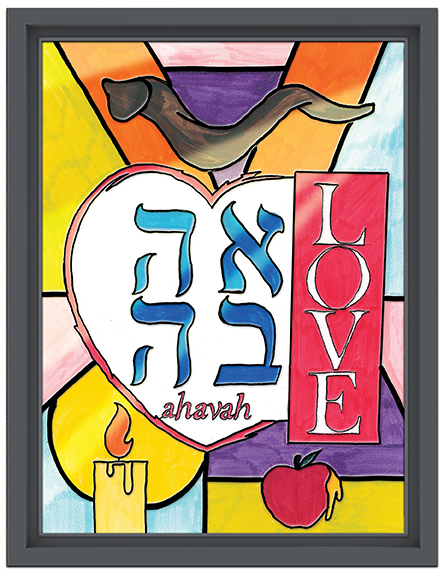
There are plenty of us in the Jewish world who are engaging with Judaism for less-than-ideal reasons: fear, guilt, or out of a sense of duty to one’s parents or grandparents, or without any clear sense of why at all.

Every person’s path to and with Torah is different, and all paths to and with Torah are valid. But if, says the Meiri, you can get to a place where you’re doing it out of love – for Torah, for our tradition, for our community, for yourself, for the world, for God, however you understand God – harei zeh meshubbaḥ. That is worthy of praise.

So how do you get to that place? As the Talmud suggests, the more you do something, like seeking to understand our tradition, or regular tefillah / prayer, or setting aside time to observe Shabbat with family and friends, the more likely you are to see how doing so creates more love in this world. 

But let’s face it: life gets in the way. We are all busy. Tefillah takes time. You might think you need Saturdays to go shopping or mow the grass or respond to work emails that you didn’t get to during the week. It can be hard to carve out time to do Jewish, let alone explore the question of why we should.

So that is why I am going to propose the following: add a little regular Jewish learning to your life. And I’m talking specifically here about Jewish text. Let me tell you why you should do this.

Because this tradition is yours, because it can help improve your life, and most importantly, because you can.

Once upon a time, Jewish text was impenetrable if you had not studied rabbinic Hebrew for years. And Hebrew schools did not have the time or the energy to teach that, so they focused on holidays and lifecycles and prayers and songs. But the real foundation for Jewish life is the Jewish bookshelf, and that was only the domain of the scholars, men with long beards. 

We failed to teach that foundation. We failed to demonstrate not only the rich, scholarly basis for why we do what we do, and the pleasure of arguing over the meaning of our texts and discovering how they can help us be better humans today. 

But we are now living in a period of great democratization of Jewish wisdom. With a few keystrokes, you can learn Torah! Talmud! Midrash! Halakhah / Jewish law! Mussar / ethics! And so forth. All in perfectly readable and in some cases interpreted English! Sefaria.com is probably the best source, available wherever you have access to the Internet, but there are other sources as well. There are podcasts and blogs and Daf Yomi study groups and all sorts of paths into our tradition.

The stunning wealth of information available today is, at least in this case, a blessing! But you might need some help, and that’s what I am here for.  This is what Rabbi Goodman, our interim Director of Derekh and Youth Tefillah, is here for.  This is what Rabbi Freedman, head of our Joint Jewish Education Program (J-JEP) is here for. Rabbi Shugerman, our new Director of Development, is also happy to help.

We are all happy to help guide you through the Jewish bookshelf. We offer many opportunities, through Derekh in particular, to get in touch with our ancient texts, which, once you dig into them, can glow with the contemporary shine of personal meaning today, but are grounded in the weightiness of ancient authority.

And what kind of things might you learn? I’m so glad you asked!

Here are just a few of the things that we have covered in various sessions at Beth Shalom in the past year: 

  • We learned how to manage our anger, and why silence is key to wisdom from one of our greatest thinkers, Maimonides.
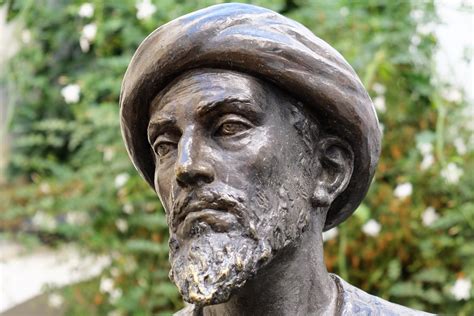
Maimonides, from the statue in Cordoba
  • We learned that giving tzedaqah is “psycho-effective,” that is, it not only benefits the receiver in a physical way, but also helps the giver understand that we should all be less attached to our own possessions and moreso to our own spiritual relationships, from 18th-century Rabbis Hayyim Vital and Jonathan Eybeschutz. 
  • We have discussed the importance of speaking up in the face of corruption, and of pursuing justice over material things, from our ancient prophets Jeremiah and Isaiah and Ezekiel.
  • We have explored our need for gratitude for what we have, from the Mishnah.
  • We have learned that the essential goal of prayer is not an empty recitation of words in an ancient language, but rather an opportunity for self-judgment. That is exactly the meaning of the word, tefillah.

George Bernard Shaw is purported to have said, “Youth is wasted on the young.”  It is adults who can truly appreciate how awesome and rich our people’s wisdom is. So you might have missed these things in Hebrew school. But the good news is, as Benjamin Franklin said, “The doors of wisdom are never shut.” We put a lot of emphasis on teaching children, who are not wired to appreciate the complexity of our tradition, and not enough emphasis on initiating adults into the most important mitzvah, the most essential holy opportunity of Jewish life: finding meaningful guidance in our texts. 

One of the great challenges that we face as Americans is what I see over and over as a crisis of guidance. We hold in front of us the principle of freedom, and understand that to mean that everybody is entitled to make their own choices, with no judgment from others allowed. And the challenge that I see, particularly in younger people, is that we are rudderless. We may be taught how to prepare for a career, but we are not taught how to shape our relationships, to live as part of a community, to think about how our actions affect the greater good.

And that is what our tradition offers – guidance on how to be better people, how to improve ourselves and our world. “When I pray,” said Rabbi Louis Finkelstein, former Chancellor of the Jewish Theological Seminary, “I speak to God. When I study, God speaks to me.”

Perhaps one of the most tragic things we have experienced over the last year-and-a-half of pandemic has been the resistance by some to effective public health measures such as wearing masks and getting vaccinated. Our tradition, and the framework of mitzvot, is essentially about commitment to one another and to society, of being aware of the common good and pursuing it. 

The essential meaning of living inside the Jewish framework of mitzvot is understanding that we do not function solely as individuals, that we are not merely in this to pursue only our own whims and fantasies, but rather to see ourselves in relationship to the others around us, to act on and elevate the qedushah / holiness in those relationships.

Our actions, our words have meaning; our connection with and respect for others has meaning. And when we seek that meaning through learning and living our tradition, we create a better life for ourselves, with happier, healthier relationships with all the people around us.

My challenge to you on this Rosh Hashanah is to seek meaning. Don’t be a Jew by default.  That is no longer good enough in our modern American context. Seek the “why.” Discover the meaning in Jewish life by learning. Doing so will open up whole new worlds of understanding for you that will help you be a better person, offer guidance at crucial moments, and raise the qedushah around you.

Reach out to me or my colleagues here at Beth Shalom.  We will set you on the path.  But we will also help you take it slow. Set a goal of learning one thing – just one – in the coming year about Judaism that you did not understand: Why we pray, why we read the Torah out loud, why we say berakhot before we eat or drink, why we continue to lament the destruction of the Second Temple in Jerusalem, nearly 2,000 years ago, even if we are not expecting it to be rebuilt, and so forth.

And then, when you have learned that one thing, learn another. You’ll be glad you did. Seek the why. Make it meaningful!

~

Rabbi Seth Adelson

(Originally delivered at Congregation Beth Shalom, Pittsburgh, PA, Rosh HaShanah Day 2, 9/8/2021.)

Categories
High Holidays Sermons

Make it Meaningful! Gathering – Rosh HaShanah Day 1 5782

First thing, before we go any further: let’s have a moment of gratitude for being able to gather once again. I know that for many of us, this is the first time you have been in this sanctuary for perhaps two years. Probably for many of us as well, this might be the largest gathering you have experienced for almost as much time.*

You’re OK! It’s all good! Take it all in. Let’s say sheheḥeyyanu to acknowledge how awesome this is:

ברוך אתה ה’ א-להינו מלך העולם, שהחיינו וקיימנו והגיענו לזמן הזה

Barukh Attah Adonai, Eloheinu Melekh ha’olam, sheheḥeyyanu, veqiyyemanu, vehigi’anu lazeman hazeh.

Praised are You, God, for giving us life, sustaining us, and for enabling us to reach this extraordinarily holy moment.

Second, I think we need to acknowledge that, even though some of us are here in the Sanctuary, many more are still not, because we are still not free from pandemic anxiety. Even as we gather at this moment, we continue to pray for a time when we can do so without any concern for our health and safety.

I’ll be talking today about what it means to gather as Jews. But first, a brief introduction to this year’s High Holiday theme: Make it Meaningful!

***

When I went to Israel for the first time in the summer of 1987 on the Alexander Muss High School in Israel program, I had a very good friend named Josh Kosoy. We were singing buddies – he wrote songs and played guitar quite well, and I helped sing and harmonize. Josh was from Houston, and although we were both entering 12th grade, he had already been through rehab for drug addiction, so he was a sort of fascinating character to me in that his life had been so challenged in a way that mine had not. 

And he looked the part, too. When we visited the Dead Sea with our group, as we were getting off the bus, two plainclothes Israeli policemen pulled Josh and me to the side and searched us for drugs, paying much more attention to Josh. There were none, of course, but I’ll never forget THAT.

At one point during the summer, Josh adopted a stray kitten that had found its way into our dorm. For several days the kitten and Josh were inseparable. Then one morning, Josh awoke to find the kitten lying on his belly, dead. We were all very upset by the loss of this cute kitten, who had wandered into our lives only to leave abruptly. We gave the cat a very moving funeral.

In retrospect, the story reminds me of the end of the book of Jonah, which we will read on the afternoon of Yom Kippur, in which Jonah feels compassion for a dead squash plant. When he expresses remorse, God rebukes Jonah for caring so deeply for a plant, after failing to have compassion for the people of Nineveh. God, of course, having created both the squash and the Ninevese, correctly framed Jonah’s earlier failure: how could Jonah have felt more for the dead plant than for people?

What made this tiny, homeless cat meaningful to us? It was that it had become part of our lives, part of our story. It had given us partnership, a few hours of cuddly enjoyment. It was a living thing that Josh could care for above and beyond his own needs; make him feel protective and needed and responsible for this life. It gave him, at least for a couple days, a special sense of purpose. And then it was gone.

One of the themes to which I regularly return is how engagement with Jewish life can bring us meaning. My mission as your rabbi is to ensure that Judaism is meaningful to you, that your involvement is never merely “checking the box,” or a mere reflex, or something that you do just to please your parents or grandparents or because you feel guilty. Practicing Judaism actually helps you improve your life, your community, and the world. And the key to making that happen is to find the meaning.

But it’s not like meaning just wanders in, like a stray kitten. Rather, you have to make it happen. To borrow an idea from physics, you have to put a little work into the system, some activation energy. If you just let Yom Kippur go by, or Pesaḥ, or Ḥanukkah or Sukkot or Shavuot or Tish’ah BeAv or your nephew’s berit millah or your friend’s wedding without framing it properly, you will not benefit from the experience.

Yes, I know that is hard, particularly if you do not have the tools with which to frame things Jewishly. But I’ll let you in on a little secret: [stage whisper] that’s why I’m here! I can give you those tools. And not just me: all the people that work here at Beth Shalom. That’s why we are here: to help you make Judaism meaningful. We offer ideas and activities and programs and discussions all the time to help you frame your life with meaning.

And that is what we will be talking about over these High Holidays. Our theme this year is, “Make it Meaningful!” By which I mean, don’t let life go by without paying attention, without putting it all in Jewish perspective, without putting in the activation energy that is the catalyst for change in yourself and the world. That is what our tradition is for. And we are going to look at this idea of making it meaningful through four perspectives:

  • Gathering (today)
  • Finding the Why (Rosh HaShanah Day 2)
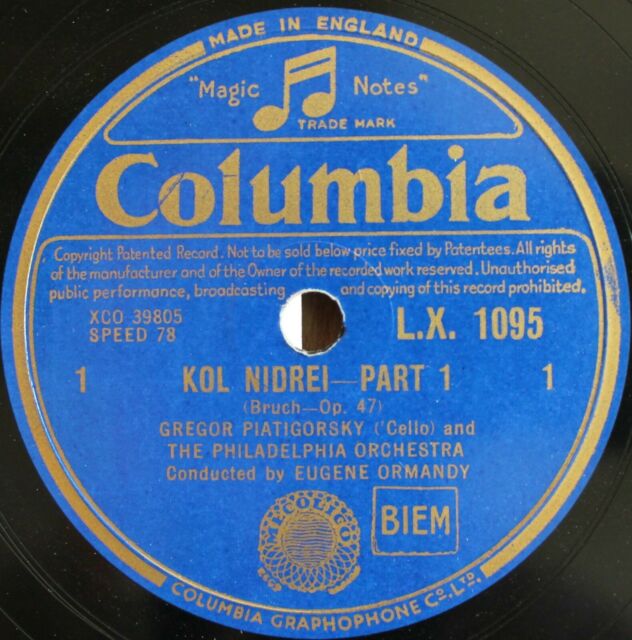
  • Engaging With Israel (Kol Nidrei) 
  • Framing Holy Moments (Yom Kippur day)

What I hope you will come away with is new ideas on how our tradition can fill your life with meaning, so that you can improve your outlook and reap the benefits of a purposeful life, and that we as a community and really the whole world may also be improved through your engagement with Judaism.

I reconnected with my friend Josh when I moved to Houston in 1996, back in my engineering days. Almost coincidentally, he was part of a group of friends who were running a ragtag theater troupe with which I had become involved. 

I left Houston in the spring of 1999, returned to Israel for a while, and then ended up in cantorial school in New York. Sadly, Josh die three years later, a victim of his own internal struggles. Reflecting on his tragic life and death, I understand that the meaning embedded in our friendship was, of course, much deeper than what we had with that poor kitten. But the process was the same: time and energy invested in friendship, in singing and traveling together, in being harassed by police together, and all the little experiences and moments that make for the depth in relationships. 

Embedded within those moments, in the interstices of life, we find meaning.

***

I do not think that our ancestors thought too deeply about meaning in being Jewish. They did not have to: Judaism was the scaffolding of their lives. The lifecycle events, the holidays, the laws and customs and foods and all sorts of boundaries. They lived and breathed Judaism, knowing that they were different from their non-Jewish neighbors, but, like the fish who does not see the water, Jewish living was simply the fabric of their lives. It was not “religion,” in the distant, Protestant sense with which we understand it here in America. Rather, being a Jew was to live with Judaism as the spiritual wrapped up in the mundane, while keeping in step with the calendar of our tradition. It’s what made them a people, distinct from the others around them, and connected to each other.

That is not true for us. We can choose to be here or not. We can choose to open the siddur / prayerbook, to belong to a synagogue, to give tzedaqah, to avoid ḥametz on Pesaḥ, and so forth. Or not. Many, many of us have opted out, and of course I find that very sad. That is the great irony of contemporary America: on the one hand, we live here more freely than at any other time in Jewish history, but we also have the freedom to not be Jewish.

But I think the reason that so many Jews have opted out of Judaism is because they were unable to find Jewish engagement meaningful. I cannot count the number of people who tell me about how their grandmother used to make the most wonderful Shabbat and holiday dinners, and how they were so special, but then when grandma died, that custom, which was so meaningful for the whole family, just went away. I cannot count the number of people who remember going to synagogue regularly as a child with their family on Shabbat mornings, but do not bring their own children to shul.

Where did that meaning go? Was it merely eclipsed by pressure to achieve at school or work, social media, travel soccer leagues, stress over government dysfunction and a worldwide pandemic and a myriad other things? Did we check it at the door at Ellis Island? Have we somehow forgotten about the power of Jewish life? 

I do not know. But I will tell you this: we need it. We need meaning. And most of us are probably searching for it in the wrong places.

We need meaning because, unlike our ancestors who swam in a Jewish sea, we have no framework. We have been burdened with the curse of infinite choice. Paper or plastic? Whitening, breath-freshening, cavity-preventing, enamel-restoring, or tartar-fighting toothpaste? Harvard or Yale or CMU or Pitt? Squirrel Hill or Shadyside or Lawrenceville? Brand-name or generic? We are constantly barraged with choices, choices which wear us down, but also have us always second-guessing ourselves. Did I make the right choice?

And ultimately, many of those choices are meaningless, in the Big Picture. But we spend so much energy on them that if we do not have a framework to our lives, guideposts to help us along, most of us just blindly stumble from thing to thing, not framing our direction in a way that is helpful, letting the world act on us without individually acting within the world. This is likely a contributing factor to the epidemics of anxiety, depression, addiction and the like that plague our society.

Not that Judaism is a 100% foolproof cure for all those ills. But there is no question that when one gains spiritual satisfaction from a traditional framework, the positive benefits tend to push some of those other things out of the way.

One of the primary ways in which we derive meaning from our tradition is through gathering. From the moment in Bereshit / Genesis when God takes a piece of Adam’s rib to create Eve, saying, לֹא־ט֛וֹב הֱי֥וֹת הָֽאָדָ֖ם לְבַדּ֑וֹ – Lo tov heyot ha-adam levado – It is not good for this person to be alone, we understand that the fundamental building block of meaning is relationship with others.  

And so we gather. 

***

At the center of virtually every Jewish custom is gathering. We of course gather for tefillah / prayer, as we are doing right now. We gather for holiday meals, particularly on Shabbat and Rosh HaShanah and on Pesaḥ. We gather for lifecycle events – weddings, baby namings, beritot millah (ritual circumcisions), benei mitzvah, funerals, and so forth. We gather to learn and to celebrate. We also love to gather institutionally – there is never a shortage of Jewish organizations, with a palette of alphabet-soup abbreviations: JCC, JAA, JCRC, JFedPGH, JJEP, CDS, USCJ, URJ, HIAS, AJC, and on and on. We are the only people who love gathering so much that the presidents of our organizations have a meta-organization: The Conference of Presidents of Major American Jewish Organizations.

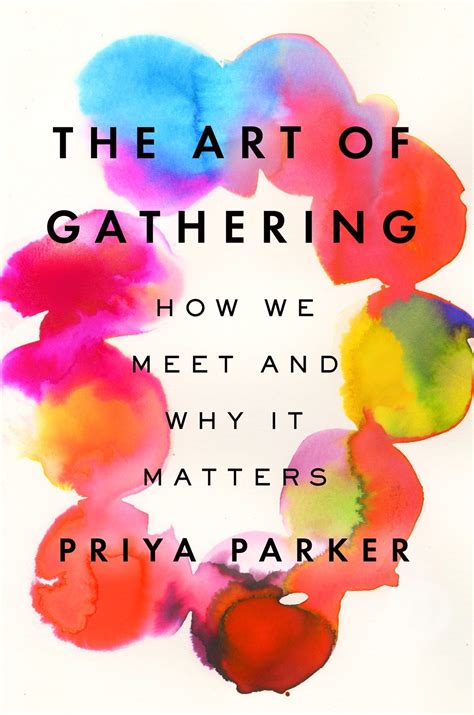
And we do that gathering pretty well. Yes, I know we like to complain about our organizations and our gatherings, but that only demonstrates how much we care about gathering. The author and consultant Priya Parker, in her book The Art of Gathering, although not herself Jewish, praises the Jews for our gathering talents. In teaching what she calls, “good gathering,” Ms. Parker invokes the “Passover Principle”: that before anyone convenes or participates in any type of gathering, we should ask ourselves, “Why is this gathering different from all my other gatherings?” 

What is it that makes for good gathering? What makes gathering meaningful? Intentionality. Gathering for a specific purpose. This year in particular, following our gradual (and, I hope, ongoing) emergence from the pandemic, our intentionality is a low-hanging fruit. Remember when we said “Sheheeyanu” a few minutes ago? That simple ritual, a well-known berakhah, helped us bring these High Holidays into focus: We are grateful merely for the ability to gather once again.

Intentionality is the key to good gathering. And we have our own word for that: kavvanah. No Jewish gathering, or ritual of any kind, should be lacking in kavvanah. It is the glue that holds our words together, that unites our hearts, minds, mouths, and hands. You may think that tefillah / prayer is a jumble of words in an ancient language which you do not understand, and without kavvanah it is exactly that. But if we have prepared ourselves properly to gather, with kavvanah, with intention, then tefillah becomes not just a jumble, but an opportunity – to check in with ourselves, to take inventory, to meditate, to breathe, to attempt to feel the qedushah / holiness in the air around us and in our lives, to remember the others in our midst and our connection with and obligations to them.

And as far as Ms. Parker’s guidance is concerned, many of the other things we do as Jews are great gathering principles. We have been preparing for these Ten Days of Teshuvah for at least a month, by blowing shofar and reciting Psalm 27 every morning, and over the past nine days as we have recited Seliot, prayers asking for forgiveness, every day. And virtually every Jewish holiday requires preparation, Pesaḥ being perhaps the most physically extensive.

And Ms. Parker also highlights an idea that I think we also do quite well: that the best kinds of gathering transport us to a temporary alternative world.

To go back for a moment to something I mentioned earlier: our lives are not saturated in Judaism like those of our ancestors. We live in multiple worlds, but most of the time we are just Americans, fully integrated into the society around us. The water in which we swim is American culture. So when we take that opportunity to do something Jewish – perform a ritual, go to a synagogue service, enjoy a festive holiday meal, learn a piece of Talmud, and so forth – we are actually doing exactly what Ms. Parker suggests. We set up a kavvanah, an intention; we speak a foreign language, we don special paraphernalia, we use unique choreography, we eat particular foods, we perform certain, curious customs.

You are sitting right now in one corner of this temporary, alternative world. And sure, it does not feel so strange to most of us, because some of us have been doing this all our lives. But think of how unique and powerful this world might seem to others who have not yet experienced it. And consider how fortunate you are to have been given this holy opportunity, by virtue of birth, or by having joined the Jewish people.

And think of how awesome it is that all of us are experiencing this holy moment together, right now. And particularly after a year and a half of isolation, of added anxiety and distance and loneliness. Consider how wonderful it is to gather right now at this moment, even as the pandemic is still not done with us. Consider how meaningful it is to be a part of this community, to be a part of this qehillah qedoshah, this holy congregation.

So here is a brief prayer for this holy moment of gathering, full of meaning:

Modim ananu lakh. Grateful are we to You, God, for endowing human beings with the tools to engage with physics, chemistry, and biology, and the wisdom and ability to manipulate our world, to produce vaccines which have enabled us to gather today. Thank You for giving us the ability to connect with one another, to share stories and celebrations and grief, which help us through our days. Thank You for the gift of family and friends and community, for which we are so grateful as we support each other through these long months of separation. Thank You for the gift of prayer and the framework of tradition, which have enabled us to open our hearts and lend structure to our lives. 

How fortunate are we to have these gifts!

I hope that, as we move forward from this point, that we continue to be grateful not only for being in each others’ presence, but also for the Jewish framework that we have received to help bring meaning to that gathering.

We’ll talk more tomorrow about how digging deep into the Jewish bookshelf can further fill your life with meaning.

Next in the 5782 High Holiday series:
Rosh HaShanah, Day 2: Make it Meaningful! Seeking the Why

~

Rabbi Seth Adelson

(Originally delivered at Congregation Beth Shalom, Pittsburgh, PA, first day of Rosh HaShanah 5782, September 7, 2021.)

* On the day this sermon was delivered, during a period in which the Delta variant had caused a significant local spike in infections, about 300 people gathered in the Faye Rubinstein Weiss Sanctuary at Beth Shalom, a room that seats about 1600 people. All who were allowed into the Sanctuary were fully vaccinated against the coronavirus, and all were required to wear masks for the entire time that they were there.

Categories
Festivals High Holidays music Sermons

Sermon in Song: A Musical Journey Through Jewish Ritual Melodies – Shabbat Shirah 5781

Shabbat Shirah, the “Shabbat of Song,” is the day on which we chant Shirat HaYam (the Song of the Sea, which the Israelites chanted upon having crossed the Sea of Reeds on dry land, Shemot / Exodus 15:1-21) as well as Shirat Devorah (the song chanted by Devorah the Prophet following victory over the Canaanite commander Sisera, Shofetim / Judges 5:1-31). In honor of Shabbat Shirah 5781, I created this musical explanation of the nusah (prayer-chant melody), musical modes and motifs, and congregational melodies used in the synagogue and in home rituals throughout Jewish life.

Enjoy!

~

Rabbi Seth Adelson

(Originally chanted at Congregation Beth Shalom, Pittsburgh, PA, Shabbat morning, 1/30/2021.)

Categories
High Holidays Sermons Yizkor

Back to Basics: Our Story Will Save Us – Yom Kippur 5781 / Yizkor

בְּרֹאשׁ הַשָּׁנָה יִכָּתֵבוּן וּבְיוֹם צוֹם כִּפּוּר יֵחָתֵמוּן

Berosh hashanah yikatevun, uvyom tzom kippur yehatemun.

On Rosh Hashanah their decree is written, and on Yom Kippur it is sealed.

That is our traditional story surrounding Rosh Hashanah and Yom Kippur – the Book of Life. As our tefillot / prayers continue throughout the day, we will continue to invoke this story.

This is the fourth and final installment in the “Back to Basics” series, inspired by the limited nature of our lives due to the pandemic. On Day One of Rosh Hashanah, we covered halakhah (Jewish law), on Day Two we discussed minhag (Jewish custom), and last night we spoke about Jewish values. (You can also listen to these as podcasts.) The final installment is about the Jewish story. Halakhah, minhag, values, story. These are the basic elements of Jewish life.

You might have thought that this piece of the basics of Judaism would come first. After all, the first thing we learn about being Jewish is that our heritage comes with a story. We learn stories from the Torah in Hebrew school. We remember the Exodus from slavery in Egypt at the Pesah seder table. We light Hanukkah candles to remember that a small band of Jewish rebels fought off the idolatrous invaders and restored the Temple in Jerusalem, and so too do we have an obligation to enlighten the world. We get a day off every seven days because God rested after six days of Creation. Even those of us with zero formal Jewish education know the stories about the Garden of Eden, Joseph (thanks to Andrew Lloyd Webber), Moses (thanks to Hollywood). The Torah and pop culture are intertwined in ways we do not even notice.

On the other hand, story serves as a beginning, and also the end; I have heard that Jewish life is something like a Moebius strip – as you follow its path, you always return to where you started. In engaging with our tradition, we always return once again to our story, our history, our culture, and we are reminded that sharing our story with others will lead to a better world: Wouldn’t it be awesome if the whole world observed Shabbat? Wouldn’t it be absolutely amazing if everybody were to gather around a holiday table and say, “Let all who are hungry come and eat”? 

And let’s face it: story is the most interesting part. For most of us, that is.

I have a slight confession to make here, although many of you probably have noticed this already. I’m not really a story-telling rabbi. Some rabbis are more inclined to pepper their sermons with good stories that lead to a moral. I am more cut-and-dried, more inclined to lay down the brief, pithy Talmud Torah than long form stories. (If you were on our Zoom service on the second day of Rosh Hashanah, you may have noticed that I tried to tell a joke and totally bungled it.)

But I am very fond of the fact that, no matter how we break down theologically or sociologically or demographically, we, the Jews, are still united by our stories. Even though we approach many things differently, the Torah is the Torah; the Talmud is the Talmud, and disagreeing over the meaning of a phrase or the halakhic import of a certain read comes with the territory. As fractious as we are, we still share our stories.  

And you know what? As long as we continue to tell our stories, they will protect and save us, just as they always have.

Think about this: what is it that enabled Jewish people to survive the destruction of the First and Second Temples, the Inquisition, the Shoah? What enabled Jews to manage being alternately exiled and welcomed, dispersed and ghettoized, massacred and delegitimized? What empowered us to look past the anti-Semitism, century after century, land after land? What encouraged the Zionists to build a modern nation in an ancient land? What has enabled this very community to pick itself up from its grief and move forward, after 11 of our friends and neighbors were brutally murdered by a white supremacist with an assault rifle?

Not history. If it were up to mere history, the Jews would have disappeared thousands of years ago. Our history is littered with destruction, dispersion, forced conscription, pogroms, and disillusionment.

No, what gave us the strength to survive was that these stories fill our lives with meaning. We mustered the courage to press on by the promises given to Avraham and Sarah, Rivkah and Yitzhaq, Rahel and Ya’aqov and Leah and Yosef. We have continued to teach our stories to our children, so that, generation after generation, their eyes were lit with the richness of our wisdom, the power of our tales, the inspiring personalities of our bookshelf.

One of the more curious things that we do as Jews, on the festival of Sukkot, is to parade around the room holding aloft the four plant species identified in the Torah as the symbols of the season: willow, myrtle, palm, and citron, also known as the lulav and etrog. And what do we do whilst parading?

We say, “Save us.” “Hosha’na.” And we say that over and over and over, and in between chanting “hosha’na,” we add tiny story fragments, a couple of words each. They always go by so quickly, because the piyyutim are long, and late in the service so everybody’s hungry and wants to get to lunch. But they include reference after reference to the Torah and to midrashim. Just a few brief examples:

We chant this on the second day of Sukkot:

הוֹשַׁע נָא אֶֽבֶן שְׁתִיָּֽה, הוֹשַׁע נָא

Hosha’na even shetiyyah, hosha’na.

Save us, Foundation Stone, save us!

The Even Shetiyyah / Foundation Stone was the mythical piece of rock, located at the top of Mt. Moriyah, the Temple Mount in Jerusalem, from which, according to midrash, the world was created. It holds a special power that we continue to invoke to this day.

Here is another one: 

כְּהוֹשַֽׁעְתָּ טְבוּעִֽים בְּצֽוּל גְּזָרִֽים. יְקָֽרְךָֽ עִמָּֽם מַֽעֲבִירִֽים. כֵּן הוֹשַׁע נָא

Kehosha’ta tevu’im betzel gezarim, yeqarekha ‘imam ma’avirim, ken hosha’na.

As you rescued this people from drowning by splitting the deep sea, Your glory crossing with them, so save us!

This is a clear reference to the Israelites crossing the Sea of Reeds, accompanied by God, an example of how God has saved us in the past.

There are literally hundreds of these types of references, some more deeply coded than others, in endless liturgical poems used over the holidays, not just for Sukkot, but around every holiday.

The message is clear: our stories save us. When we are in trouble, when we need something to hold onto, we lean into the rich assortment of tales that have inspired us and given us a meaningful framework for thousands of years. 

Now, I know I have a few armchair skeptics out there in Zoom-Land right now (and you may actually be seated in armchairs!) who are thinking, or perhaps even remarking out loud, “Come on, Rabbi. The stories of the Torah are not true. They conflict with the scientific record. There’s no archaeological evidence of the Exodus, or that the Israelites were actually enslaved. Do you really think that Moshe took dictation from God on Mt. Sinai?!”

To you I say, “I’m happy you’re listening!” and then, “So what? That is not the point.” History and story are not the same thing. Scientific truth and the foundational stories of an ethnic or religious group are not in the same category; they answer different questions. Science tells us that the universe is 14 billion years old, following a Big Bang in which all matter was violently expelled from a single, infinitely dense point, and ultimately cooled to the point where atoms and molecules and (at least in the case of one particular planet) life formed through a series of fascinating phenomena. 

But science does not tell us that we need a day off every seven days, because God rested on the seventh day of Creation. And science does not provide us with the wisdom to raise our children to be human beings, or to seek the common good, or to behave with integrity, or to remember the needy, or to pursue justice. Science teaches us facts; our stories teach us not only how and why to be Jewish, but also how and why to aspire to be the best humans we can be.

Our story, the Jewish story, may not meet the standard of scientific fact, but they are ours. My teacher at the Jewish Theological Seminary, Rabbi Neil Gillman, taught me the value of what he referred to us as “myth.” Not myth in the sense of falsehood, but the series of stories that help us explain our world, the lens that helps us make sense of the information we take in. Every nation, every ethnicity has its own myths. 

That is why the contemporary tools of biblical criticism, which cast doubt on some of our stories, do not trouble me. No matter what scholars may say about our foundational myths, they continue to frame my life and yours in holiness.

Some of you may be aware that there is a new translation out of the memoirs of Glikl, a Jewish woman who lived in Germany in the 17th and 18th centuries. I’ve been captivated by her story for many reasons, among them the fact that stories of and by women are too few and far between on the Jewish bookshelf. Glikl was born in the 17th century to a wealthy family, and she is not only literate in the sense that she can write her own memoirs in Old Yiddish, but also she is Jewishly literate, peppering her language with quotes from the Torah and rabbinic text. She writes about her family’s ups and downs, about intrigue and marriage and of course anti-Semitism, which is very much a part of her world. 

One of the captivating aspects of her work is the way in which the Jewish story nourishes Glikl. 

Throughout the seven books of her memoirs, which cover 28 years from 1691 until 1719, she weaves Yiddish folktales, Talmudic stories, and personal anecdotes into the details of her family life. She unspools lengthy yarns to teach us a moral, like the value of patience, and then she tells the tale of how she and her mother both gave birth around the same time, and one night their babies were confused and the entire household was in an uproar. She expands the story from the Talmud about Alexander the Great’s search for the Garden of Eden, to teach us that we should be satisfied with what we have. And she urges us to settle our personal accounts during our lifetime, a notion particularly salient for these days of teshuvah, repentance. 

Glikl’s memoir is not only a fascinating slice of history, a particular moment captured in remarkable prose, but also a testament to the power of story. As we listen to her unspool her tales, we also see how the Jewish story supports and nourishes her and her family, how Jewish rituals and holidays, drawn of course from our story, are very much a part of her everyday existence.

Ladies and gentlemen, I know that right now, things might seem much worse than they have ever been. I know that these Ten Days of Teshuvah / repentance, starting with Rosh Hashanah and concluding today (at 7:47 PM) have been nerve-wracking for reasons I do not need to enumerate. But underlying the threat of chaos and anxiety about the future, I know that over the past week, in the back of my head, I have been praying for life. Zokhreinu lehayyim. Remember us for life, God. And even though the story of the Book of Life should also fill us with awe, I must say that it has been comforting to me to be able to share these melodies and stories, these High Holiday sounds and ideas, with all of you, even virtually, over these days. 

Our story, the Jewish story, offers us comfort and meaning and protection. It holds us together in a way that halakhah cannot. It continues to brighten the eyes of our children and inspire all those who listen of all ages. And our rituals and customs and values bring us back again and again to our story.

Yizkor Coda.

What do we do when we recall a loved one? We recall their story.

It has often been observed that the hyphen on a memorial stone or plaque stands for a whole lot. A short, straight line. But none of our stories are straight; they contain twists and turns and loops and dead-ends. And it is up to us, the living, to recall all of those twists and turns in the lives of those whom we remember.

In the context of this pandemic, we have lost 1,000,000 people worldwide, including over 200,000 here in the United States, including members of this community and even a past president of Beth Shalom. And millions of people have lost their jobs; many more are living with less. The spiritual and economic pain from which we are all suffering is immeasurable; the deep frustration at our elected officials, and our fellow citizens, for their various failures is palpable.

When all is said and done, many, many people around the world will have died alone; many will be buried in overwhelmed cemeteries without any kind of funeral or eulogy. Many will have left this world in a way that their story remains unfinished, or untold.

Back in August, the city of Detroit memorialized its coronavirus victims by putting up huge photos of them in a city park, so that people could drive through and see their faces. There were 900 portraits in the exhibition, accounting for more than half of the 1,500 city residents who had by then died of the virus.

The photographic memorial drive in Detroit

A face is not a story, but in its lines and contours you can perceive quite a bit about a person. It was a moving tribute; the very idea brings tears to my eyes.

Ladies and gentlemen, we will likely have many months to go of isolation, of sickness and death. But we also have the gift of memory – remembering those we have lost; remembering our lives before the pandemic, remembering that humans are awfully clever, and will ultimately turn this time of sadness into one of rejoicing.

Although Yom Kippur is a Yizkor day, a day on which we remember those whom we have lost, and a day of gravitas as we seek repentance, rabbinic tradition tells us it is also a day of rejoicing; rejoicing at the fact that we know that if we work hard at the former, we will achieve the latter.

It is memory which may bring us salvation. It is memory which will bring us joy.

~

Rabbi Seth Adelson

(Originally delivered at Congregation Beth Shalom, Pittsburgh, PA, morning service of Yom Kippur 5781, 9/28/2020.)

Categories
High Holidays Sermons

Back to Basics: Values / Integrity – Kol Nidrei 5781

As I hope you have noticed by now, the theme for this High Holiday sermon series is “Back to Basics.” In the context of the pandemic, our options for Jewish engagement have been somewhat limited (as with every other sphere of life, of course). As such I am taking this opportunity to go “Back to Basics”: to consider the essential items of Jewish life. These essential items are halakhah (Jewish law), minhag (customs), values, and story. We spoke about halakhah and minhag on Rosh Hashanah, and this evening’s subject is values. (If you missed them, you can read them on this blog, and you can also hear them on our podcast, the Beth Shalom Torah-Cast.)

Once upon a time, American Jews loved to play the game, “Who is a Jew?” We were filled with pride to see Dinah Shore or Kirk Douglas on our screens, looking so beautiful and strong and goyish, but we knew the truth. “He’s one of us,” we would boast to each other. I know that many of us are bursting with pride, alongside the grief, as the first Jewish female Supreme Court justice, Ruth Bader Ginsburg, lay in state last week. 

But then there are plenty of Jewish people of whom we are not proud, members of our tribe who are among the highest-profile criminals and detestable public figures today. I won’t mention any names, but I am sure you can come up with a list in your own head.

(BTW, Christians have it easier in this regard: they generally only count church-goers as Christians. But we count people differently: once a Jew, always a Jew. We could excommunicate these people, like we did with Barukh Spinoza (actually, we lifted the herem / excommunication on Spinoza a few years back), but we cannot deny the Jewishness of people whom we would rather not claim.)

And that hurts. Because we like to think that our Jewish values are universal; that somehow we all acquire them in Hebrew school or they are instilled in us by our parents; that even if we eat treyf (non-kosher food) and proudly violate Shabbat in public that the pintele yid, the tiny spark of Jewishness within us, will somehow keep us connected to the fold.

But it does not work that way. Our values will only hold if we act upon them, if we teach them to our children, if we model them for each other, if we remember that the Qadosh Barukh Hu is paying attention to our behavior.

I think it is very hard right now, six-and-a-half months into a worldwide pandemic, with maybe another year of isolation in front of us, and then coupled with all of the other chaos in the world, political and social and economic and spiritual, to be optimistic about the future. Many of you know that I am a self-described optimist, and yet I have found myself severely challenged by our current predicament. Everything is not OK.

And then I remember that we have a spiritual framework. Our Jewish heritage of learning, of action, of values is there to uphold us in times of trouble. Our ancestors, who survived many centuries of turbulence and upheaval, pogroms and genocide and dispersion, did so by leaning into their tradition. Etz hayyim hi, they sang, lamahazikim bah. The Torah is our Tree of Life if we reach out and grasp it. Our great-great-grandparents grasped and grasped and held on for dear life, and as a result, we are still here.

Part III: ערכים / Arakhim / Values

So tonight’s subject is values. Upholding our values at this time is more important than ever. If we are going to pull through this pandemic as a society, we have to remember that we have guardrails on our choices and behavior, not only from halakhah (Jewish law) and minhag (Jewish custom), but also drawn from our values. Values like:

  • Honesty
  • Empathy
  • Compassion
  • Taking care of the needy among us
  • Gratitude for what we have
  • Justice
  • Seeking peace
  • Pursuing the common good
  • Seeing the Divinity in all of Creation, including all people and all of God’s creatures

All of these have sources in Jewish text, in the Tanakh or in rabbinic literature. I am going to focus on one essential value this evening, one that I think is absolutely the key to all of them: integrity. While there are many sources on integrity from the Jewish bookshelf, here are a few that resonate with me:

Micah 6:8

הִגִּ֥יד לְךָ֛ אָדָ֖ם מַה־טּ֑וֹב וּמָֽה־ה’ דּוֹרֵ֣שׁ מִמְּךָ֗ כִּ֣י אִם־עֲשׂ֤וֹת מִשְׁפָּט֙ וְאַ֣הֲבַת חֶ֔סֶד וְהַצְנֵ֥עַ לֶ֖כֶת עִם־אֱ-לֹהֶֽיךָ׃

God has told you what is good, And what the LORD requires of you: Only to do justice And to love goodness, And to walk modestly with your God.

Some of you may know that this one is on my list of “refrigerator-magnet” texts – those that are just so pithy and essential that you should have them on your fridge. The prophet Micah tells us that the most essential path is that of acting from a place of justice and hesed, lovingkindness, but also to approach life modestly, that is, to approach all of your interactions with others from a place of holy humility.

Devarim / Deuteronomy 25:16

אֶ֣בֶן שְׁלֵמָ֤ה וָצֶ֙דֶק֙ יִֽהְיֶה־לָּ֔ךְ אֵיפָ֧ה שְׁלֵמָ֛ה וָצֶ֖דֶק יִֽהְיֶה־לָּ֑ךְ לְמַ֙עַן֙ יַאֲרִ֣יכוּ יָמֶ֔יךָ עַ֚ל הָֽאֲדָמָ֔ה אֲשֶׁר־ה’ אֱ-לֹהֶ֖יךָ נֹתֵ֥ן לָֽךְ׃

You must have completely honest weights and completely honest measures, if you are to endure long on the soil that the LORD your God is giving you.

The key to a long and happy life, says the Torah, is to deal with all others fairly. The essence of living a just life is treating everybody equally, not only measuring out your goods in the marketplace in an honest way, but also by measuring out your love and deeds and favor honestly and fairly.

Pirqei Avot 4:1 

אֵיזֶהוּ מְכֻבָּד, הַמְכַבֵּד אֶת הַבְּרִיּוֹת

Who is honored? The one who honors all of God’s creatures.

The way that we gain honor is not by expecting others to submit to you, but exactly the opposite. If you interact with the people around you from a place of respect, from honesty and good intentions, then those things will come back to you.

What does it mean to act with integrity? It means that we treat all people fairly and respectfully, regardless of who they are. It means that we are honest with ourselves and others in all our dealings. It means that we model upright behavior for others, and understand that the image of ourselves that we put out into the world should be one that others want to emulate.

Some of you may know that the Kol Nidrei prayer is among the more controversial pieces of liturgy in our tradition. Yes, we the Jews like to argue, even over what’s in the siddur / prayerbook. 

But Kol Nidrei is one of the few prayers in the Jewish canon that was controversial from the outset. It first appeared, as far as we know, in the 10th century, and its purpose was originally to nullify vows that one made with oneself and did not fulfill in the past year, vows like, “I’m going to learn to speak French this year,” or “I’m going to go on a diet, right after Simhat Torah.” A few centuries later, the renowned scholar Rabbenu Tam, one of Rashi’s grandchildren, changed the tense from past to future, making Kol Nidrei a pre-emptive nullification of such vows. 

Vows, promises that we make to ourselves, to others, or to God, are important; in addition to passages in the Torah about various types of vows, there is a whole tractate of the Talmud, Nedarim, devoted to issues surrounding vows. Right up there with being a person of integrity is the principle of keeping one’s word.

However, Kol Nidrei also provided material for anti-Semites. Misunderstanding the point of the prayer, which nullifies only those vows that we make with ourselves, the Jew haters of this world took Kol Nidrei as evidence that you can’t trust a Jew. And some rabbis railed against Kol Nidrei for centuries, because they thought that the less-scrupulous among us would take it as license not to live up to one’s word with impunity.

But you might think of Kol Nidrei today as a kind of relief valve, in particular for the very difficult kinds of resolutions we make with ourselves on Yom Kippur, like, “This year I’m really going to make peace with my estranged sibling,” or, “I’m going to give more tzedaqah.” The promises that we might make to ourselves, when we know that the Book of Life is closing, and we know that we really should do these things, but maybe we have tried and failed at self-improvement in the past. And we might very well fail again.

Keeping your word is very much a part of the value of integrity. And our tradition wants you to keep your word, especially to the others around you. Kol Nidrei does not excuse you from that.

OK, Rabbi, that all sounds very interesting. I want to act on this Jewish value of integrity. How do I do this?

I’m so glad you asked! Here are some ways we can act on this value:

In the personal sphere, that is, in your most immediate relationships, with your children, family and friends:

  • Do what you say you’re going to do.  Be the parent/friend/sibling/spouse that everybody can count on.
  • Follow through on promises, both the good (“I’ll be there to see your baseball game / play”) and the bad (“If you do that again, you’ll be punished.) The Talmud teaches us (BT Bava Metzia 49a) “Let your yes be yes, and your no be no.”
  • Model the behavior you know is best for the others around you. Teach integrity by acting with integrity.

In the communal sphere, that is, in interacting with the people in your neighborhood, your synagogue, your school, your workplace:

  • Decide what are the three characteristics for which you want to be eulogized.  Then consider if your actions and words reflect those characteristics.
  • Integrity means respecting your interlocutor and trusting that reasoned arguments are the only honorable way to have discourse. It is very easy in today’s world for disagreements to devolve into insults. Remember the spark of qedushah/holiness in all people when engaging in this way.
  • Do not criticize unless you are willing to be part of the solution. Always be prepared to offer up suggestions alongside criticisms, and be prepared for the possibility that others may not want your suggestions.

As a citizen of this nation and of the world:

We may not be able to solve all of the complicated problems in the world right now (I do not need to enumerate them for you), but if we were all to take a leap forward on the integrity scale, I think there is a good chance we could at least ease some of the pain. The world needs a good deal of healing right now, and although you might feel quite small, remember that you have real power, which you exercise every time you interact with somebody, whether it is your neighbor, a store clerk, or a stranger on the street. 

You have the potential, with your words and your deeds, to make someone’s day brighter or darker, to build up another’s confidence or to destroy it, to lift up your community by working for the common good or tear it down in your own self-interest. This power demands that we always act with integrity. 

At least three times per day in Jewish prayer tradition, we say, “Elohai netzor leshoni mera, usfatai middabber mirmah.” God, keep my tongue from evil, and my lips from deceit. The Talmud (BT Berakhot 17a) tells us that we should conclude every Amidah with these words. It is a reminder that our words count as much as our actions in creating a world based on integrity.  This is an effective daily meditation on our potential to impact others.

The Zen Buddhist priest, angel Kyodo williams, says the following in her book, Radical Dharma

We cannot have a healed society, we cannot have change, we cannot have justice, if we do not reclaim and repair the human spirit.

If we model integrity in the personal, communal, national and worldwide realms, we have the potential to heal and uplift the human spirit. If we act out of selfishness, deception, bias, prejudice, and fear, we will only continue to see our world crumble. 

The choice is ours. Pick the road of integrity, for the benefit of all of our fellow people. Remember your obligation to raise the level of qedushah / holiness in this world. Seek the betterment of yourself and others. I am confident that, by acting on the Jewish value of integrity, we can regain a more civilized world. We are all in this together.

Shanah tovah! 

~

Rabbi Seth Adelson

(Originally delivered at Congregation Beth Shalom, Pittsburgh, PA, evening service of Yom Kippur 5781, 9/27/2020.)

Categories
High Holidays Sermons

Back to Basics: Gather. Customize. Listen. (Minhag) – Rosh Hashanah 5781, Day 2

There is a classic rabbinic story about the mother who is teaching her son how to make a meatloaf for their Rosh Hashanah lunch. After mixing the ground beef and onion and egg and breadcrumbs and spices, she rolls up the loaf, chops the ends off and throws them away, and places it in the meatloaf pan.

The son notices that she has chopped off the ends, and, concerned about unnecessary food waste in a world where climate change and sustainability are paramount, asks his mother why she throws the ends away.

“I don’t know,” she says. That’s how my mother, your grandmother did it.

They call the grandmother to ask. She says, “I don’t know. That’s how my mother did it.”

They call the great-grandmother to ask. She is not well; she is weak, and can barely talk. “Why did I chop the ends off?” she asks, reflecting deep into the recesses of her mind. “Why did I chop the ends off? Because the pan was too small.” 

***

We are a people who are committed to tradition. “Tradition!” calls Tevye the Milkman in Fiddler on the Roof. It’s a word that captures a whole lot of things in three short syllables.

Our theme for these High Holidays is “Back to Basics.” Yesterday, we spoke about the ongoing value of halakhah, usually translated as “Jewish law,” although that is at best an approximation. More accurately, halakhah is “the way to walk through life while acting on the imperative to be holy people.” In particular, we spoke about the Conservative movement’s role in conserving halakhah by occupying the central area between tradition and change. 

But another essential aspect of tradition, and indeed a basic feature of Jewish life, is the area of Jewish behaviors that are not halakhah, not based in Jewish law from the Torah or Talmud, but rather in the area of minhag, custom. Customs are not mandatory, and can in fact be easily changed, but stripped of customs, Judaism is not recognizable. Medieval rabbis, when describing ancient minhagim that did not rise to the level of halakhah, would say, “Minhag avoteinu beyadeinu.” Our ancestors’ customs are in our hands.

Part II. Minhag / Custom

Our ancestors’ customs are in our hands.

So what are these minhagim / customs? Some, like the wearing of a kippah or the recitation of kaddish while in mourning are so ubiquitous and so long-standing that they seem like they should be halakhah. Some are instantly recognizable as symbols of the richness of Jewish life, like braiding hallah or singing songs at Shabbat dinner. Some are deeply personal and spiritual, like immersing in the mikveh before Yom Kippur (something which I am going to deeply miss this year, because I am not convinced that I can do it safely). Some are family things, like that special dish (meatloaf, maybe?) that your grandmother made for holiday meals, and some are regional, like the Persian-Jewish custom of whipping each other with scallions while singing Dayyenu.

Melodies. Clothes. Foods, Ritual objects. Holiday practices. Many of these things fall into the area of minhag, and it is the minhagim / customs of Jewish life that make Judaism interesting. Think of it this way: you have to wear clothes in public. If you do not, you are violating the law (and risk being arrested). But the law does not dictate the color of your clothes, or whether you wear a tie or a hat or a dress, or who designed the clothes. The variety and palette of clothing options are what allow us to express either our individuality or our commitment to a group, on a sliding scale therein, and this variety is what makes clothing appealing.

Some minhagim are ubiquitous throughout the Jewish world, and some are particular to a family or a small town in Poland or a region of North Africa. 

These minhagim are in our hands.

They are in our hands in the sense that we can carry them and give them to our children and grandchildren. They are in our hands in the sense that we can acknowledge the power of minhagim only if we act on them. They are in our hands in the sense that it is up to us to choose to continue them or not.

How many of us occasionally think about something our parents or grandparents used to do that we do not? How many of us have discovered our grandfather’s tallit, for example, and wistfully recalled playing under its folds and fringes, but would never consider taking our own grandchildren to synagogue to do the same? How many of us have tried to recall the tasty dishes of past Passovers (in my house, for example, it’s my Grandma Rosie’s stuffed cabbage recipe, which my mother affectionately describes as a “patshke,” a messy bother, that may not survive to my children’s generation), or the familiar holiday melodies that we cannot quite remember, or that game that we used to play with cousins on Rosh Hashanah, but we haven’t done so in years because everybody lives so far apart now? 

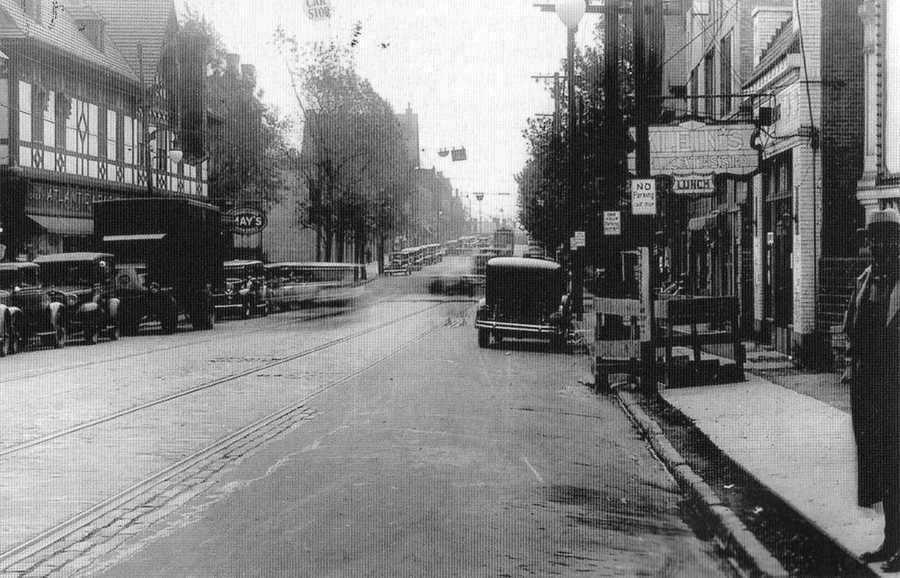
One of the things that we continue to lose, generation after generation in America, is what Brandeis Jewish studies professor emerita Sylvia Barack Fishman has identified as the “thick relationship” with Jewish life. You know, the fact that there used to be something like 12 kosher butchers on Murray Avenue, and how at one time all your neighbors were Jewish. You knew where everybody was on the first day of the month of Tishrei, because who didn’t go to shul on Rosh Hashanah? And you knew that a certain product in the grocery store was kosher because, as my father has told me about his own mother’s shopping habits, “everybody else was buying it.”

Murrau Avenue, Squirrel Hill, 1932

We have clearly lost that sense of “thickness,” that constant connection and reinforcement of Jewishness in America, even here in the shtetl of Squirrel Hill. There are many sociological factors in play here, and these things are far too complex to discuss here.

But the greater point is this: it is the customs of Jewish life that give it its ongoing appeal from generation to generation, and we let go of them at our own peril. So as much as halakhah is foundational to what we do, so too is the varied tapestry of minhag that seasons our Jewishness. And we need that thickness, that rich range of customs to ensure that Judaism continues to enrich our lives and our world. We need to be in the thick of it, in thick relationship with Jewish life, culture, ritual, and of course custom.

So how do we do this, given that our world has changed so dramatically in the past few decades? I am going to suggest three actions that are rooted in Jewish minhag:

You know how cool businesses have one word names? I’m going to give each of these ideas a cool name. Imagine them written in a simple, bold typeface, with a period at the end.

Gather.

Gathering as a family, gathering with friends, gathering as a community in a Jewish context – this is the most fundamental Jewish minhag. Yes, gathering is a little fraught right now, but we are still doing it, even if this virtual connection is somewhat tenuous and woefully unsatisfying. And I assure you that when this whole pandemic is over, we will surely gather once again.

For this to work, however, gathering in this sense needs a Jewish ritual to frame it. Gather for Shabbat meals. Gather for a brief havdalah candle-lighting with cocktails. Gather for services via Zoom at Beth Shalom (and some day, bimherah beyameinu, speedily in our days, we will be able to gather again for services in person on a large scale). Gather for singing niggunim, which we have done both virtually and in-person.

And a subset of gathering is tefillah, prayer, although not in the way you might think.

Look, I know that synagogue services are not for everybody; they are something of an acquired taste. I know that if you do not read Hebrew, or if the melodies are unfamiliar, or if you just cannot quite stomach classical descriptions of God (yeah, BTW, I can’t either. Let’s talk!), if those things do not work for you, then tefillah does not work.

Also, I know that Jewish prayer takes a long time. Even on a weekday, in a Zoom service that is traditionally complete yet also short and to the point, I spend about 70 minutes in prayer. That’s actually a significant chunk of my day. 

But let’s face it: despite our halakhic obligations, tefillah, that is, the recitation of liturgy in an ancient language that we do not understand is not really why we gather in synagogues. OK, so your friends will NOT believe you if you tell them your rabbi said this, but let me be clear about this: Fulfilling our obligation for daily prayer might be the nominal reason why we have synagogue services, but there are a host of implicit reasons for gathering in synagogue that have nothing to do with halakhah: among them, seeing your friends, meeting new people, learning, schmoozing, eating, comforting those who mourn, celebrating lifecycle events, etc., etc.

Ladies and gentlemen, even during these COVID-19 times, we have strong daily minyanim, every morning and every evening, and even without breakfast, or the opportunity to walk up and down kibitzing in the chapel (not mentioning any names here, but this is a long-standing Jewish minhag), we are still gathering, because it is just so powerful. 

Next: Customize.

Creatively redesign your Jewish practice; that is, making new customs. 

We gave you tools in the High Holiday Guide to hold a Rosh Hashanah seder, wherein before you start eating in earnest, you spend a few minutes discussing symbols of the holiday season, like a fish head (so you should be like the head of the year and not the tail), or beets (a Hebrew pun that plays on the word for beet, seleq, sounding like the word for to scatter one’s enemies).

But you can also be creative on Pesah: there are online tools for making your own haggadah, so go for it.

And Sukkot is a wonderful holiday for creativity – build a sukkah and make it your own!

I’m guessing that there is not enough singing in your life right now. Make a songbook to share with your family. Who cares if you’re all tone deaf! Seek out new melodies; there are plenty of resources for this online.

Finally, Listen.

The third action that you can take is to pay attention. There are so many ways of connecting to Judaism and Jewish life right now, in addition to synagogue offerings: websites, blogs, podcasts, social media, and so forth and so on. It is so easy not to pay attention, because we have so many things vying for our eyeballs. But you should fight this inclination: Instead of tuning out, tune in by curating. Listen by creating a bookmark folder on your browser of favorite go-to Jewish sites: One for ideas about Jewish religion, one for your favorite rabbi’s blog (you should definitely bookmark themodernrabbi.com), one for your favorite Jewish news source, etc. 

But make it your custom to put some daily effort into finding out what’s going on in the Jewish world. As you have heard me say before, it’s not assimilation or intermarriage which are threats to the Jewish future; it’s indifference. Listen. Make paying attention your minhag.

The kosher butchers of Murray Avenue are not coming back; they will not be able to compete with Costco. But you can create the thick relationship of Jewish life in your own home. Gather, customize, listen. That is the secret “minhagic,” not halakhic, key to living a Jewish life. Minhag avoteinu beyadeinu – our parents’ customs are in our hands. And so too are our own customs. 

I am hoping that I or somebody else in my family will someday come up with a vegetarian version of my Grandma Rosie’s stuffed cabbage. And I look forward to hearing about your innovations as well, as we gather and listen to one another. 

Shanah tovah.

~

(Originally delivered at Congregation Beth Shalom, Pittsburgh, PA, second day of Rosh Hashanah, 9/20/2020.)

Categories
High Holidays Sermons

Back to Basics: Halakhah / Reach Higher – Rosh Hashanah 5781, Day 1

OK, so let’s face it: we are missing right now the most valuable thing that synagogues offer: the opportunity to meet in person, to sing together with your community, to rub elbows at kiddush as you crowd around the last remaining slices of lox. We are missing the glue that holds us all together, the social capital that the synagogue experience is all about.

So what remains? That is the subject of this High Holiday sermon series for the new year of 5781: the essentials. The social shell of shul (say that ten times fast) has been stripped away, and what is left is, well, Judaism. It’s back to basics, folks.

Instead of dwelling on what we do NOT have at this time, I have been trying to lean into what we do have: Jewish tradition, that is, law, custom, values and story. While a synagogue thrives as a beit kenesset, a house of gathering, the synagogue also plays a role as the symbolic center of what we do in our homes as well. 

My central function as a rabbi is not to run services. It is not to give eulogies at funerals or give a charge to a bat mitzvah, although these are clearly things that I do. Rather, I see my role as a rabbi is to inspire you while using the words and history and customs of Jewish life and tradition, and to be as creative as possible, so that you will actually perk up your ears and listen. While the shofar’s job is to wake you up, my job is to get your attention now that you’re awake, so that you might go out into the world and act.

And these six months of pandemic isolation have been difficult for all of us. In the wake of so much sickness and death, unemployment and economic devastation, our collective emotional health is not good. Statistics are telling us that more of us are experiencing anxiety and depression than before, that one in four young people are experiencing suicidal ideation. And then there is everything else going on in the world: the public clashes over racism, the anxiety surrounding the coming national election, hurricane season, devastating, record-setting wildfires out west, and so forth.

We need something to hold onto, emotionally and spiritually. We need basic, foundational principles that will firm up the earth beneath our feet. And that is why this series of sermons features the essential pieces of what it means to be Jewish today. 

The framework I will be following for the four sermons of High Holidays 5781 is: Halakhah / Jewish law, Minhag / Jewish custom, Jewish values, and the Jewish story. Here are the basics.

***

Part 1 – Halakhah

Over the summer, I read for the first time a wonderful novel: Things Fall Apart, by the Nigerian author Chinua Achebe, a staple of contemporary African literature that captures the disintegration of traditional Igbo society in Nigeria under British colonialism in the 19th century. The title of the book, as you may know, comes from a poem by the Irish poet W. B. Yeats: 

Turning and turning in the widening gyre
The falcon cannot hear the falconer;
Things fall apart; the centre cannot hold;
Mere anarchy is loosed upon the world,
The blood-dimmed tide is loosed, and everywhere
The ceremony of innocence is drowned;
The best lack all conviction, while the worst
Are full of passionate intensity.

Yeats, and indeed Achebe, were convinced that human beings cannot successfully maintain traditional ways in the face of a new construct. In Achebe’s novel, the Igbo’s way of life is upended when the British colonizers demean their customs and beliefs and kill or jail those who speak out against them. The rich sphere of Igbo tradition and hierarchy was no match for the invaders’ firepower and courts and prisons.

We the Jews are trying to maintain our own traditions while balancing lives that bear little resemblance to those of our ancestors. We have been doing this for 2,000 years, but in particular since the French Revolution in 1789, when Napoleon granted citizenship to the Jews of France, the struggle between tradition and modernity began in earnest. When Jews were allowed to live among their non-Jewish neighbors and attend their schools and universities and mingle in non-Jewish society, they were faced with the question of, “How do I maintain my Jewishness while also joining the wider society?”  

And we continue to face this question today. Let’s face it: many of us have given up the struggle. We all have relatives and Jewish friends who no longer belong to synagogues, who no longer participate in Jewish life. And the pandemic has, I know, only exacerbated this situation.

But you’re still here. The very fact that you are participating in this service right now is a strong indicator that you have not yet given up. And that has everything to do with the resilience of the Conservative movement, the ideological center of American Jewish life. Perhaps defying Yeats and Achebe, the center can hold! Let me explain.

 Judaism has many, many features. Law, customs, stories, values, practices, wisdom, rabbinic argument, and so forth. But the essential feature of Judaism is doing. Yes, belief is important, but it actually takes a back seat to behavior. And there is real wisdom in that: simply being Jewish will not pass Judaism on to the next generation. So too thinking Jewish thoughts. Only doing Jewish will keep the flame of Judaism alive.

And since our subject is “Back to Basics,” what are those essential Jewish actions?

It all comes down to halakhah. That is a word that is often translated as “Jewish law,” although that is an inadequate translation. Halakhah is, as many of you know, derived from the Hebrew verb, “Lalekhet,” to go. It is the way we go through life as we pursue being holy, an analog of the Chinese philosophy of Tao, the Way. A better definition of halakhah is “the way to walk through life while acting on the imperative to be holy people.” 

And we still need halakhah. Trust me on this: our world is more fragmented than ever. The information age has not made us smarter, nor more interconnected in a meaningful way. On the contrary: social media has enabled us to divide more easily, to always see ourselves in opposition. Ever tried to follow an argument in a Facebook thread?

Halakhah is how we connect to other people and to God. We have a need to be connected to each other right now through low-tech, traditional means. We need traditional structures for communal support. We need guideposts to assist us in making good choices. And the best way to do that is to engage with Judaism’s traditions, to walk through life in the way that our ancestors have handed down to us. And we can still do that without compromising our contemporary existence.

Yes, halakhah has many intricacies, and applies to all facets of our lives, from how we eat to how we speak to how we interact with others. But the most essential aspects of halakhah are those that enable us to frame our lives in qedushah, holiness. And the most enduring, regular features of halakhah, the three that are most beneficial, are Shabbat, kashrut / mindful eating, and tefillah / prayer.

  1. Tefillah: I spend at least an hour in prayer every day. It not only connects me to my community, it also connects me to myself. I wrap myself in tallit and tefillin every morning, and I am energized by being literally swaddled in our tradition, and asking myself the hard questions as I start my day: Who am I? What is my life? What are the acts of hesed / lovingkindness I perform every day? My life is enriched by these self-reflective moments. 

    And, yes, there are days when my mouth utters the words but my mind wanders, allowing mental space and time for reflection, which are also healthy and stimulate my creativity. 

    Whether you do it every day or just a few times a year, tefillah is an essential Jewish act.
  1. Kashrut: Mindful eating. You are what you eat. Paying attention to what we eat, to the lines drawn in Creation, to the limits set on our behavior, ensures that our sensitivity to what we have been given by God and how we should respect it rises dramatically. 

    We have so much choice, and it is killing us. Not every option is a good one. Furthermore, making good choices about what I put into my mouth also reminds me that what I say, i.e. what I do with my mouth when I am not eating, must be just as holy. Kashrut.
  1. Shabbat: Respect yourself; respect your neighbor; respect the world. You need a day off, a separation from all of the craziness of the week. Shabbat helps me tune out the anxiety, reconnect with family, reconnect with myself. Those magical 25 hours are a gift that restore the soul. Take that break every week; you need it.

Three things – a simple halakhic formula for improving your life and our world.

Those are the fundamentals. But what about the ideological center of Jewish life? How does our being affiliated with Conservative Judaism help us act on these imperatives?

In 1950, the Conservative movement made the halakhic decision that if you lived too far to walk to the synagogue on Shabbat, that it was better that you should drive than (a) stay at home or (b) be so ashamed of driving on Shabbat that you have to park three blocks away. The whole raison d’etre of the Conservative movement was to enable traditional Jews, many of whom were immigrants or the children of immigrants, to adhere to halakhah while living as proud, integrated Americans. The intent was and still is to conserve halakhah by occupying the central area between tradition and change. That is a principle that has held now for more than a century. 

The fact that you are participating in this service right now, in this virtual space, is the best example of why you, and the Jewish world, need the Conservative movement. At the beginning of the pandemic, way back in March, synagogues all over the world shut down for in-person services. Most Orthodox congregations could not meet for services at all. Most Reform congregations do not have daily services. So the overwhelming majority of synagogues that continued meeting for daily tefillah / prayer were Conservative-affiliated. And Conservative rabbis paved the way for a halakhically-acceptable way of conducting these services online, to both protect the health of our participants and still make it possible for people to grasp the daily framework of Jewish tradition that is tefillah, Jewish prayer, to enable folks to get that daily jolt of energy and mindfulness that tefillah gives.

One of the hallmarks of my own approach to halakhah, and the one that I think is most important for our community, is that I acknowledge that we have a range of practices within our own congregation: some folks who are very traditional, and some who are not at all. And I do not believe in shaming anybody for what they do or do not do in a Jewish framework, but I do want you to reach higher. 

Your commitment to halakhah, to engaging in the traditional way of living Jewishly, will be paid back to you in the form of more sanctified relationships, a better sense of self, and a healthier world. We at Beth Shalom strive to give you the space and the tools you need to reach higher. That is why we still do many things the traditional way; that is why we adhere to halakhic principles surrounding Shabbat, kashrut, and tefillah.

We in Conservative Judaism have held the center of American Jewish life for more than a century. Despite Yeats’ assertion that the center cannot hold, we are still here, providing a space for tefillah, a means of pursuing the benefits of a life lived in a halakhic context while accounting for how substantially the world has changed since the creation of the halakhic system.

And you know what? We need this, now more than ever. I cannot even imagine what it must be like to be part of a congregation that does not offer live services for their people on this day. You are here because you need this, because we need this; this virtual gathering space, a testament to the strength of the idea of “Tradition and Change,” is a sign of the vitality of the Conservative movement, and the ongoing value of halakhah, the way that we go.

The center must hold. We are it. The world needs tradition, and the Jewish world needs the flexibility of Conservative Judaism.

Tomorrow, we will talk about the rich palette of minhag, customs which illuminate and flavor Jewish life.

Shanah Tovah! A healthier 5781 to all.

~

Rabbi Seth Adelson

(Originally delivered at Congregation Beth Shalom, Pittsburgh, PA, first day of Rosh Hashanah 5781, 9/19/2020.)

Categories
High Holidays Kavvanot

Today the World is Pregnant

Hayom harat olam. Today the world is pregnant, as we will recite six times on Saturday and Sunday. Not the traditional translation, I know, but a more accurate one. The world is pregnant with a new year, one upon which we will place our hopes and our dreams.

As I scramble with last-minute Rosh Hashanah preparation, I am placing a whole lot of pressure on 5781 to be a better year. And as all parents know, you cannot force your children to be better; you can only love them and nurture them and provide the environment in which you hope they will thrive.

That environment is the one that we create. If we want an environment of health, we have to create that. If we want happiness, we must work to make others happy. If we want truth and justice and fair treatment for all people, we need to foster that atmosphere in the neighborhoods and cities and nations in which we live.

So yes, on Rosh Hashanah we celebrate God’s coronation with the sounding of a horn and music and liturgy of depth and grandeur. But we must also focus on working harder, even in the diminished capacity in which we find ourselves, to nurture 5781 and greet her in a way that reflects our highest values. Hayom harat olam.

Join me at all of Congregation Beth Shalom’s services at https://zoom.us/j/896828166. Schedules and much more information may be found at https://bethshalompgh.org/high-holidays-5781/.

שנה טובה / Shanah tovah! A happy new year to you.

(BTW, the photo above was taken by Jim Busis, publisher of the Pittsburgh Jewish Chronicle. The sock at the end was an experiment – it actually makes it much more difficult to blow.)

Categories
High Holidays Sermons

All of This Belongs to You: Finding Resilience in Jewish Tradition – Yom Kippur Day 5780

This is the fourth and final installment in the “All of This Belongs to You” High Holiday sermon series. You may want to read the first three:

The Greatest Jewish Hand-Off Play Ever – Rosh Hashanah 5780, Day 1

Be a Jewish Superhero! – Rosh Hashanah 5780, Day 2

Do Not Be Indifferent – Kol Nidrei 5780

***

One of my favorite books from childhood was The Phantom Tollbooth, by Norton Juster. In it, there is a wonderful story about a city where somebody discovers that if you walk while looking only at your feet, you get to your destination much more quickly. Soon everybody in the city is looking down at their feet as they are walking from place to place. And nobody is talking to each other, and nobody is noticing the trees and the buildings and the birds and the flowers. Soon enough, the city starts to disappear.

Our tradition, Jewish tradition, is like a beautiful city, with the most wonderful, architecturally stunning buildings. Rabbi Abraham Joshua Heschel spoke about Shabbat as a “palace in time.” That palace is at the center of this city.

I am not suggesting that Judaism is disappearing, because it certainly is not. But I am suggesting that we all take a better look at what it has to offer. Because there is much more there than what you might think. And if we are only looking at the things with which we are already familiar – the comfortable, the expected – we are missing a whole lot of scenery. And that is what I want you to see more of: the value that Judaism can bring to your life, our community, and the world.

Our theme over these High Holidays, as you really should know by now, is, “All of this belongs to you.” My goal is to remind all of us that, in the wake of the completion of Project Assimilate, it is up to us to reclaim our tradition, to make it ours once again. To make it yours once again, because it belongs to you.

And how will we reclaim it? That can be summed up in one word: meaning. We have to seek out and find meaning in our tradition. And that means looking beyond where you usually look. That means stretching yourself a little bit, to perhaps show up for a different service, for a new program, for a Talmud discussion, for a cultural event, for something that you have not sought out before. Because I’ll tell you this, folks: what we teach can change your life.

And today, in particular on one of the four days of the Jewish calendar in which we actively remember those whom we have lost, there is something that our tradition stands for that is tremendously valuable at this particular moment, in this particular place, and that is resilience.

5779 was a year of grieving. We will continue to grieve, of course, but this new year, 5780, will have to be one of looking forward.

Consider the great catastrophes of Jewish life. The destruction of the First Temple in Jerusalem by the Babylonians in 586 BCE. The destruction of the Second Temple by the Romans in 70 CE. The crushing of the Bar Kokhba revolt in 136 CE. The massacres at the hands of the Crusaders in the 11th century. The Expulsion from Spain in 1492. The Sho’ah / Holocaust. And so many other mini-exiles and dispersions and destructions and pogroms and so forth along the way.

And in each case, what have the Jews done? We have buried our dead. We have mourned. We have grieved. And then we got up from shiv’ah and continued doing what we do: worshipping the one true God; learning and teaching and debating about our tradition; supporting each other in times of need; yearning for freedom and working for the freedom of others; finding ways to illuminate this world based on Jewish texts and wisdom.

Many of you probably know journalist Bari Weiss, whose family belongs to Beth Shalom, and who became bat mitzvah in the context of this community in 1997. Her bat mitzvah service was held at the Tree of Life building, because that is where Beth Shalom services were located following the fire in 1996. Ms. Weiss just published a book titled How to Fight Anti-Semitism. In it, she describes the various expressions that anti-Semitism takes. But more importantly, Bari makes the case for how to respond to it.

Among the strategies that she suggests (with an assist from Rabbi Danny Schiff) is that the way we have always overcome anti-Semitism is by doubling down on our identity, and by turning back to tradition. The haters win, she says, when we take our kippot off and try to hide. She points to the statement by Rabbi Jonathan Sacks, former Chief Rabbi of the British Empire, who said, “Non-Jews respect Jews who respect Judaism, and they are embarrassed by Jews who are embarrassed by Judaism.”

She cites the case of Theodor Herzl, who grew up in a secular Hungarian-Jewish family that was barely connected to Jewish tradition. At one point, young Herzl even made the case for why Jews should convert en masse to Christianity.

And then, while he was working as a journalist in Paris, he had a front-row seat to the trial of Alfred Dreyfus, a Jewish captain in the French army who was falsely accused of treason. Herzl witnessed the anti-Semitic mobs in Paris chanting “Mort aux juifs!” “Death to the Jews!”, and concluded that the only safe future for the Jews lay in the Zionist imperative to build a Jewish state in Palestine.

When faced with existential threats, we have responded by looking inward, by embracing our peoplehood, our traditions, our community. As Bari wrote in a New York Times op-ed, “The long arc of Jewish history makes it clear that the only way to fight [anti-Semitism] is by waging an affirmative battle for who we are. By entering the fray for our values, for our ideas, for our ancestors, for our families, and for the generations that will come after us.”

Her solution is to “build, without shame, a Judaism and a Jewish people and a Jewish state that are not only safe and resilient but also generative, humane, joyful and life-affirming.”

Must say, I could not have said that better myself! Remember that city? The better we know it, the more familiar we are with its alleyways and architecture, the less likely it is to disappear. The more we own our heritage, the more we claim our Jewishness, the more resilient we will be as individuals and as a people.

The key to fighting anti-Semitism is to lean into tradition. Our resilience in the face of hatred comes from knowing and loving and acting on what is distinctly ours.

And let me tell you something, folks: ours is a rich heritage, one with a pedigree that stretches back thousands of years. And our strength is derived from knowing our tradition, and practicing it. It is a framework that has always nourished us, in times of persecution and in times of freedom.

Has anybody here been to Terezin? It’s the location of the “model” concentration camp, which the Germans called Theresienstadt, about an hour northwest of Prague. If you have been on a tour there, you may have seen the “secret” synagogue, tucked into a hidden basement behind a house. It was created by Jewish prisoners interned at Terezin. On the wall in this otherwise nondescript room, written in 80-year-old, flaking paint, there is a quote that we recite three times every day in the Amidah: “Vetehezenah eineinu beshuvekha letziyyon berahamim” “May our eyes envision Your return to Zion in mercy.” It was a plea for better times, an acknowledgment of the fact that despite this low point of Jewish existence, we as a people, and maybe even as individuals, will soon see better days.

That kind of statement is hard-wired into who we are. The resilience that is in our DNA is found all over our liturgy, our siddur.

In a recent episode of the renowned radio show This American Life, the show’s host and creator Ira Glass reflects on going to synagogue for the first time in many years, to say qaddish on the occasion of his mother’s yahrzeit. And although he admits that he does not really believe in aspects of our tradition, particularly the idea of God, he confesses that the words of Jewish prayer nonetheless hold a very strong power for him:

I always liked going to synagogue as a kid. We went a lot. And so it was nice going back. I know all the Hebrew prayers by heart. And [LAUGHS] I don’t know if this is good or bad, but not having sat in a synagogue in over a decade, it really hit me how every day is a rerun.

Do you know what I mean? They never do a new episode. Every day, the same words, same songs in the same order, stretching back hundreds of years. They read a new part of the Bible, part of the Torah some days. So there’s that, but all the rest is basically exactly the same every day.

And everybody is singing and chanting… And I really was struck at how many of [the prayers] — the Amidah, the Ashrei– are about praising God at length. That’s what the words mean. Even the Kaddish, which you say over and over during services.

יתגדל ויתקדש שמיה רבא

… “May His great name be exalted and sanctified. Blessed and praised, glorified and exalted, extolled and honored, adored and lauded be the name of the Holy One.” That is what they have you say when your mom dies. Comforting, huh? It’s basically God is great over and over, building up to this beautiful line, really beautiful, that’s basically God is so great. It’s beyond the power of any prayer, or word, or song, or praise. It’s beyond the power of language to capture it…

But weirdly, even… without believing any of the words, I do find it’s a comfort to say the prayer. It’s just– it’s familiar. It’s familiar as the nursery rhymes my mom sang to me as a kid, as the Shema, the prayer that she had me and my sister say every night before we went to sleep. It’s comforting.

Despite the fact that it’s in another language and part of a doctrine I don’t believe anymore, just the fact of it handed to me by my parents and to them by their parents– Frida, and Lou, and Melvin, and Molly– and their parents before them– David, and Elizabeth, and Isidore, and people whose names I don’t even know– and before them, their parents for hundreds, and hundreds, and hundreds of years and standing in synagogue that day, standing and saying these words in unison with other mourners, it was comforting.

***

I know that Ira Glass thinks like a radio producer rather than a shul-going Jew, but it’s neither fair nor accurate to say that it’s a rerun every day. Yes, the words may be similar from day to day, and with the appropriate seasonal changes for holidays and so forth, but what makes tefillah / prayer interesting is that every day, month, and year, we are different. What changes is the kavvanah, the intention, the mind-set, what’s on your plate. We change, we grow, we celebrate and we mourn, and our traditions are there as a framework to support us. The liturgy may be set, but as we change, the words of our tradition continue to reveal new things to us – about ourselves, about our community, about life.

Regardless, Mr. Glass gets it: our tradition brings us comfort and strength and resilience, even if you do not entirely buy into it. Or, as the modern Jewish philosopher Franz Rosenzweig would have put it, even if you do not buy into it yet.

Many of us gathered on a Saturday night two and a half weeks ago for the first recitation of Selihot, traditional prayers in which we ask for forgiveness in preparation for this day. At that time, I read a commentary that appears on the pages of your mahzor, p. 298 in the margin if you would like to see it. It comes from Rabbi Rob Scheinberg, a very good friend of mine, whom I have known since my first summer at Camp Ramah in New England in 1980. (Some of you may know that Rabbi Scheinberg was among a handful of rabbis who came to Pittsburgh to help out New Light Congregation in the months after the shooting. Rob was also among the founders of Pizmon, the Jewish a capella group from Columbia University that performed here at Beth Shalom last November.)

Rabbi Scheinberg’s commentary refers to the line that we say every time we put the Torah away. It is the next to last verse in Eikhah (5:21), the book of Lamentations, which we read on Tish’ah Be’Av, the day on which we commemorate all the destructions in Jewish history:

 הֲשִׁיבֵנוּ ה’ אֵלֶיךָ וְנָשׁוּבָה, חַדֵּשׁ יָמֵינוּ כְּקֶדֶם

Hashiveinu Adonai elekha venashuvah; hadesh yameinu kekedem.

Return us to You, O God, and we shall surely return; renew our days as of old.

It is the only hopeful note in the entire book of Eikhah, which is a litany of the destruction of Jerusalem and Israel wrought by the Babylonians 2600 years ago. A midrash (Eikhah Rabba) interprets this verse as referring back to Adam haQadmon, the first humans, following their exile from Gan Eden, the Garden of Eden. Rabbi Scheinberg explains the midrash as follows:

“It means, ‘Renew our lives, as you renewed our lives after we were exiled from the Garden of Eden.’ Hadesh yameinu kekedem is then not a plea for restoration of a formerly perfect condition, but rather it is a plea for resilience, a plea for the ability to renew ourselves after future crises and dislocations, just as our lives have been renewed before.

In other words, the verse is not about requesting to take us back to Eden. It is, rather, about pleading for the capacity to recover quickly from dire circumstances. As Elie Wiesel said, “God gave Adam a secret – and that secret was not how to begin, but how to begin again.”

Ledor vador, from generation to generation, we have begun again and again and again, packing up in one place and unpacking in another; leaving behind the old synagogues and cemeteries and building new ones; starting over in a new culture with a new language. We have been doing it for thousands of years. And what has maintained us, then as now, is our tradition.

And now, in 5780, we have an opportunity to begin again. Only this time we do not need to pack our bags and move.  We have to unpack our emotional suitcases and take stock in what we, the Jews, have, what belongs to us that is unique.  What belongs to you.

And the way to do that is to stare proudly in the direction of the anti-Semites who have crawled out of their holes, put on a kippah, and dive right in.

And we at Beth Shalom give you so many opportunities to do so. We will never be rid of anti-Semitism; but the way to respond, ladies and gentlemen, is to know what we stand for. Nothing suits an anti-Semite more than a Jew who cannot defend the value of his/her own tradition.

So before you leave today, pick up a Derekh High Holiday Guide, which we have lovingly produced to make it easy for you to find your way into Jewish learning. Peruse the offerings. And pick one.

And let me assure you, there are lots of things to choose from. In 2018-19, Derekh hosted 168 events, yielding nearly 2900 encounters in five areas, empowering many members of this community not only to learn, but to take leadership roles in this community.

And if you do not see something you like, do this: come up with your own idea, find two friends, and then drop in on Rabbi Jeremy Markiz to make it happen. That is what Derekh is set up to do.

The response to hatred, to persecution, to anti-Semitism, to grief, and even to cold-blooded murder, ladies and gentlemen, is to double down on Judaism. It is not to hide our kippot and cower behind armed guards. It is, rather, to be loud, proud, and informed. To be the Jewish superhero, with the big red alef on your chest, as I described on Rosh Hashanah. To dwell in that beautiful city, the one with Heschel’s Palace in Time at the center. To know our tradition and to live it. To share it with others. To act on Jewish values and do so boldly.

The anti-Semites won’t like it, of course, but, y’know, haters gonna hate.

This is yours, and if you take the ball and run with it, Jewish wisdom and ritual and prayer and text and community will continue to nourish our people and the world forever.

All of this belongs to you. Ta shema! Come and learn.

~

Rabbi Seth Adelson

(Originally delivered at Congregation Beth Shalom, Pittsburgh, PA, Yom Kippur day 5780, October 9, 2019.)

Categories
High Holidays Sermons

All of This Belongs to You: Do Not Be Indifferent – Kol Nidrei 5780

This is the third installment in the “All of This Belongs to You” High Holiday sermon series. You may want to read the first two:

The Greatest Jewish Hand-Off Play Ever – Rosh Hashanah 5780, Day 1

Be a Jewish Superhero! – Rosh Hashanah 5780, Day 2

***

Have you seen the TV show, “The Good Place”? It is a sharp and witty comedy about the afterlife, and conceptions of “heaven” (i.e. the Good Place) and “hell” (the Bad Place). [MILD SPOILER ALERT!] In the most recent season, the characters on the show discovered a flaw in the algorithm that determines to which place people go when they die. What they found is that life today is so complicated that none of our decisions can be completely, decisively good or bad.

Buying an organic tomato, for example, is better for the Earth in some respects and maybe better for you. But if it was picked by underpaid migrant workers, shipped on a diesel truck from California, sold in a store where there is no gender parity in their pay-scale, placed in a single-use plastic bag, and then driven home in a large gas-guzzling vehicle, then you’ve racked up exponentially more negative points. And so they determined that nobody was getting into the Good Place anymore, because life has become so perpetually fraught.

(It’s worth noting here that Judaism is not so hung up on the afterlife – we are more about the here and now than about what comes after. Our reward for doing the right thing is found in the quality of our personal and communal relationships. But although that is an excellent sermon for Yom Kippur, that is not the direction we are going this evening.)

Let’s face it: we are all overwhelmed. Overwhelmed with all that needs fixing in our world.  Overwhelmed with emails, texts and notifications. Overwhelmed with the pace and complexity of contemporary life. Overwhelmed by so many choices, and so little reliable guidance. We have difficulty prioritizing our time, particularly because it seems that there is just not enough of it. And who has any time left over for volunteering, let alone doing things that are good for your soul, like daily tefillah / prayer?

Given the above, how can we possibly be the best versions of ourselves?  If the demands on our attention continue to grow, how can we hope to ensure a just society, one in which everybody gets a fair shake?

As many of you already know, the theme of this year’s High Holidays is, “All of this belongs to you.” My plea for you for the 80s, the 5780s, is to acknowledge that the great project of assimilation into American society is done, and that we now need to consider how we can reclaim our tradition.

Too many of us have taken Judaism for granted for too long; we have reduced it to a day or two per year in synagogue, a few home-based rituals, and lifecycle events. But if that is the extent of your Jewish engagement, you are missing most of the richness and value of our heritage, of our customs and rituals, of our ancient wisdom.

To that end, I am going to address this evening an essential message that Judaism offers us and our world, a message that our texts return to over and over. (Get ready – I’m about to do some text, then follow that with a story that drives the point home.)

The Torah teaches us that all of us are responsible for members of society that are less fortunate than ourselves.  Here is just one example (Deut. 15:11):

כִּ֛י לֹֽא־יֶחְדַּ֥ל אֶבְי֖וֹן מִקֶּ֣רֶב הָאָ֑רֶץ עַל־כֵּ֞ן אָֽנֹכִ֤י מְצַוְּךָ֙ לֵאמֹ֔ר פָּ֠תֹחַ תִּפְתַּ֨ח אֶת־יָֽדְךָ֜ לְאָחִ֧יךָ לַֽעֲנִיֶּ֛ךָ וּלְאֶבְיֹֽנְךָ֖ בְּאַרְצֶֽךָ׃

For there will never cease to be needy ones in your land, which is why I command you: open your hand to the poor and needy kinsman in your land.

God expects us to take care of the poor, and the Torah refers more than thirty times to all those in ancient Israelite society who were likely to be destitute: the widow, the orphan, the foreigner, the Levites (who in ancient Israel did not own land, and were therefore among the poor).  The reasons for doing so may be obvious, but just for good measure, and also in multiple places, the Torah gives us a justification based on our national history (Exodus 23:9):

וְגֵ֖ר לֹ֣א תִלְחָ֑ץ וְאַתֶּ֗ם יְדַעְתֶּם֙ אֶת־נֶ֣פֶשׁ הַגֵּ֔ר כִּֽי־גֵרִ֥ים הֱיִיתֶ֖ם בְּאֶ֥רֶץ מִצְרָֽיִם׃ 

Do not oppress the stranger, for you know the soul of a stranger, for you were strangers in the land of Egypt.

As Jews, we must have compassion for others in difficult situations, because we know, as a people, what that feels like.  This is so important that we commemorate our slavery in Egypt for eight days out of every year by retelling the story and eating the “bread of poverty,” the matzah of Pesah. And to some extent, that is also the message of Sukkot, when we are commanded to leave our comfortable, climate-controlled homes to live in ramshackle huts.

Thank God, most of us have never known true hardship. But our tradition urges us to at least consider it.

In the 19th century, there was an intellectual movement among Lithuanian Jewish thinkers called mussar, meaning “moral conduct.” An important figure in the mussar movement was Rabbi Nosson Tzvi Finkel, leader of the famed Slabodka Yeshivah in Lithuania. He took that verse about not oppressing strangers a little further. Rabbi Finkel reads it as requiring us not only to sympathize with others, but to make an effort to feel their joy and their suffering.  Referring to our obligation not to oppress gerim, strangers, he writes:

Please do not explain these words according to their plain meaning, that we are forbidden to oppress a stranger because we too have been strangers and have been oppressed, and thus know the taste of oppression.

Rather, the reasoning behind it is that a person is obligated to feel and to participate in the happiness of his/her fellow, and also their troubles, as if they had afflicted him as well. ‘You shall love your neighbor as yourself’ (Leviticus 19:18) – truly just like yourself. One’s relationships to others are not found to be complete unless one can feel oneself and one’s fellow person as being in the same situation, without any separation.

If we feel neither the joy nor the suffering of our neighbors, says Rabbi Finkel, we ourselves are not complete.

It is all too easy to ignore the plight of others around us, particularly people we do not personally know. And yet, says the Torah, for our own welfare, we cannot afford to ignore others in need.  A few weeks ago, in Parashat Ki Tetze, we read about returning lost items to your neighbor (Deut. 22:3):

וְכֵן תַּעֲשֶׂה לַחֲמֹרוֹ, וְכֵן תַּעֲשֶׂה לְשִׂמְלָתוֹ, וְכֵן תַּעֲשֶׂה לְכָל-אֲבֵדַת אָחִיךָ אֲשֶׁר-תֹּאבַד מִמֶּנּוּ, וּמְצָאתָהּ, לֹא תוּכַל לְהִתְעַלֵּם

You shall [also return your neighbor’s] donkey; you shall do the same with his clothes; and so too shall you do with anything that your fellow loses and you find: you must not remain indifferent.

Rashi, writing in 11th-century France, tells us that “lehit’alem,” to remain indifferent, means “To conquer your eye, as if you do not see it.”  That is, to actively choose to overlook human loss or suffering that is directly in front of you.

Ladies and gentlemen, we are exposed to poverty, suffering, and the needs of others every day, and we usually do not see it.  Yes, these are complex, multi-faceted issues, and it is easy to be indifferent, particularly in the face of intractable problems.  However, it is incumbent upon us as Jews not to allow ourselves to “conquer our eyes.” We cannot ignore others in need, whoever they are.

The following is a true story that appeared in the New York Times Magazine eight years ago. It speaks volumes about the positions of Rabbi Finkel and Rashi. It’s called, The Tire Iron and the Tamale, by Justin Horner, a graphic designer from Portland, Oregon.

During this past year I’ve had three instances of car trouble: a blowout on a freeway, a bunch of blown fuses and an out-of-gas situation. They all happened while I was driving other people’s cars, which for some reason makes it worse on an emotional level. And on a practical level as well, what with the fact that I carry things like a jack and extra fuses in my own car, and know enough not to park on a steep incline with less than a gallon of fuel.

Each time, when these things happened, I was disgusted with the way people didn’t bother to help. I was stuck on the side of the freeway hoping my friend’s roadside service would show, just watching tow trucks cruise past me. The people at the gas stations where I asked for a gas can told me that they couldn’t lend them out “for safety reasons,” but that I could buy a really crappy one-gallon can, with no cap, for $15. It was enough to make me say stuff like “this country is going to hell in a handbasket,” which I actually said.

But you know who came to my rescue all three times? Immigrants. Mexican immigrants. None of them spoke any English.

One of those guys stopped to help me with the blowout even though he had his whole family of four in tow. I was on the side of the road for close to three hours with my friend’s big Jeep. I put signs in the windows, big signs that said, “NEED A JACK,” and offered money. Nothing. Right as I was about to give up and start hitching, a van pulled over, and the guy bounded out.

He sized up the situation and called for his daughter, who spoke English. He conveyed through her that he had a jack but that it was too small for the Jeep, so we would need to brace it. Then he got a saw from the van and cut a section out of a big log on the side of the road. We rolled it over, put his jack on top and we were in business.

I started taking the wheel off, and then, if you can believe it, I broke his tire iron. It was one of those collapsible ones, and I wasn’t careful, and I snapped the head clean off. Damn.

No worries: he ran to the van and handed it to his wife, and she was gone in a flash down the road to buy a new tire iron. She was back in 15 minutes. We finished the job with a little sweat and cussing (the log started to give), and I was a very happy man.

The two of us were filthy and sweaty. His wife produced a large water jug for us to wash our hands in. I tried to put a 20 in the man’s hand, but he wouldn’t take it, so instead I went up to the van and gave it to his wife as quietly as I could. I thanked them up one side and down the other. I asked the little girl where they lived, thinking maybe I’d send them a gift for being so awesome. She said they lived in Mexico. They were in Oregon so Mommy and Daddy could pick cherries for the next few weeks. Then they were going to pick peaches, then go back home.

After I said my goodbyes and started walking back to the Jeep, the girl called out and asked if I’d had lunch. When I told her no, she ran up and handed me a tamale.

This family, undoubtedly poorer than just about everyone else on that stretch of highway, working on a seasonal basis where time is money, took a couple of hours out of their day to help a strange guy on the side of the road while people in tow trucks were just passing him by.

But we weren’t done yet. I thanked them again and walked back to my car and opened the foil on the tamale (I was starving by this point), and what did I find inside? My $20 bill! I whirled around and ran to the van and the guy rolled down his window. He saw the $20 in my hand and just started shaking his head no. All I could think to say was, “Por favor, por favor, por favor,” with my hands out. The guy just smiled and, with what looked like great concentration, said in English: “Today you, tomorrow me.”

Then he rolled up his window and drove away, with his daughter waving to me from the back. I sat in my car eating the best tamale I’ve ever had, and I just started to cry. It had been a rough year; nothing seemed to break my way. This was so out of left field I just couldn’t handle it.

In the several months since then I’ve changed a couple of tires, given a few rides to gas stations and once drove 50 miles out of my way to get a girl to an airport. I won’t accept money. But every time I’m able to help, I feel as if I’m putting something in the bank.

What an inspiring story!  Would that we all could have such heart-warming interactions!  Better yet, may we all be blessed with finding opportunities to create them.  When Mr. Horner was in need, he was helped by those who clearly understood what it means to need help.  He learned to appreciate those who are willing to help others, and translated that into his own willingness to reach out to strangers in their time of need. And when the family returned his $20 in the tamale, he surely learned that acts of kindness are, in fact, their own reward, a particularly Jewish concept.

These are the principles that the Torah is trying to teach us.  As a people, we must not remain indifferent to the needs of others, because we, the children of Israel, not only know what it’s like to be strangers in a strange land, but that our tradition requires us to participate in their joy and in their suffering. And we also understand the value that action for the benefit of others brings us in the here and now.

Ladies and gentlemen, the essential message of the Aseret Yemei Teshuvah, the Ten Days of Repentance that include Rosh Hashanah and Yom Kippur, is that we have the power to change ourselves for the better.  We can become more compassionate, more understanding, more forthcoming in our outward relationships. 

Fasting and afflicting our souls through abstention from physical pleasures on this day is not for its own sake. Yom Kippur is not some kind of macho endurance test, or an opportunity to lose weight.  It is to remind us that we have obligations to everybody else, that the hunger we experience today is the hunger that too many experience every day, that we may not remain indifferent in the face of suffering. 

Although some have the custom, before Yom Kippur to greet others with, “Tzom qal,” “Have an easy fast,” I do not say this. It is more appropriate to say, “Have a meaningful fast.” But here is another suggestion: Have a challenging fast.”  This day should be, in fact, a challenge to our values, a challenge to our daily routine, to our modes of comfort. To face the challenge of fasting for 25 hours, and yet remain unchanged by that challenge, that would be an embarrassment before God.

Tomorrow morning, we will read the words of Isaiah in the haftarah (58:6-7):

This is the fast I desire: to unlock fetters of wickedness, and untie the cords of the yoke.  It is to share your bread with the hungry, and to take the wretched poor into your home; when you see the naked, to clothe them, and do not ignore your own flesh.

We cannot ignore the hungry, the poor, or the naked, says Isaiah.  I would extrapolate Isaiah’s line of thinking to include the homeless, the neglected, the abused, the emotionally and physically wounded.

Just a few quick statistics:

Did you know that more black children in Pittsburgh grow up in poverty than black children in 95% of similar American cities? That black infant mortality puts Pittsburgh in the 6th percentile? That’s not compared to white people – that’s only compared to black people.

Did you know that the food insecurity rate in Allegheny County is 14.2% overall, but for children it is 17.8%? That means that nearly 1 in 5 kids go hungry regularly.

Did you know that at any given time, there are a couple of thousand homeless people in Allegheny County? Some of them can even be found in our own neighborhood.

We are surrounded by people in need, and we cannot remain indifferent. 

Why are we here this evening?  On this, the holiest night of the year, a night on which we focus on improving ourselves, a night on which we pre-emptively invalidate frivolous vows (that is the purpose of the Kol Nidrei prayer), we should consider making some vows that we will strive to keep:

  • To be aware of those around us who are in need
  • To reach out to them, whether directly, in person, or through all the various charitable organizations that do so
  • To think pro-actively about how we can make a difference in the lives of others

And you can turn that awareness into actual deeds right now: you can fill up those bags for the Squirrel Hill Food Pantry. You can donate to any number of organizations that help those in need. You can volunteer to work in a shelter or soup kitchen.

And, as with Justin Horner and his flat tire, you do not even have to look very far to find somebody in need of help. The point, ladies and gentlemen, is to be aware of others, to think beyond yourself, and to stop and give aid.

On this day of teshuvah / repentance, of self-denial and self-judgment, our task is to challenge ourselves not to succumb to information overload, not to tune out the ever-present challenges of poverty, of suffering, of those who have less than we do.

Rather, this is the essential message of our tradition: we must surmount our indifference and to turn it into action. This is a fundamental value of Judaism. All of this belongs to you. Now go out there and make 5780 a year that counts.

Gemar hatimah tovah.  Have not an easy fast, but a challenging fast.

~

Rabbi Seth Adelson

(Originally delivered at Congregation Beth Shalom, Pittsburgh, PA, evening of Yom Kippur 5780, October 8, 2019.)

Continue reading the final installment in the “All of This Belongs to You” series: All of This Belongs to You: Finding Resilience in Jewish Tradition – Yom Kippur Day 5780