Categories
High Holidays Sermons

Into the Future, Part I: It’s About Us – Rosh Hashanah 5784, Day 1

Once upon a time, I was a big fan of science fiction. I loved the work of Arthur C. Clarke, and in particular 2001: A Space Odyssey, both the book and Stanley Kubrick’s fantastic 1968 film version. Clarke’s visions were often of future worlds where humans interacted with usually-benevolent alien powers. Humanity was not inclined to destroy itself; rather, humans found their way off of our home planet and out into the universe with gradual technological innovation, facilitated by alien assistance. Sure, in 2001 the computer HAL 9000 goes on a murderous rampage in an epic fail of artificial intelligence, but that is just a small hiccup on the way to the creation of the Star-Child by some vastly superior alien power to aid humanity.

I think that many of us are concerned that the future may not be as bright as science fiction writers like Clarke and others envisioned. In our current moment, it may seem as though Clarke misread the future by being hopelessly naive about our species. After all, many things have gone horribly wrong. Consider where we are today:

  • The very people who created artificial intelligence are warning that it may in fact be a real threat
  • We are being relentlessly tracked and mined for data by commercial and government interests
  • What is objectively true has become relative to your political perspective
  • Culture wars have pitted us against our neighbors on multiple fronts
  • Anxiety and depression are on the rise
  • Anti-Semitic activity has increased dramatically
  • Authoritarianism is also back with a vengeance while democracy is in decline

I could go on. Global warming. Opioid abuse. Homelessness. Loneliness. The list of society’s ills continues to grow.

One of my primary jobs as a rabbi is to try to keep us inspired and optimistic about the future. It’s not so easy in today’s environment.

But we Jews have an ancient secret that has enabled us to survive the worst of times for thousands of years. We have survived persecution and dispersion; we have survived exile and genocide; we have survived forced conversions, forced conscriptions, anti-Jewish legislation and regimes of all sorts. We survived the destruction of Jerusalem at the hands of the Babylonians 2600 years ago, and the Romans 2000 years ago. We survived accusations that the Jews caused the Black Death in the 14th century and we survived the Expulsion from Spain a century-and-a-half later. We survived the Holocaust. Even as we in Pittsburgh continue to mourn the 11 holy souls whom we lost on the 27th of October, 2018, we as a community survive and continue to thrive.

And what is that secret Jewish super-power? It is our holy framework, which has unfolded over the last 3,000 years through Torah and its ongoing interpretation. It is the story of our past, coupled with our willingness to continue to engage with it, to retell it, to cling to it, and to apply it to navigate the present. And it is our inclination to gather with other Jews, to be together in community for mutual support and meaningful engagement.

In short, it’s about us. Our story, our community, and our rituals, all intertwined.

One piece of ancient wisdom we learn in Pirqei Avot (4:21):

רַבִּי יַעֲקֹב אוֹמֵר, הָעוֹלָם הַזֶּה דּוֹמֶה לִפְרוֹזְדוֹר בִּפְנֵי הָעוֹלָם הַבָּא. הַתְקֵן עַצְמְךָ בַפְּרוֹזְדוֹר, כְּדֵי שֶׁתִּכָּנֵס לַטְּרַקְלִין:

Rabbi Ya’aqov taught: this world is like a vestibule before the world to come; prepare yourself in the vestibule, so that you may enter the banquet hall.

If we are to enter the future in a way that is healthy and sustainable, we have to be ready for it. And the way that we the Jews can do so, for the benefit of the rest of the world, is to use the framework that we have received from our ancestors, because it has worked for thousands of years. It is our fervent desire, for our collective benefit, that humanity makes it to the banquet hall of the future.

Over these High Holidays, we will be talking about moving “Into the Future” from different angles. Today, it’s about us. Tomorrow, we will be discussing the future of Conservative Judaism. On the evening of Kol Nidrei, we will discuss our future vis-à-vis the State of Israel. And on the day of Yom Kippur, we will be speaking about retaining our humanity as artificial intelligence infuses itself into our lives.

***

In all of the challenges that we have faced at any point in time, the Jewish inclination has always been to look to the past. How did our ancestors survive? By re-reading the Torah, by arguing about it, by following its guidelines for behavior and emulating the better qualities of its major characters, and by applying it to our lives wherever we have been and whatever we have faced.  

And this formula still works today. 

In his 2017 book Homo Deus, the Israeli history Yuval Noaḥ Harari explains what fundamentally differentiates humans from other animals. While there are many species, from ants to chimpanzees, that form social groups in which the individuals cooperate by playing distinct roles, only humans have the potential to act collectively in a way that can change our destiny. In other words, a bee hive is a kind of community, but bee colonies will always more or less be the same – the same structure, the same system of “governance,” with, as far as we know, no long-term sense of past or future.

But humanity is different, particularly due to our ability to gather around shared stories. And all the more so for us, the Jews. Our stories, our texts, our wisdom hold us together and help us move forward, with an eye to our past. Our strength as a people is on our collective bookshelf, and in our hearts and minds. 

One essential lesson, fundamental to Jewish life, is the idea that we are all connected to one another. Two pieces of wisdom in particular say, in essence, that we have to think about “us” before we think about “me” or “you” or “them.” 

  1. Kol Yisrael arevim zeh bazeh (Midrash Sifra on Vayiqra / Leviticus 26:37)

We are all “arevim” – guarantors for one another. The word arevim comes from the Hebrew for “to mix.” We are all mixed up, or integrated with one another. And given the way we live today, not just with fellow Jews, but with our non-Jewish neighbors. We must all be responsible for one another.

  1. Al tifrosh min hatzibbur (Pirqei Avot 2:4)

Do not separate yourself from the community. We cannot all be individuals in complete isolation from one another. Our shared, just, sustainable future depends on our willingness to be in relationship, to acknowledge each other’s humanity. That is, we have to think about us as a collective with a shared destiny. And that is harder to do than it is to say, particularly given that the way our society is constructed today tends to isolate, rather than bring together.

And to universalize once again, the same is true for the entire world. It has become woefully easy to divorce yourself from the people around you. And this is not good for humanity.

Back in August, my son introduced me to a YouTube channel online produced by a “YouTuber” who goes by the name of Mrwhosetheboss. What he does is review hi-tech products, and we watched a review of a new gadget: Apple’s virtual-reality headset, which will be available early next year at the low, low, bargain-basement price of $3500.

After gushing about the revolutionary marvels of this gadget he makes a stunning confession: 

There’s already very little separation between us and our technology. You only have to take your phone out of your pocket and your screen auto-turns-on and you’re blasted by notifications. When the device is on your face, there’s no escaping it, and that’s slightly worrying… But the key thing about this headset that I don’t think any future or vision of this headset can solve is the potential for isolation. I am so incredibly excited that this new era of tech is here, but I’ve never wanted, and NOT wanted, a product to exist at the same time as much as I do with this one, for the simple fact that I do think this is the start of the end for shared experiences.

That is not the future for me, in which we are all in our own sensory bubbles, where all of our communication with others and the outside world is through an intermediary, which controls every aspect of the experience. That seems to me a wee bit too close to The Matrix, rather than Arthur C. Clarke.
Now, I need to state clearly:  I am NOT anti-technology. In fact I believe technology will do wonderful things for us if we use it cautiously. 

But here is the point: every one of us in this room has a wonderful tool at your disposal to build social capital and fight isolation: Judaism. Our faith is one of the best sources of social capital. This synagogue is an ancient technology that still does an amazing job at bringing people together as a force for good in the world. 

Here is a four-point plan (out of many more possible Jewish points) to save our future:

  1. Shabbat (or, setting aside sacred time)
  2. Kashrut (or mindful consumption)
  3. Shemirat halashon (or mindful speech)
  4. Tefillah (or, meditative moments)

Each of these items are among the most important principles of Jewish life, located at the nexus of the personal and the communal. They unite the “me” with the “us.”

Shabbat / Setting Aside Sacred Time

Many of us observe Shabbat in a traditional way in this congregation: we have luxurious family meals, often with guests, on Friday night and Saturday afternoon; we attend synagogue; we “unplug” for 25 hours from sunset on Friday till dark on Saturday night to devote time to family, friends, ritual and reflection.

In my own home, Shabbat is when the imperatives of our busy lives are placed on hold and we play games: Settlers of Catan, Wingspan, Rummikub, building with Legos. And of course, dining and napping as well.

But there are many more of us who do not unplug and reconnect on Shabbat. And even if you have some sense of what you might be missing by not observing Shabbat traditionally, I understand. It’s not so easy to close all your digital devices for that time, to disconnect, to not go shopping or watch YouTube. It’s not so easy even to plan Shabbat meals with family or friends.

But once you have truly tasted the traditional observance of Shabbat, where our range of activities is minimal and our relationship with the Earth and each other is more immediate and organic, you understand the value of setting aside sacred time.

And furthermore, when the news-and-outrage cycle goes non-stop, as Big Tech vies for your eyeballs and your money, shutting all of that down – even if just for 25 hours each week – is a mitzvah not just for you, but for the future of humanity.

Shabbat is good for your soul, but it also helps you connect with the people in your neighborhood, which is where we should all be at least once a week.

Shabbat / setting aside sacred time: it’s about us.

Kashrut / Mindful Consumption

Sure, you might think that holy eating is just an annoyance, an obstacle to living a full gustatory life, unencumbered by antiquated rules. Come on, Rabbi, what’s wrong with shrimp? Didn’t God also create shellfish? And beef is beef, whether an old guy with a beard blessed it or not, right?

Ask any parent whether they can properly raise children without boundaries. Kashrut is just that: a daily reminder that we cannot merely take all we want when we want it. Kashrut is Jewish mindfulness, a structure to help us maintain a sense of holiness in this world. And if we embrace a mindful consumption practice, it leads to a sense of interconnectedness with each other and all of God’s creatures. If we were all to practice this mindful way of eating, we have the potential to spread that awareness of our consumption patterns far and wide.

Even during my years as a young adult when I was not going regularly to synagogue, I maintained my kashrut practice, because it reminded me on a daily basis of my connection to our people and our tradition. Paying careful attention to what we eat, where it came from, and how our consumption affects God’s Creation models behavior for the rest of the world to appreciate.

Kashrut / mindful consumption: It’s about us.

Shemirat haLashon / Mindful speech

Our tongues need guards. We have to be ever-vigilant about the way we talk, and text, and tweet. With the dissolution of guardrails in speech, and with social media platforms which exercise little control over what is acceptable, we are in danger of creating a future in which words will be weaponized in unimaginable ways. It has never been so easy to destroy a person, an institution, an idea as it is today. If we are to maintain any sense of togetherness as a society, we have to be careful about what we say and how we say it. 

But sanctified speech is that where we acknowledge the power of our words and their potential for danger. Too many today are focused on dividing people through speech; only through shemirat halashon may we succeed in bringing people together for a better humanity and a better future.

Mindful speech is about respecting the humanity in each person.  Shemirat haLashon is about us.

Tefillah / Meditative Moments

There are many paths through Jewish life. But there is only one thing that gathers the Jews like no other, and that is being together in our house, the beit kenesset, the synagogue, the ancient and modern house of Jewish gathering.

Now, I know that tefillah is hard. It requires intent, concentration and practice, all things that can be challenging in a busy sanctuary during the High Holidays. And there is a high bar to entry. To fully participate, you have to be able to read Hebrew, or at least puzzle through transliterations. And there are tunes and choreography and ritual gear, which can be off-putting to the uninitiated.

But when we have prayerful moments together, when all the people in this room sing together, or meditate together, or even mumble together, it is breathtaking. And it is also be liberating – an upward spiral of energy that moves us as a community and ascends heavenward.

The Hebrew word, tefillah, does not mean, “to recite a jumble of ancient words in a language that nobody speaks.” It actually means “self-judgment.” When we stand together, ideally in silence, reciting the words of the Amidah, we create a strong sense of power in the room – hearts united in deep, meditative analysis of the self. If we allow ourselves to be swept up in the sense of tefillah as a community, it will help us all be better people, opening our hearts and bringing us together as a community. And this too has the potential to infuse the whole world with awareness and connection.

Tefillah / meditative moments: it’s about us.

***

OK, Rabbi, that all sounds great, but you have not convinced me. How exactly will this framework create a better future?

We have the power, when we think and act together, when we draw on our shared stories and ritual, to face all the challenges of our world in a way that will enable us to overcome. That is why the Jews are still here. We are a model for resilience, a model which can be shared with others.

My goal as your rabbi is, in facing the future, to recognize the awesome power of our Jewish framework, of your heritage, and to give it to the world. This world, God help us, needs to set aside sacred time, needs mindful consumption, mindful speech and meditative moments.

And indeed, the situation is urgent. We all have the potential to think, “Hey, I’m a good person. I am respectful of my neighbors. I make charitable donations. I replaced my incandescents with LEDs. I buy organic produce.” And hey, those things are great. 

But we have to think wider and greater than that. We have to think not just about ourselves or our immediate relations, but rather how we can influence the world for the better. Our future as a species depends on you to consider how your personal observance of essential Jewish principles can bring us safely and sustainably into the future. And this may only be realized if we take up the reins of our own personal Jewish observance and demonstrate its value to the world.

So here is a suggestion: Take one element of Shabbat – a holy moment every Friday evening at sunset to light candles as a family, for example -and build on that. One element of kashrut. Come once more to synagogue for a service than you ordinarily would, to learn a new prayer, a new tune, a new idea from our rich textual tradition.

And as you come to appreciate these aspects of our tradition yourself, you must share them with your friends and neighbors. Our ancient secret can be universalized and presented to the world. Not that we should try to make non-Jews practice Judaism, but to understand the eternal value of these principles so the whole world can derive the benefits of the Jewish secret. 

Do it for yourself, but all the more so, do it for us, so that we may all enter the banquet hall together. Into the future.

***

Next in the series:

Rosh HaShanah, Day 2: The Future of Conservative Judaism

Kol Nidrei: The Future of Israel

Yom Kippur: The Future Must Be Human

~

Rabbi Seth Adelson

(Originally delivered at Congregation Beth Shalom, Pittsburgh, PA, first day of Rosh Hashanah 5784, 9/16/2023.)

Categories
Sermons

I’m a Fundamentalist: Kashrut / Mindful Consumption – Shemini 5781

Having just completed Pesaḥ a little more than a week ago, I am still grateful for the dietary freedom that has suddenly re-appeared on my plate.

There is a funny thing about Pesaḥ – just about everybody takes the idea of kashrut over Pesah a wee bit more seriously.

My family actually became kosher (that is, everyday kosher, not just K-for-P) when I was around 11 or 12, mostly at my urging. While my parents both grew up in kosher homes, they had more or less abandoned the practice. But Pesaḥ was always 100% kosher – we went all out. One year, before that time, I was visiting my cousins in Hartford during Pesaḥ, and one afternoon my older cousin Stephen and I walked to a nearby mall. We were hungry, so we went into a non-kosher restaurant to have lunch, at a kind of low-end steakhouse. I was a bit hesitant, thinking that this did not seem quite right during Pesaḥ, but I trusted my cousin. So we ordered steaks, which came with a slice of toast. Stephen rationalized, “OK, so since it’s Passover, we just won’t eat the toast.”

Now my cousin’s family was less kosher by traditional standards than my own. But when my aunt Brenda, Stephen’s mother, heard that we had eaten at a non-kosher restaurant, during Pesaḥ, she absolutely hit the roof. My cousin was caught completely by surprise. I just felt guilty and embarrassed.

Regardless of the outcome, this story is a reminder of the fact that we, the Jews, have a fairly strong historical attachment to dietary guidelines, and that even amongst those of us who do not hew to the letter of the law regarding kashrut, there are still limits to how we eat. Even when my family did not explicitly keep kosher, for example, there was still a strong inclination to avoid pork, and I’m sure that there are many members of Beth Shalom who are in the same boat. 

Data from the Federation of Jewish Pittsburgh’s community study a few years back suggested (not directly – you have to attempt to extract the estimate yourself) that about one-third of self-identified “Conservative” Jews keep some form of kashrut inside and outside the home, and although I would suppose that the figure is somewhat higher for Beth Shalom members, it is difficult to parse out what the respondents meant by kashrut.

Nonetheless, I thought that today would be a good day to return to my very-occasional series on the Fundamentals of Judaism. In certain ways, I am a fundamentalist, and this is the sixth installment in an occasional series on the fundamentals of Jewish life. The others are:

Parashat Shemini, from which we read this morning, includes one of the two passages in the Torah dedicated to things we are permitted to eat and things we are not. Sometimes there are discernible patterns: land animals that are ruminants and that have a split hoof, fins and scales, and so forth, and sometimes there are not, as with birds (while no distinct features are described, the only implicit rule is that they are not birds of prey, which is a behavioral distinction, more so than a physical one). 

But let’s face it: restricting ourselves to particular foods is difficult, and that’s even before all of the complicated layers added in rabbinic law: the rigorous separation of meat and dairy implements, the rules surrounding kosher slaughter (which of course are not found in the Torah), procurement of “hekhshered” products, and so forth. 

And all the more so today, in which boundary-crossing of all sorts has become the norm: we do not like being fenced-in by boundaries that seem arbitrary. On the contrary, in our 24/7 world, in which conventions of the past are being tossed out, seemingly at blisteringly fast rates, traditional dietary restrictions, at least those that are religion-based seem at best somewhat quaint, and at worst downright annoying.

My life has no limits in so many areas. Why should I be limited in what I eat, particularly by guidelines from an ancient book?

This, of course, raises the larger question of why we would want limits on our behavior at all. Judaism is fond of limits: things you should do on Shabbat vs. things that you should not. There are codes of behavior with respect to daily prayer, how we speak, how we interact with others in a business context, how we educate our children, how we grieve, and so forth.

As Americans, we chafe at the idea of being limited in any way. “Don’t tell me how to behave, ” we say. “This is a free country, ” is our persistent refrain.

And yet, we know that there are some problems that come with the principle of “everything is available to me at all times.” Life has to have guard rails. 

All parents and teachers know that setting limits is healthy for the development of children:  it makes them feel safe, builds patience and problem solving skills, resourcefulness, responsibility and self-discipline. If we are the children of God, then all the more so for us as humans. The Sages warn us not to presume to understand God and the reasons for the laws, but I am certain that this is one of the fundamental principles behind kashrut: to set boundaries within Creation.

Even beyond the idea of boundaries, a related challenge that we face is too much choice. Too many options. I have given in the past the relatively innocuous example of the toothpaste aisle, in which there are seemingly endless varieties of toothpaste. Too much choice sometimes makes life more difficult. 

But germane to today’s discussion, we know that too much dietary choice in particular is dangerous: the CDC website, for example, says the following: “Adults who eat a healthy diet live longer and have a lower risk of obesity, heart disease, type 2 diabetes, and certain cancers.” And we all know that many of us are not eating a healthy diet; certainly the range of unhealthy foods easily available for our immediate consumption is contributing to these maladies. To make matters worse, attempts to help limit our consumption of these foods through legislation, like mandating smaller portion sizes, usually fail when political forces intervene. We like having lots of opportunities to make bad choices.

Put more starkly, too much choice is killing us. When confronted with many options, people often do not choose the healthier one, particularly when it is up against foods specifically designed to turn on our pleasure centers: fatty, salty, sweet edibles that our bodies feel like they just cannot get enough of.

And that brings me back to kashrut. You may have been told, as I was growing up, that “kosher food is healthier,” because of diseases like trichinosis, which can be contracted from under-cooked pork. Ramban, who lived in Spain in the 13th century, believed that the flesh of non-kosher fish was toxic. 

But let’s face it: that is a disingenuous argument. Kosher food can be just as unhealthy as non-kosher food. 

The more persuasive argument, in my mind, is that kashrut, particularly in combination with the range of berakhot / blessings surrounding food consumption, heightens our awareness, and simply being aware of what we eat is 90% of the battle. Kashrut is mindfulness of consumption.

When I know that I am limited in what I am permitted to consume, it makes me pay attention: I look for the hekhsher at the grocery store; maybe I check the ingredients as well. I think about my meals in advance: is this a dairy meal? A meat meal? Have I prepared a salad, which is pareve, and can go either way, and then I’ll have some left over that I can use at the next meal? 

I am aware that some things are available to me and some are not. I do not necessarily know why God said this and not that, that and not this, but I do know that this awareness helps me understand that I am interconnected within the greater ecosystem, that I have been shaped by these boundaries to consider the consequences of the choices that I make. I am therefore aware that what I eat shapes our food production system, our economy, our world.

I am aware that the Talmud teaches us that eating food without saying a berakhah is like theft of God’s Creation, that my food is not simply at my disposal to take or to leave, and that even the most mundane human task of eating can be elevated to a holy moment, and that this holiness keeps me grounded firmly in Creation. It reminds me of my obligation to protect and defend what God has given us from unbounded despoliation.

Awareness. Awareness of what and how we eat leads to a greater awareness of ourselves, our world, and the necessity of taking responsibility for what God has given us. 

Kashrut is a fundamental statement of who we are as a people. It helps us to stay connected to each other and to our identity as Jews. But beyond that, it is also an opportunity on a daily basis to reaffirm the holiness in our lives and our world.

As a fundamentalist, 

  • I observe kashrut because it reminds me multiple times each day of the Jewish value of gratitude for what we have
  • I practice holy eating to nourish the spark of the Divine within me by being mindful of what I put into my body
  • I practice kashrut to remind me to respect Creation by considering the resources I consume
  • I observe kashrut to acknowledge my connection to my people

And so should you. If you need any help in stepping up your kashrut game, please give me a call and we’ll talk.

~

Rabbi Seth Adelson

(Originally delivered at Congregation Beth Shalom, Pittsburgh, PA, Shabbat morning, 4/10/2021.)

Categories
Sermons

How to Leave a Better World for Our Children in Five Easy Steps – Re’eh 5780

One of the most challenging things for me right now, in this pandemic time, is the deep dissatisfaction I am feeling; I am living with a gnawing sense that whatever I do, it is not enough. Yes, to some extent I have that feeling in “normal” times as well – it’s a rabbinic affliction. But something about the isolation and limitations on human interaction in this time has vaulted that feeling of “It’s not enough” to the top of my list of regular anxieties. 

My work, which, you may know, is mostly NOT leading services and giving sermons, but rather talking with people and teaching, is not particularly satisfying right now, because I know that no matter how much I do, no matter how well we at the synagogue plan for High Holidays or JJEP or benei mitzvah celebrations, no matter how many people I call, it will not be enough. And so too at home. No matter how much time I spend with my family, it is not enough. No matter how awesome it was to go tent camping out in the woods this summer, it is not enough.

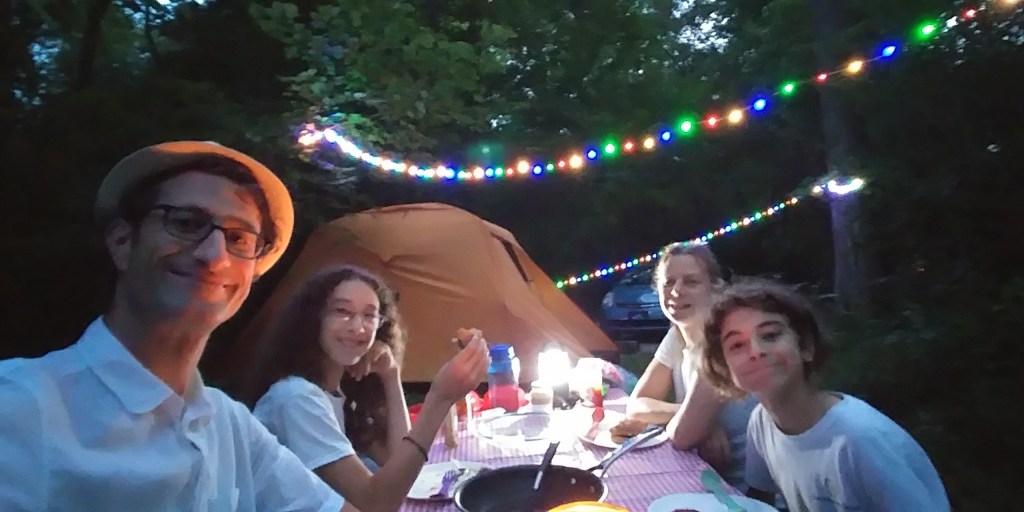
A recent family dinner, cooked over a campfire in Laurel Hill State Park

And I am continually asking myself, “When this is all over, will I be able to look back and say, did I use this time as best as I could? Could I have done better? Could we have done better?”

As you know, we have been learning some great midrashim / rabbinic stories between minhah and ma’ariv on Shabbat afternoon, in a series I have titled, “My Favorite Midrash.” One that we covered recently, certainly a favorite midrash of mine, is about one of the more curious characters of rabbinic literature, a fellow who is known as “Honi haMe’aggel,” Honi the Circle-Maker. He is so called because of his unique talent of drawing circles in which rain falls. Seemingly unrelated to this remarkable gift, the following midrash is also told (Babylonian Talmud, Tractate Ta’anit 23a):

יומא חד הוה אזל באורחא חזייה לההוא גברא דהוה נטע חרובא אמר ליה האי עד כמה שנין טעין אמר ליה עד שבעין שנין אמר ליה פשיטא לך דחיית שבעין שנין אמר ליה האי [גברא] עלמא בחרובא אשכחתיה כי היכי דשתלי לי אבהתי שתלי נמי לבראי

One day, Honi was walking along the road when he saw a certain man planting a carob tree. Honi said to him: This tree, after how many years will it bear fruit? The man said to him: It will not produce fruit until seventy years have passed. Honi said to the tree-planter: Is it obvious to you that you will live seventy years, that you expect to benefit from this tree? He replied to Honi: I myself found a world full of carob trees. Just as my ancestors planted for me, I too am planting for my descendants.

Carob

The midrash does not tell us about how many carob trees the man found, nor how many he planted. He was probably not too concerned about whether or not he had planted enough trees; the larger point is that he made an effort to ensure that there would be some for his grandchildren.

While my first inclination is to read this story as referring to our responsibility to take care of God’s Creation, such that we can bequeath it in good condition to those who come after us, I think it is also possible to read this as a metaphor not only for our physical environment, but for our spiritual milieu as well. 

The beginning of Parashat Re’eh is very concerned about the idea of the Land of Israel as the yerushah, the inheritance of the Israelites. Various forms of the Hebrew word “lareshet” / to inherit appear five times in the first two aliyot we read this morning. It is clear that the Torah wants us to see Israel as the reward; it is the gift for being party to the covenant, for fulfilling the mitzvot. It is what the Torah’s original audience needed to hear; that they would inherit this land as a sign of God’s love to them.

And so, as I am thinking about the emotional state of the world, the divisive nature of American politics right now, and the numbers of people we have lost unnecessarily to the pandemic, and the grief and pain that this loss as well as the economic devastation it has caused, I am left with the following question:

What do we want our children to inherit? What will their spiritual inheritance be?

Do we want them to inherit a polarized world, one in which people not only cannot see the other side of an argument, but openly denigrate those who hold opposing views? Do we want them to inherit a world in which coarse language is the norm, that prevarication goes unpunished, that advocacy for your team always wins out over thoughtful, considered positions? In which news is not fact, but merely spin? In which people on different sides of any particular issue cannot even speak to each other or break bread together, because they view the other as stupid or heartless?

I come back to the line at the end of today’s reading (Devarim / Deuteronomy 12:28):

שְׁמֹ֣ר וְשָׁמַעְתָּ֗ אֵ֚ת כָּל־הַדְּבָרִ֣ים הָאֵ֔לֶּה אֲשֶׁ֥ר אָנֹכִ֖י מְצַוֶּ֑ךָּ לְמַעַן֩ יִיטַ֨ב לְךָ֜ וּלְבָנֶ֤יךָ אַחֲרֶ֙יךָ֙ עַד־עוֹלָ֔ם כִּ֤י תַעֲשֶׂה֙ הַטּ֣וֹב וְהַיָּשָׁ֔ר בְּעֵינֵ֖י ה’ אֱ-לֹהֶֽיךָ׃

Be careful to heed all these commandments that I enjoin upon you; thus it will go well with you and with your descendants after you forever, for you will be doing what is good and right in the sight of the LORD your God.

How do we plant the carob trees for our grandchildren? How do I use this pandemic time to create a foundation for a better world, so that my children’s spiritual inheritance will be tov veyashar, good and right?

Hevreh, the framework of mitzvot that God has given us is the formula by which we can live better. It was given to us a long time ago, and if more of us were to follow it, the world we will leave to our children will be a much better one. Here is, if you will, a simplified formula for success:

  1. Keep Shabbat. Doing so encourages respect for yourself and those close to you. Keep your conversations and your activities local and low-key. Be with your nearby family and friends. Don’t spend money; avoid technology. Connect with the here and now, and leave behind the elsewhere and the later.
  1. Keep kashrut (the Jewish dietary laws). It encourages respect for God’s Creation. The lines in what we can or cannot consume are there to remind us that there are limits to what is Divinely-acceptable behavior. Maintain the holiness in the natural world.
  1. Pray daily. Connect with yourself; hold your mind and your heart in self-judgment, and leave room for doubt. You may not be right about every single thing.  Introspection leads to intentionality, which leads to patience, planning, and presence of mind in all the spheres of life.
  1. Observe Jewish holidays, and make sure you know why. Yom Kippur teaches us humility. Pesah teaches freedom for all. Hanukkah teaches enlightenment. Sukkot teaches simplicity. Simhat Torah celebrates learning. Purim celebrates standing up for what is right.
  1. Learn Torah. The wisdom of the ancient Jewish bookshelf teaches us how to be human beings, not cogs in a machine. It sensitizes us to the needs of others, and forces us to consider how our behavior impacts this world.

It is a simple formula. But of course you are thinking, “Rabbi, I’ve been Jewish all my life and while I may do some of those things, it’s just too much for me to take on something that I’m just not used to doing.”

Let me tell you why you need to reach higher: because the world depends on your mitzvot. Because our heritage – the world our children inherit – depends on your willingness to think and behave for the benefit of the common good. And that is what every single one of those things is about.

What kind of world do you want our children to inherit? One in which everybody is looking out for themselves, seeking personal gratification at any cost? Or one in which we cooperate to solve the big problems, in which we acknowledge the humanity in each other and the Divinity of Creation, in which we seek the holiness that is waiting for us under the surface of every relationship?

The choice is yours. Reach higher. Think of those carob trees, bearing fruit 70 years hence.

And I know this is hard, but try not to worry too much about whether you have done enough. If you take on this formula of five things, I am certain that you will be able to look back and say, “Yes. That was good and right.”

~

Rabbi Seth Adelson

(Originally delivered at Congregation Beth Shalom, Pittsburgh, PA, Shabbat morning, 8/15/2020.)

Categories
Sermons

Shall There Be No Needy? – Re’eh 5779

These are good times in which to be living if you are a vegetarian. You may know that I have been a “Jewish vegetarian” since 1988 – that is, I eat anything that does not qualify as “meat” for kashrut purposes. So while many traditional vegetarians do not eat fish, I do. Kosher fish, of course.)

These are good times because of the explosion of interest in plant-based foods, and the growing availability of meat-like products, like the Impossible Burger and the Beyond Burger. And I heard earlier this week that KFC just began test-marketing a plant-based chicken-like product in one of its restaurants in Atlanta. Apparently, it tastes like chicken.

I must say that the Torah was extraordinarily prescient in its time for setting limits on food. The laws that appear in Parashat Re’eh (pp. 1072-74 in the Etz Hayim humash) draw fairly clear lines: for land animals, only ruminants (which are, by definition, all herbivores) with a split hoof. For sea creatures, only those with fins and scales. No birds of prey. (Yes, I know there are a few critters that fall into grey areas, but such are the glorious complexities of God’s Creation.) 

And there are good reasons for us to limit our consumption. It is a reminder that not all things are nor should they be available to humans to eat or otherwise cultivate. Although God has given us the power and the know-how to manipulate our environment for our benefit, that should not be a boundless endeavor. There are just some things we should keep our hands off of.

But there is another way of reading Parashat Re’eh that I had not previously put together. Just after Deuteronomy chapter 14, in which those lines of consumption are drawn, in the following chapter we encounter what may be one of the most striking statements in the Torah (Deut. 15:4, 1077):

אֶפֶס, כִּי לֹא יִהְיֶה-בְּךָ אֶבְיוֹן:  כִּי-בָרֵךְ יְבָרֶכְךָ, ה’, בָּאָרֶץ, אֲשֶׁר ה’ אֱ-לֹהֶיךָ נֹתֵן-לְךָ נַחֲלָה לְרִשְׁתָּהּ.

There shall be no needy among you – since the Lord your God will bless you in the land that the Lord your God is giving you as a hereditary portion…

And here is the striking part (15:7-8):

כִּי-יִהְיֶה בְךָ אֶבְיוֹן … 

If, however, there is a needy person among you…

Now, hold on there a minute. Did the text not just say that there will be no needy among you? How can that be? 

OK, so regardless, if there is a needy person among you: (1078)

לֹא תְאַמֵּץ אֶת-לְבָבְךָ, וְלֹא תִקְפֹּץ אֶת-יָדְךָ, מֵאָחִיךָ, הָאֶבְיוֹן.  ח כִּי-פָתֹחַ תִּפְתַּח אֶת-יָדְךָ, לוֹ; וְהַעֲבֵט, תַּעֲבִיטֶנּוּ, דֵּי מַחְסֹרוֹ, אֲשֶׁר יֶחְסַר לוֹ.

… do not harden your heart and shut your hand against your needy kinsman. Rather, you must open your hand and lend him sufficient for whatever he needs.

The logical conclusion that we can draw is that the world free of needy people will never exist. It is a blueprint for a world that could be, an ideal to which we should aspire.

And of course, that begs the question: how are we working to build that world?

There is a classic rabbinic textual-interpretation principle known as “semikhut parashiyyot,” literally, the juxtaposition of passages. The idea is that adjacent stories or concepts in the Torah are near each other for a reason; they must therefore comment on each other. 

One traditional example of this principle is that many items of the list of 39 avot melakhah / Shabbat prohibitions – things like hammering, weaving and building – are drawn from semikhut parashiyyot. In Parashat Vayaqhel, the Torah’s description of the building of the mishkan / tabernacle follows a restatement of the requirement to rest on the seventh day. The rabbis conclude that the activities related to creating the mishkan were therefore forbidden on Shabbat. 

So, using this principle of semikhut parashiyyot, we must ask,

”What do dietary restrictions have to do with the ongoing existence of poverty?”

And the answer emerges on two different levels. 

On an individual level, we might derive from this the fundamental requirement to be mindful of our food will ensure that we are also mindful of the nutritional needs of others. That is, drawing lines in what we eat should remind us of the imperative to make sure that all people around us have food, particularly those most likely to be food-insecure – i.e. evyonim – poor people. 

We should therefore take seriously the mitzvah of opening our hands to evyonim, as the Torah instructs, by supplying them with food. There are many means of doing so; one, the Squirrel Hill Food Pantry, is nearby and run by Jewish Family and Community Services. (As in past years, we will have donation bags available prior to the High Holidays.) 

But on a greater scale, I think we have to consider our manipulation of the natural world on a grand scale to provide food, and perhaps we might consider how our food choices affect our environment, which in turn will lead to greater numbers of food-insecure people around the world. Now, I don’t have time to address all the issues therein, but consider the following:

  1. Lots of people to feed (7.6 billion!), diminishing agricultural lands.
  2. Climate change is disrupting agriculture in various ways.

Vegetables.  We all need to be eating more vegetables. And the vegetables need to be of greater quality. And the only way we can really do that is to make sure that we are eating vegetables in the proper season. How many of us have traveled to foreign countries and discovered that the vegetables that they eat are tastier and cheaper? Our vegetables come from far away, and the entire system is geared toward longer shelf-life and year-round availability, not local and tasty.

We just love packaged, processed foods! But you know what? They are generally not good for you, nor good for the Earth. The more highly-processed foods are, the more energy they take to produce, and the more energy, the greater the contribution of greenhouse gases.

Waste. Americans throw away nearly 40% of the food we produce. That is staggering, considering all the energy we put into producing that food – $160 billion, and it is equivalent to putting 3.3 billion tons of carbon into the atmosphere unnecessarily. Our Torah teaches us not to waste: the mitzvah of bal tashhit (Deut. 20:19-20) is understood by Maimonides to apply to wasting anything of value. 

Meat. Meat production, and in particular beef, is a major source of climate-change-causing gases, particularly methane. Also, water: it takes 106 gallons of water to produce one ounce of beef; soy requires only 22 gallons; chicken only 17 gallons. Greater water consumption also requires more energy to make that water useable, which brings us back to greenhouse gases.

If we all ate a few more locally-grown vegetables and just a little less meat, we would be well on our way to making our food consumption more sustainable. 

If we could, at the same time, figure out how to waste less – I know, it’s not so easy – that would certainly help.

I’m not trying to convert you to vegetarianism. For some, Shabbat is not Shabbat, or a simhah is not a simhah without meat.

But I am suggesting that you might want to consider eating less meat.  Be mindful.  Be deliberate in your food consumption as our tradition demands us to.  

Rabbi Jeremy and I were at the miqveh yesterday morning as we brought a candidate for conversion to complete her journey to becoming Jewish. Before immersing herself, she recited a kind of pledge that is found in the Rabbi’s Manual for Kabbalat Ol Mitzvot, which literally means, “taking upon oneself the yoke of mitzvot / commandments.” Among these statements of commitment to the holy opportunities of Jewish life, she pledged that one of the ways that she will be committed to Jewish life is:

“By incorporating kashrut into my life and by sharing my bread with others who are hungry.”

These two things clearly belong together, and not only because they are both found in Parashat Re’eh; they also belong together because our local awareness and our global conscience regarding not only the boundaries, but also the essential needs surrounding food should be intimately linked.

What cannot be forgotten in this picture is the essential requirement  (p. 1077) that will make it possible for there to be no needy among you – that we keep the Torah, the mitzvot that God has given us. If we do this by fulfilling not just the letter of the principles of kashrut, but also the global spirit therein, maybe, just maybe, we will achieve that theoretical world of no needy people.

~

Rabbi Seth Adelson

(Originally delivered at Congregation Beth Shalom, Pittsburgh, PA, Shabbat morning, 8/31/2019.)

Categories
Sermons

Drawing Lines in the Data – Earth Day / Shemini 5777

Last Monday, the 7th day of Pesah, Beth Shalom member Chris Hall spoke during morning services about the relationship between science and religion, and one element that he presented is that they answer different questions. In my mind, there is no conflict between science and religion because while science might tell us how the world works, it does not attempt to answer, “Why?” That is for the theologians.

We might be tempted to dismiss the Torah’s story of Creation because it conflicts with the story that current scientific opinion tells us. But I think it is essential for us to consider what we learn from both. While astrophysicists have determined that the universe is about 14 billion years old, and that the after-effects of the Big Bang can still be measured to this day, we learn nothing from this about our responsibility for the world we have received. That we can learn from the book of Bereshit / Genesis. What is our relationship to the Earth, says Bereshit? Le’ovdah ulshomerah. “To till it and to tend it.” (Gen. 2:15)

Now granted, we haven’t read that parashah since October, so I am not going to dwell on it today. But something that does appear in Parashat Shemini is a list of things we are permitted to eat and not eat. And there is a lesson to be drawn from that as well.

But first, a little science.

Today, you may know, is not only Kylie’s bat mitzvah. It is also Earth Day, the annual, global awareness-raising event that brings people together around the world to remember the obligations of Genesis. To that end, I would just like to share a few items with you:

  1. 2016 was the hottest year on record, the third straight year in a row of record-setting temperatures since record-keeping began in the 1880s. https://www.nytimes.com/2017/01/18/science/earth-highest-temperature-record.html
  2. This past February, the average global temperature was 1.76 degrees Fahrenheit above the average for the 20th century. That may not sound like a lot, but in climatology terms, it’s huge. https://www.usatoday.com/story/weather/2017/03/17/globe-second-warmest-winter-on-record/99303812/
  3. The great plume of plastics that continues to grow in the Pacific Ocean is now flowing northward into the Arctic Ocean. https://www.nytimes.com/2017/04/19/climate/arctic-plastics-pollution.html?hp&action=click&pgtype=Homepage&clickSource=story-heading&module=photo-spot-region&region=top-news&WT.nav=top-news

I could cite numerous other such bits of data: how much oil we consume each day, how much food we throw away, how much carbon dioxide enters the atmosphere per hamburger eaten, and so forth. But what does it mean to us? How might we regard that information and take action? What might our Jewish tradition teach us about our responsibilities vis-a-vis Creation?

On this Earth Day, let us turn to kashrut, the principles of holy eating, for answers.

What does the word “kasher” (accent on the second syllable) mean? Fitting, appropriate. (“Kosher” is the Yiddish/Ashkenazi pronunciation.) The word does not appear in the Torah at all, but in rabbinic literature is used to denote anything that may be used for a holy purpose, not just food. What makes something kasher? That it is legally permissible under Jewish law to eat it or use it for ritual purposes.

In Parashat Shemini, we read a list of animals that are appropriate to eat. Some are identified by certain categories – the split-hoofed ruminants, like cows and deer and sheep – and some are named specifically, mostly the birds. The Torah does not tell us why these are allowed and not camels or shrimp or alligators. All we know, at least from the parashah, is that God does not want us to eat those other things, which are called “tamei” (impure) or “sheqetz(literally, an abomination; this is the Hebrew origin of the Yiddish slur sheygetz / shiktza, and why one should never use these terms).

It is curious that the Torah provides no rationale. Did the authors want us not to ask why? Was the answer known to the ancients, and so obvious that it did not need to be stated? Perhaps this “why” is left dangling for us to discover ledor vador, in each generation according to what is relevant in its time.

Or maybe it is that the only reasoning we might be able to glean from this passage is that, well, some things are in and some things are out. That when God gave Creation to us, to till and to tend, that there were simply some natural limits to our behavior. That not all things are available to us. That while we are permitted to take advantage of some things, others are off limits. That we must leave some parts of Creation untilled and untended.

Perhaps, as Midrash Tanhuma (Parashat Shemini, #7) suggests, the goal of kashrut is to teach us mindful consumption:

“The mitzvot [of kashrut] were given solely in order to train people. For what does it matter to the Qadosh Barukh Hu / God about the ‘purity’ or ‘impurity’ of the animals we eat?”

Perhaps we might learn from this that the drawing of boundaries in the natural world should lead to our ethical behavior in other spheres: in our relationships with others, in our relationships with ourselves, in our relationships with the animal realm. Perhaps the drawing of lines in what we consume as individuals will lead us to draw lines in how we as a society consume our resources, to determine where our limits are as we continue to advance as a civilization.

Where are our lines?

How will we know when we have crossed them? When the Arctic ice is gone? When the giant, swirling heap of plastic currently in the Pacific Ocean has filled the Chesapeake Bay? When the bumblebees are gone?

I recall a curious incident in a rabbinical school theology class. Most of my classmates were not science people; they had degrees in literature, or history, or Judaic studies. I know you may find this hard to believe, but I was somewhat unusual in that I had two degrees in chemical engineering. I do not recall the apropos, but the subject of science vs. God came up, and I said that our understanding of God changes, but science does not. Several of my classmates jumped on this, saying, “But science does change.”

Actually, no. As with God, our understanding of science changes. As we move forward, we learn more about the world that we have been given, and so we adjust our understanding, our theories and formulas, to reflect the data that we collect. But science and God do not change. Their nature and secrets are revealed to us as human civilization matures. Just as God continues to be revealed to us, so does science.

The principles of physics and chemistry and thermodynamics and math that govern how our world works are immutable. And they will neither teach us about faith nor answer the hard questions that we face every day.

But our tradition teaches us to act. And act we must. We must till, we must tend, and we must draw lines. We do not have free reign to use and abuse Creation.  With God-given power comes God-given responsibility.

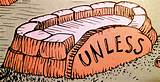
My personal rabbi on the subject of our responsibility to Creation is the author Theodore Seuss Geisel, best known as Dr. Seuss. In what I consider to be his finest work, The Lorax, Dr. Seuss reminded us of our responsibility vis-a-vis the Earth. The Lorax, after failing to prevent the destruction of a piece of unspoiled land, a beautiful, holy gift of plants and animals and scenery, takes his leave from an altar labeled “Unless.”

unless

We can make personal, individual choices to reduce our own energy footprint. We can use LED light bulbs and compost our kitchen scraps and recycle our plastic and even buy electric cars. We can draw many personal lines in our own behavior.

But unless we as a society make some collective decisions for change on a grand scale, nothing will change. Unless we draw some lines, we will continue to monitor and watch and take data that give us no answers.

The time to act is now.


~

Rabbi Seth Adelson

(Originally delivered at Congregation Beth Shalom, Shabbat morning, 4/22/17.)