Categories
Sermons

Horeb and Sinai: Pennsylvania’s Clergy Abuse Report – Shofetim 5778

I was actually not planning on giving a formal sermon this week, given that I should be dedicating my time to preparing for Rosh Hashanah and Yom Kippur. And then the report released by the Pennsylvania grand jury investigation into more than 1,000 victims of abuse by Catholic priests over the last 70 years hit the news. And I realized that I cannot let this go by without comment.

And here is why: we who care about religion, and the image that religious people have, are all affected by this. Yes, it might be easy to say, “That’s not us; that is the Catholics.” But that would be an exercise in rationalization. While I think it would be difficult to make the case that the horrific, even systematic kinds of abuse described in this report exist to this extent in the Jewish world, there have certainly been a few cases among the Jews, and even here in Pittsburgh as well, and recently.

I do not think that there is anything that anybody can say or do that can help those who have been hurt in this way by religious leaders. There is nothing that will remove the fear and suspicion, pain and mistrust caused by the abusers. It is a “hillul haShem,” a profanation of God’s name of the highest possible order. And I am simply devastated that those victims may never again be able to put their trust in God, or even in people.

This is not good for the Jews. It’s not good for Judaism, because we, the faithful, have to continue to reach out to those who have been turned off by the appalling behavior of few outwardly pious people. As you know, it is not only my job, but yours as well, to make the case for the value of our tradition, of our prayer and learning and community. However, the echoes of those sins described in the report, and the failure of these dioceses to respond properly, will continue to ring in the ears of those who are looking for an exit not only from the church, but from all forms of religious life, including ours.

Perhaps the only upshot that will come from this is that the report has made it clear that, even though the Church claims that it handles abuse allegations very differently from in the past, the most important thing to do if you ever hear anything that suggests that a case of abuse has taken place is to go immediately to local law enforcement.

You might say that this principle is enshrined in the opening of today’s parashah, Shofetim, which mandates the creation of “shofetim veshoterim,” judges, courts, and law enforcement officers, and gives the imperative, “Tzedeq, tzedeq tirdof.” Justice; you shall pursue justice. It is our responsibility as Jews to ensure that we live in a just society, and that we have the people in place to enforce justice.

***

A childhood acquaintance of mine, Andrew Nicastro, was abused by his Catholic priest in my hometown of Williamstown, Massachusetts, when we were in junior high school. Most of you know that I grew up in an idyllic New England setting, a small college town where life was generally quiet; scandals happened elsewhere.
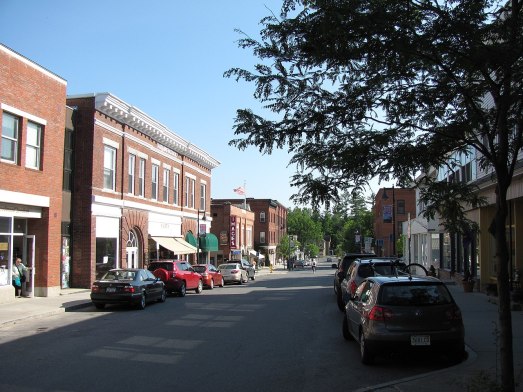
Williamstown

My perspective as an adult makes everything back in my childhood home seem somehow smaller, less powerful when seen through adult eyes.  The soccer field upon which we rejoiced in victory and choked up over loss; the schoolyard where 6th-grade drama played out in its full, nasty glory, the single-screen movie theater where my friends and I saw the best and worst movies of the 1980s are today less valent, less polarized with emotional residue.

My current realities of fatherhood, of meetings and mortgages and the endless logistics of scheduling the modern family have changed the equations of memory and my youth. We grow, we change, we mature.

But more than this, we learn to take responsibility for our choices.  We learn independence, and we learn how to lead.

A few weeks back, in Parashat Va-ethannan, we read the re-iteration of the covenant at Mt. Sinai, the so-called Ten Commandments or Aseret Ha-Dibberot.  It is worth noting that in Shemot, the place where they receive it is called Sinai, and in Devarim it is called Horev / Horeb.

Moshe

Why the change?  What’s the difference?

The names are different precisely because the context is different.  Not Shemot vs. Devarim, per se, but rather that in the first recounting of Moshe’s sojourn on the mountain, the Israelites have just left Egypt; they are, for the first time, masters of their own destiny, but not yet mature. We all know that the generation of freed slaves, as if they were children, whined their way across the desert.  “Moshe, are we there yet?” “Moshe, we’re thirsty.” “Moshe, we miss the meat and the leeks of Egypt.”

But the second telling, the one we read today, occurs nearly forty years later.  The tribes are now led by the children and grandchildren of those former slaves, and they have a new perspective.  As such, they are ready to accept the mitzvot, to accept the obligations of the covenant with God.  They are now a mature people, about to enter their own land. They have grown.

Horeb and Sinai are not really two names for the same place; they are distinct names for different states of mind.  Sinai is a place of immaturity; Horeb is a place of readiness, of willingness to step forward into a new life, of leading rather than following. Of responsibility.

At Sinai, Moses is at the height of his leadership, but that is as much about the Israelites as it is about him.  At Horeb, Moses is preparing to relinquish leadership, to hand over the reins to Joshua, the only clear leader who emerged from the prior generation.  This leadership piece is an essential part of the Horeb equation. As the Israelites have matured between Sinai and Horeb, they have also gained the ability to accept and participate in leadership.

Now back to Massachusetts. My abused friend, Andrew Nicastro was awarded a settlement of $500,000 in 2012 for his civil lawsuit against two retired bishops of the local diocese of the Catholic church. Between 1982 and 1984, when we were in junior high school, Mr. Nicastro was regularly molested by a local priest, Father Alfred Graves. The lawsuit charged that the bishops knew that Father Graves had committed similar sins elsewhere within the diocese in 1976, and had covered it up.

I knew Andrew from the age of eight or so because we played on the same soccer team; his father was also a member of the faculty with my father at nearby North Adams State College; I was unaware of the abuse until 5 years ago. However, the details of this case suggest that this horrible crime against him could easily have been prevented.

I am clearly not in a position to judge the Catholic Church and its issues; let’s leave that to God. But it is clear that what happened to my friend resulted from a disastrous failure of leadership.  Rather than do the right thing in 1976, when charges against Father Graves were first raised, the bishops covered up the problem and moved him to a different parish, as was done with Catholic priests in Pittsburgh and all over the world when such charges came up.

The diocesan elders were not at Horeb; they were at Sinai.  They responded to the problem not by defrocking Father Graves (as eventually happened, but not soon enough), but rather by seeking a quick fix.  This is not leadership. We can only hope that after all of the similar cases that have come to light in recent years, that they have in fact made the move to Horeb, have learned to make the responsible choice, and have atoned for their past failures.

I was shocked when I first heard this news a few years ago. But this was not a faceless victim; this was somebody I knew personally. And I remembered Andrew again this week. And I remember that although I never went to St. Patrick’s Church in Williamstown, Massachusetts, on some level, that could have been me.

This tale serves as a reminder that no matter where we are, we are never exempt from the responsibilities of doing the right thing.  We can never be at Sinai; we must always be at Horeb. We must always step back from the situation, from the anxiety and the emotion and sometimes even the inclination to forgive those whom we know personally for their wrongs.  Moshe will not be there to accompany us into the Promised Land; that we must do ourselves. Let us hope that the Catholic Church has taken that step, so that not only will my friend Andrew find some peace, but that there will be no more like him.

The grand jury report demonstrates that the shofetim veshoterim / judges and law enforcement officers are the right people to handle cases of abuse at the hands of clergy. As for the task of restoring faith in religion, well, I leave that up to all of us to continue to teach the values of the Torah, among them the values of leadership, of responsibility, of making the right choices in our interactions with everybody.


~

Rabbi Seth Adelson

(Originally delivered at Congregation Beth Shalom, Shabbat morning, 8/18/2018.)

Categories
Sermons

The World is Burning – Re’eh 5778

I mentioned last week that I was out west two weeks ago. My son and I, along with my brother and my nephew, took an epic road trip that began in Phoenix. We spent Shabbat in Grand Canyon National Park, then moved on to Arches NP, Dinosaur NP (which has a Pittsburgh connection, by the way: it was initially excavated by Earl Douglass of the Carnegie Museum beginning in 1909; several of the dinosaur skeletons unearthed there are located in PGH at the museum); Devil’s Tower NP; and ending at Mt. Rushmore, with a few other destinations along the way. It was a long drive and a lot of fabulous locations to squeeze into a week, but it was my first trip out west (excluding California), and the scenery was almost overwhelmingly beautiful. The mountains, the rivers, the cliffs, the arches, the prairies, the unusual rock formations, the spacious skies, the amber waves of grain, etc.

Devil's Tower

It’s almost impossible to believe or understand how you can drive 90 miles between two intersections and not see a single home or store or even gas station, and barely any other cars on the road. There is a lot of space out there. And, given that we spent most of the time without wifi or mobile phone service, it was easy to forget about the world, to not be reminded of the Russia investigation, or the burning kites released into Israel from Gaza, or the anniversary of Charlottesville.

Except that there was one thing that we could not get away from, something lurking in the background pretty much wherever we went. Lurking in the background is this:

The world is on fire.

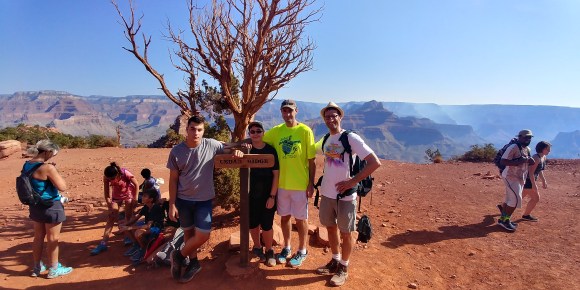
On the South Rim of the Grand Canyon, you can clearly see on the North Rim three wildfires. (Smoke by day, actual fire by night.) At several points along the trip, in Arizona, in Utah, and in Colorado, we saw signs and smelled the smoke of wildfires.

Smoke in Grand Canyon
The Adelson boys in the Grand Canyon. Smoke from wildfires can be seen over my left shoulder.

You may be aware that the currently-burning Mendocino Complex Fire is the largest ever recorded in California, having destroyed over 300,000 acres; another current fire, the Carr Fire, has killed 8 people and destroyed over 1,000 homes.

And it’s not just the American West. There are currently 1200 firefighters and 19 aircraft battling wildfires in southern Portugal. Wildfires in Sweden (!) destroyed 61,000 acres of forests in July. A wildfire in Greece killed 90 people in the last couple of weeks. There is an epic heat wave in Europe, such that the cattle who graze in the Swiss Alps are parched – helicopters are airlifting water to them. Sweden’s highest peak, the Kebnekaise glacier, actually dropped into second place because the heat melted the glacier, and it is now 13 feet shorter. There is a severe drought in Australia as well.

Ladies and gentlemen, the world is burning up.

Now, of course we cannot attribute any particular weather event to climate change; please remember that climate is not equal to weather. But when we consider that 7 of the 12 most destructive fires in California’s history have occurred in the last three years; when we consider that we are now losing polar ice at a rapid rate; when some climate scientists are concerned that we have already passed a global “tipping point,” beyond which we may never return to where we were, we have to ask ourselves, where are we headed? If we extrapolate this line, what will our future be?

And, as Jews, we must ask ourselves, what can we do right now to change the outcome?

Up front in Parashat Re’eh, right at the very beginning, is one of the clearest statements of the Torah’s understanding of theology (Devarim / Deuteronomy 11:26):

רְאֵה, אָנֹכִי נֹתֵן לִפְנֵיכֶם הַיּוֹם בְּרָכָה וּקְלָלָה

Re’eh anokhi noten lifneikhem hayom berakhah ukelalah.

See, this day I set before you blessing and curse.

Look, says God, I have put before you today blessing and curse. If you follow My mitzvot, you’ll get the blessings. If you don’t, you’ll get the curses.

It’s very simple. Black and white. You do X, you get Y. If you don’t do X, you don’t get Y. That is also the theology described in the second paragraph of the Shema, and in many other places in the Torah.

However, that is not actually the theology that we hold by, we who live in 21st-century America. We know that God is more complicated than that. And that’s not a contemporary re-reading; even the rabbis of the Talmud (Bavli Berakhot 7a) observe that God does not seem to work like this. And I am grateful for all of the modern Jewish philosophers (Buber, Heschel, Kaplan, Gillman, etc.) who have enabled us to understand God differently.

But there is also something powerful here, embedded in this binary theological formula that cannot be ignored: that we still have to strive for blessings, and we have within our hands, at least in some cases, the potential to earn those blessings. We also have the potential to create curses. In endowing us with free will, God puts before us the power to create our own blessings and curses.

None of the classical commentators picks up on this, but note the presence of the word “hayom” (“today”) in that verse. Look, says God, I have put before you TODAY a blessing and a curse.

It is up to us today to make the choice. And every day we make these choices. Today is not just today; it is yesterday and tomorrow. In every moment, we can fashion the future.

So how do we maintain the blessing? How do we choose the good? How do we honor God’s Creation and make sure that it is there for generations to come? How do we ensure that we do not turn Scandinavia into a desert and drown Bangladesh?

It is that we make the choice today. And not just us, in this room, but all of us. The entire world.

Here is why the challenge of climate change is so hard for us to solve: we all have to cooperate to make it happen.

The reason that we are all here, ladies and gentlemen, gathered together in this building, in a city in North America, is because of the most salient ability of Homo sapiens: the ability to share ideas. Were it not for this remarkable talent, humans would never have passed the stage of nomadic hunter-gatherers. It was this intellectual revolution that enabled agriculture, trade, money, religion, nation-states, human rights, universities, the space program, etc., etc.

And you know what? As individuals, we can all spend all of our energies trying to minimize our carbon footprints, offsetting our transportation by planting trees, and so forth. We can stop eating meat. We can reduce, reuse, recycle all day long. But this will accomplish virtually nothing with respect to climate change – not compared to the 100 million barrels per day of crude oil that the world consumes.

The polar ice caps will continue to melt until every single government in the world commits to some serious legislation that will lessen the amount of greenhouse gases that we are pouring into the atmosphere. That was exactly the point of the Paris Climate Accords, through which the 196 signatories pledged to ensure that total global warming is limited to 2 degrees Celsius. (We are already halfway there.) It’s not enough of a limit according to scientists, but it is something.

Now, I know that there are always those among us for whom government is perceived to be the problem, rather than the solution. To you I offer a challenge: How can the private sector alone solve this problem? Is this something that the free market can solve? If so, I would like to hear those ideas.

Failing some other solution, I think that the only thing we can do is to implore our elected officials to push for legislation. The United States produces 15% of the world’s greenhouse gases; China produces 25%. Changing that will be hard.

But as California burns, I think we have to ask ourselves, can we afford not to do so?

Yesterday morning, I heard an interview with Pastor Ira Acree, who leads a Christian congregation on the west side of Chicago. He was speaking with an NPR reporter about violence in Chicago. The reporter noted that last weekend was especially bloody: 70 people were wounded in gun violence, 11 died. Toward the end of the interview, he quoted Proverbs 29:18:

בְּאֵין חָזוֹן, יִפָּרַע עָם

Where there is no vision, the people perish (KJV)

About half of the population of the world lives within 120 miles of a coast. Without a vision for reining in our production of greenhouse gases, many, many people will die, and for the rest, life will be unimaginably transfigured.

Re’eh anokhi noten lifneikhem hayom.

I put this before you today. Now is the time to act for blessings. Now is the time for vision.

Shabbat shalom.


~

Rabbi Seth Adelson

(Originally delivered at Congregation Beth Shalom, Shabbat morning, 8/11/2018.)


Categories
Sermons

A Tish’ah Be’Av Message on Recent Ominous Events in Israel – Devarim 5778

It was one of those weeks that a rabbi dreads: I had a good chunk of this sermon already written when I was walloped on Thursday by two big pieces of news out of Israel. Those of you who were here last Shabbat know that I spoke about my visit to the Yitzhak Rabin Center in Tel Aviv two weeks ago. I was planning to follow up on that discussion, but the news kind of hijacked the sermon, so I had to retool extensively at the last minute.

Here is what happened on Thursday (7/19/2018):

  1. The Knesset passed a very controversial bill into law. Known as the Nation-State Law, the law states that Israel is the “national home of the Jewish people.” Now this is not really a revolutionary idea, and to some extent many Jews in Israel and around the world already think of it as exactly that. But there are a couple of problematic features, some of which were toned down in the final version of the bill. The law downgrades Arabic from being an official language to having a “special status.” Israel is a multi-cultural democracy, and the challenge that democracy faces when one ethnic or religious group is favored over another is in play here. Can Israel in fact continue to be a democracy if 15% of its citizens are further alienated?Another problematic feature of the law is the following passage:“The state shall act within the Diaspora to strengthen the affinity between the state and members of the Jewish people.” The Jewish Federations of North America (JFNA) has characterized this clause as “patronizing to Jews outside of Israel, ignoring the fact that Israel-Diaspora relations are a two-way street.” The JFNA believes that this language was promoted by religious parties to “limit the impact of Diaspora Jewry on religious pluralism in Israel… [It] was meant to avoid claims that Israel needs to further religious pluralism in Israel as part of an effort to advance its connection with Diaspora Jews.”
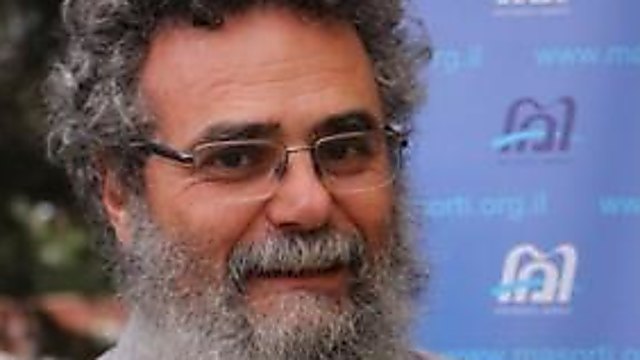
  2. Rabbi Dubi Haiyun, the rabbi of Congregation Moriah in Haifa, a Masorti (Conservative) congregation, was arrested by local police at 5:30 AM at his home, at the behest of the local Rabbinate, ostensibly for performing marriages not sanctioned by the State. Rabbi Haiyun was questioned extensively and released, but it appears that the Israeli Rabbinate, which controls matters of personal status in Israel, wanted to “rough him up.” Many rabbis, Orthodox and non-Orthodox, perform weddings outside the bounds of the official Israeli Rabbinate for various reasons; these weddings are not recognized by the State, and neither are civil unions. This is one more sad chapter in the ongoing struggle with the Israeli Rabbinate’s hegemony over Judaism in Israel, something which has contributed to the growing rift with the largely-non-Orthodox North American Jewish population.
rabbi dubi haiyun
Rabbi Dubi Haiyun

Now, I must say that I am not inclined to air Israel’s dirty laundry in public. But I am certainly inclined to put this in the greater context of what it means to be Jewish today, and in particular what it means to be Jewish in the Diaspora.

Why are the Jews still here? Why are we here today, in Pittsburgh of all places, very far from where we started? Why are we celebrating a new baby girl today, and a young couple about to be married? Why are we singing ancient words in a foreign language that none of us speak?

I have a theory about this: it’s because of argument. Two Jews, three opinions. It’s all over every page of the Talmud. It’s an ancient and modern tradition. We don’t agree with each other on anything.

Actually, let me refine that: it’s because of respectful disagreement- agreeing to disagree, and yet still to hang together as a tribe.

Today we commemorate the destruction of the Second Temple (among other things) as we observe the fast day of Tish’ah Be’Av. Since the Romans destroyed the Temple in 70 CE, Judaism thrived in Diaspora precisely because there was no one central authority. Yes, there came to be voices on the Jewish bookshelf who speak very loudly: Moshe Rabbeinu, of course, but also Rabbi Akiva, and Rambam and Ramban and Rashi, and many others. Some of those guys disagreed with each other quite vehemently. (Do you know why your mezuzot are at an angle? As a compromise between Rashi, who believed that they should be upright, and his grandson Rabbeinu Tam, who argued that they should be horizontal.)

But we have no pope. We have no supreme authority whose word is Divine. We are all just trying to understand God and what God wants of us, and nobody has a lock on the truth. We are all Jews, attempting to find our way through life, making a living, raising families, and trying to frame essential moments in holiness.

I was mulling over unity and disunity in Israel when I was struck by a line from the beginning of Devarim / Deuteronomy, which we read from today (Deut. 1:5):

בְּעֵבֶר הַיַּרְדֵּן, בְּאֶרֶץ מוֹאָב, הוֹאִיל מֹשֶׁה בֵּאֵר אֶת-הַתּוֹרָה הַזֹּאת לֵאמֹר

On the other side of the Jordan, in the land of Moab, Moses undertook to expound this teaching (Torah).

Ramban (13th century Spain, then moved to Israel; was a proto-Zionist, believing that making aliyah / moving to Israel is a mitzvah / commandment) says the following about “Moses undertook to expound this Torah”: This implies that he was also repeating the commandments already given and adding certain details.

The implication of Ramban’s comment is that Moshe is already disagreeing with himself, already modifying his first take. We are a people who have been arguing with ourselves from, if you will, the very beginning.

And yet, what has managed to keep us Jewish is that very disagreement. Why are we still here? Because it is the argument which has kept us in dialogue with ourselves; we have continued to revisit our texts and traditions over and over, to interpret and reinterpret, and derive value from them that continues in every generation to teach us to lead better, holier, more fulfilling lives.

So what does that mean for Israel? As long as the disagreement is civil, as long as we can live with each other and continue to talk with each other and celebrate and grieve together, then Judaism will continue for at least another 2,000 years. As long as we can respect each others’ opinions and customs, and acknowledge that we can all daven (pray)at the Kotel / Western Wall or anywhere in Israel according to our own customs, and not be assaulted by police or people throwing chairs or whatever, then we will continue to thrive as a people.

If, however, the Orthodox authorities continue to work against the interests of the non-Orthodox world, if the democratic character of the State of Israel continues to suffer, the future does not look so bright. The Talmud tells us that the very reason we fast tonight and tomorrow for Tish’ah Be’Av, the reason the Second Temple was destroyed, is because of sin’at hinnam, because the Jews’ behavior was rife with baseless hatred.

I prefer a vision of tolerance, of democracy, of peace and mutual respect and understanding.

Israel’s largest base of support in the Diaspora is non-Orthodox Jews. It is us, ladies and gentlemen.

Last week, to drive the point home about Rabin’s life, and his personal understanding of the costs of both war and peace, I shared with you what was widely known to be his favorite song: HaRe’ut, the Fellowship. Today I am going to share with you another song which captures, to me and particularly to many Israelis, the challenges of every Jewish person’s relationship with Israel. Titled “Ein li eretz aheret” / “I have no other country,” it was originally recorded by Gali Atari in 1982 (lyrics by Ehud Manor, melody by Corinne Allal, who also performed it).

אין לי ארץ אחרת
גם אם אדמתי בוערת
רק מילה בעברית חודרת
אל עורקיי, אל נשמתי
בגוף כואב, בלב רעב
כאן הוא ביתי

לא אשתוק, כי ארצי
שינתה את פניה
לא אוותר לה,
אזכיר לה,
ואשיר כאן באוזניה
עד שתפקח את עיניה

Ein li eretz aheret
Gam im admati bo’eret
Rak mila be’ivrit
hoderet el orkai el nishmati
Beguf ko’ev, belev ra’ev
Kan hu beiti 

Lo eshtok
ki artzi shinta et paneha
Lo avater lehazkir la
Ve’ashir kan be’ozneha
Ad shetifkah et eineha

I have no other country
even if my land is aflame
Just a word in Hebrew
pierces my veins and my soul
With a painful body, with a hungry heart,
Here is my home.

I will not stay silent
because my country changed her face
I will not give up reminding her
And sing in her ears
until she will open her eyes

I love Israel passionately; although I am 100% American, there have been times when I have felt that Israel is the nation where I truly belong, even with all of her challenges.

After Rabbi Haiyun was released by the police, he went to Jerusalem to do what he had originally been scheduled to do: teach at a forum about Tish’ah Be’Av convened by Israeli President Reuven Rivlin, which apparently the President features every year as a reminder that we have to overcome sin’at hinnam, baseless hatred, even today, in Israel and around the world.

rivlin panel

President Rivlin reminded those present that the kinnot, the dirges we will chant tomorrow morning on Tish’ah Be’Av are not merely medieval expressions of mourning. Rather, they must teach us how to be different people. How to begin again after destruction.

And I would add that all of the lamenting of Tish’ah Be’Av teaches us how to make sure that we continue to talk to each other and live with each other respectfully, even while we disagree, to work for the betterment of ourselves as individuals, our relationships, the State of Israel, and everything that we do as Jews. If we do not, shame on us all.


~

Rabbi Seth Adelson

(Originally delivered at Congregation Beth Shalom, Shabbat morning, 7/20/2018.)

Categories
Sermons

Israel, History, and the Current Moment – Mattot-Mas’ei 5778

On this trip to Israel, I experienced Israel’s true national religion: kaduregel, known to the rest of the world as football, but that game which we Americans call soccer. From the moment we landed at Ben Gurion Airport, when our taxi driver insisted on trying to talk to me about soccer all the way to Tel Aviv, to the games I watched with my son at various scenic locales (on the Tel Aviv beach, literally in the streets of Jerusalem, in the airport as we waited for our departing flight), the constant subject was the World Cup, which is a far bigger deal, apparently, than either the Stanley Cup or the Superbowl. (I know! Hard to believe!)

Soccer is all about this moment, about the exhilaration of scoring, of winning, of watching the sublime mechanics of team sports and admiring the talents of super-human players. It is something that unites Arab and Jew, Christian, Muslim and Druze, Ashkenazi and Sephardi, Labour and Likud, black and white, and so forth. In that exceptionally divided land, the World Cup brings everybody together. Sure, when I saw the Russia-Croatia game seated outdoors at a Jerusalem restaurant surrounded by screens, the crowd seemed evenly split between those cheering for Russia and those rooting for Croatia, but it’s all in good fun.

However, just as present in the Israeli psyche and across the land in memorials, museums, politics and places, is history. The past. And while there is history in soccer (this is the first time that England made the semifinal in 28 years, for example), once the World Cup is over, the excitement lays low for another four years.

Not so with the history of Israel. You can’t ever get away from history in the Promised Land. Not in a place with names from the Tanakh (the Hebrew bible), with memorial statues and plaques wherever you look, where you are greeted in the airport by a bust of Ben Gurion and a mosaic from an ancient synagogue, where every tourist itinerary includes visits to sites that are thousands of years old. Depending on how you count, there have been about 17 different ruling bodies over the historic land of Israel in the last 3,000 years, from the time of King David’s unified rule; each left their mark on the land, a land that is as soaked in blood as it is in qedushah, holiness.

One thing that drove this point home for me on my most recent trip was the Yitzhak Rabin Centre, a relatively new museum, only about 13 years old, on the campus of Tel Aviv University. I had never been there before.

The way that this museum works is that it is structured around Rabin’s life; you start at the top of a downward spiral, learning about his early years and his rise as one of Israel’s foremost military leaders, coming eventually to his two terms as Prime Minister and of course, his assassination at the hands of a Jewish right-wing extremist angered by Israel’s signing of the Oslo peace accords. Along the course of his life, entryways lead off to rooms on the side that include more general descriptions of the Israeli and world context that are the background to Rabin’s personal story. All the while, in the center of the building, you hear the music of Rabin’s favorite song, HaRe’ut / “The Fellowship”. Written after the first year of the War of Independence by the Israeli poet Hayyim Gouri and set to music by Sasha Argov, who created the popular sounds of the new state, the song captures marvelously the yearning for those comrades who died for the sake of establishing the new State of Israel:

על הנגב יורד ליל הסתיו
ומצית כוכבים חרש חרש
עת הרוח עובר על הסף
עננים מהלכים על הדרך

כבר שנה לא הרגשנו כמעט
איך עברו הזמנים בשדותינו
כבר שנה ונותרנו מעט
מה רבים שאינם כבר בינינו

אך נזכור את כולם
את יפי הבלורית והתואר
כי רעות שכזאת לעולם
לא תיתן את ליבנו לשכוח
אהבה מקודשת בדם
את תשובי בינינו לפרוח

הרעות נשאנוך בלי מילים
אפורה עקשנית ושותקת
מלילות האימה הגדולים
את נותרת בהירה ודולקת

הרעות כנערייך כולם
שוב בשמך נחייך ונלכה
כי רעים שנפלו על חרבם
את חייך הותירו לזכר

Al hanegev yored leil hastav
Umatzit kokhavim heresh heresh
Et haruah over al hasaf
Ananim mehalkhim al haderekh.

Kvar shana, lo hirgashnu kim’at
Eikh avru hazmanim bisdoteinu.
Kvar shana, venotarnu me’at
Ma rabim she’einam kvar beineinu.

Akh nizkor et kulam
Et yafei hablorit vehatoar
Ki re’ut shekazot le’olam
Lo titen et libenu lishkoah
Ahava mekudeshet bedam
At tashuvi beinenu lifro’ah.

Hare’ut, nesanukh bli milim
Afora, akshanit veshoteket
Milelot ha’eima hagdolim
At noteret behirah vedoleket

Hare’ut, kin’arayikh kulam
Shuv bishmekh nehayekh venelekha
Ki re’im shenaflu al harbam
Et hayyekh hotiru lezecher

Venizkor et kulam
Et yafei hablorit vehatohar
Ki re’ut shekazot le’olam
Lo titen et libenu lishko’ah
Ahava mekudeshet bedam
At tashuvi beinenu lifro’ah.

An autumn night descends on the Negev
And gently, gently lights up the stars
While the wind blows on the threshold
Clouds go on their way.

Already a year, and we almost didn’t notice
How the time has passed in our fields
Already a year, and few of us remain
So many are no longer among us.

But we’ll remember them all
The elegant, the handsome
Because fellowship like this will never
Permit our hearts to forget
Love sanctified with blood
will once more bloom among us

Fellowship, we bear you with no words
Gray, stubborn and silent
Of the nights of great terror
You remained bright and lit

Fellowship, as did all your youths
Again in your name we will smile and go foreword
Because friends that have fallen on their swords
Left your life as a monument

But we’ll remember them all
The elegant, the handsome
Because fellowship like this will never
Permit our hearts to forget
Love sanctified with blood
will once more bloom among us

he song brings tears to my eyes whenever I hear it. And so I was walking through this museum, constantly tearing up as the beautiful and tragic story of Yitzhak Rabin unfolded: a man of war who sought peace and paid the ultimate price. His is merely one chapter in the many ironies of that small strip of land, and the pain and glory and frustration and pride that are all mixed together in the Israeli narrative.

Contrary to what you might think, I do not believe that this museum is a naive peacenik display that presents a hagiography of Rabin while appealing to the left’s desire to continue to pursue foolishly the two-state solution when everybody else agrees that it is dead. Not at all. Rather, this museum displays over and over the nearly insurmountable challenges that Israel faces: the need to protect her people and her territory alongside the horrible, painful costs of war, the essential relationship between military strategy and peaceful coexistence. Rabin lived and died knowing that both war and peace are expensive, just in different ways.

Last Shabbat I davened on Shabbat morning at the Masorti (Conservative) synagogue on Agron St. in central Jerusalem, where of course I bumped into fellow travelers, including the Federation’s regular visiting rabbi, Danny Schiff. Rabbi Adam Frank, who is the rabbi of that congregation, has the somewhat-enviable position of having a different traveling group of American Jews every Shabbat, He could actually give the same sermon every single week, although the handful of Jerusalem-based regulars might eventually complain. (He is a proud vegetarian, like myself, and have heard him give the “you-should-be-vegetarian-too” sermon at least twice.)

But last week it was about history and current events. It was about how Israel is portrayed in foreign media and on American college campuses, and how the reality of the situation is far more complex, one that requires a far greater knowledge of history than most people have. He told the following story:

Suppose you watch a TV show in which you see a pack of wolves – mean, snarling, slobbering wolves – howling and chasing after a fox – a cute, furry, defenseless fox. The wolves chase, the fox runs, and eventually the fox evades the mean, ugly wolves and makes it to her lair. Relieved, you turn off the TV.

What you do not see is what follows: the fox returns to her young, dropping the wolf cub it had taken into the mouths of her own pups.

Now, the image is perhaps over-simplified, but the message is clear: there is always more to the story. It is never as clear-cut as, “The Palestinians are the aggressors; they are building tunnels with cement that could be used to build new homes for their people, and sending burning kites over the border to destroy Israeli crops.” Nor is it as simple as, “The Israelis have created an open-air prison in Gaza, limiting the transfer of resources as they continue to oppress the Palestinian people.” Just as there is no “apartheid” or “genocide” being committed by either party. And it is definitely not so simple as for either side to point and say, “But they started it.”

There is history. There is context. And it can be hard to see through all of the spin.

Yitzhak Rabin was a leader who knew war and peace, who understood context and history, who did not seek power for selfish reasons, but sincerely cared about his work for all of the people crowded together in that tiny, highly-charged area. I wish that there were leaders like him today.

Yes, the history of the land of Israel is complex, painful, and ubiquitous. Yes, there are many grievances on both sides. Yes, compromise hurts. But so does the status quo. And, as with soccer, there are things that unite us, and it is up to us to find them and build on them.

As Jews, we are commanded to offer words of prayer three times daily. In the course of every Jewish service, we offer statements about Israel: about restoring us to our land, about rebuilding and bringing peace to Jerusalem / Yerushalayim / Ir shalom, the “City of Peace.” The one prayer a week we offer for Medinat Yisrael, the modern State of Israel, which we read on Shabbat morning, reminds us not only that we seek strength for those who defend the State, but also strength to its leaders in bringing about the peace for which we pray.

The Psalmist (34:15) tells us, “Baqqesh shalom verodfehu.” Seek peace and pursue it. The life and legacy of Yitzhak Rabin teach us that those who have fought and lost comrades can ultimately seek peace, and the greater lessons of history show that this is the ultimate challenge. As Rabin did, we must rise from the depths of pain and loss to the challenge of reaching out for the greater good.


~

Rabbi Seth Adelson

(Originally delivered at Congregation Beth Shalom, Shabbat morning, 7/14/2018.)


Categories
Sermons

The Tent of Love – Balaq 5778

If you have read my column in the most recent Mishpachtenu, our quarterly magazine, you know that I have already announced the theme for High Holiday sermons this fall. That theme is Ahavah / Love. I think that, in the wake of recent events, we all recognize the need for more love in this world. So we’ll derash (interpret) that out from four perspectives: love of self, love of family, love of community, love of world.

ahavah - love 5779

The Jewish world in which I grew up did not speak so much about love. Rather, Judaism was about scholarship and law. To be sure, that is a significant component of what it means to be Jewish. I have even had teachers who suggested that speaking about love (as some religious groups often do) suggests a certain neediness, an almost shameful instability that we Jews have left to others. It is true that ours is a heady tradition; we are academic; we are interested in discernment and hermeneutics and argument. Judaism, in this line of thinking, is an ongoing study in havdalah – separating this from that; drawing lines; delimiting boundaries.

Perhaps you have noticed a tension in the way that I speak about these things. I have often pointed to the value of boundaries in a completely open world – keeping kashrut (dietary laws) and Shabbat keeps us not just Jewish, but human. It reminds us that true holiness is derived from maintaining the distinctiveness in our lives, in understanding that some things are permitted to us and some things are not.

But Judaism also speaks of love. Consider the second verse of the Shema, the essential statement of Jewish life: Ve-ahavta et Adonai elohekha (Deut. 6:5). You shall love the Lord your God. Or the paragraph right before the Shema recited every morning: Ahavah rabbah ahavtanu – with great love you have loved us – that equates love with Torah. Consider that some Jewish groups recite Shir HaShirim, the Song of Songs, on Friday evening before Shabbat. It’s love poetry, erotic even. We don’t recite that at Beth Shalom of Friday evenings, but we do sing Yedid Nefesh, which speaks of our yearning for God as one of love. “Nafshi holat ahavatakh,” we chant. My soul is sick with love for You, O God.

But love is not only something that happens between us and God. Rabbi Isaac Luria, the famed 15th-century kabbalist of mixed Ashkenazi and Sephardi parentage who is most strongly associated with the northern city of Tzefat, taught that each morning we should restate our commitment to “mitzvat ha-borei,” the essential obligation of our Creator, which is “Ve-ahavta lereiakha kamokha.” Love your neighbor as yourself. (That’s a quote from Vayiqra / Leviticus, 19:18.) By the way, Rabbi Luria’s morning prayer is in our siddur on the bottom of p. 102). Although we usually begin with Modeh Ani or Mah Tovu (we’ll come back to that in a moment), our tradition teaches us to re-emphasize our love for each other every single morning.

The loving, human relationship with God is understood to be a template for relationships between people. The prophet Hosea speaks of his own marriage as a metaphor for the relationship between God and Israel. We are not only a people of justice and law; we are also a people of love. And that brings us to Bil’am.

Bil’am, the non-Israelite prophet we met in today’s parashah, is seemingly in denial of his own love of Israel. When called upon to curse the Israelites by Balaq, the king of Moab, he can only bless them. He sort-of agrees to Balaq’s request, but Bil’am acknowledges that he can only do what God wants him to do. So it is no surprise to him that what emerges from his mouth is a blessing.

Bil’am is a kind of bumbling character. He certainly does not handle his donkey very well, beating her for misbehavior that is not her fault. He seems to lack a certain self-awareness. And embedded in that self-awareness is his actual love of Israel. Of course he cannot curse Israel; he acknowledges that it is the Israelites’ God that gives him his power. Had there been somebody around to make him an Israelite, Bil’am would have wanted in. He would have signed up.

So perhaps it is no great surprise that the words that we say when we enter a synagogue first thing in the morning are Bil’am’s words: Mah tovu ohalekha Ya’aqov, mishkenotekha Yisrael. How good are your tents, O Jacob, your dwelling places O Israel. (Numbers 24:5).

We follow those words a minute later with Rabbi Luria’s exhortation to state explicitly the fundamental mitzvah of loving your neighbor as yourself.

How are they connected?

The essential act of loving our neighbors, ladies and gentlemen, is welcoming them into our tent. This is our tent; this is our communal mishkan, dwelling place. A midrash about Avraham Avinu, our father Abraham, describes his tent as having four doors, entryways in each direction, as if to welcome all who would come by. And that is our obligation as well.

Some of you may be aware of the fact that we recently conducted a survey about inclusion here at Beth Shalom. Now, inclusion means many things: it often is used to refer to incorporating those with various physical and/or cognitive disabilities into our environment. It can also refer to welcoming those who are lesbian, gay, bisexual, transgender, and so forth, and of course we should be working harder to include all of the above.

But a few people understood inclusion to speak not necessarily about those individuals, but about whether they had been personally welcomed into the synagogue. And as a referendum on being welcoming, ladies and gentlemen, this survey was somewhat damning. A few people characterized this congregation, characterized us, as not being sufficiently friendly or open, or as being cliquishly exclusionary. Here are some of the quotes taken from the survey results:

  • “People are not always friendly.”
  • “Some prominent members seem very insular and not welcoming or inclusive. They need to be more aware of their actions as key members of Congregation Beth Shalom.”
  • “Cliques on surface are initially friendly. People stay in their own zones. Leadership does not go around to say hi.”
  • “I attend kiddush and services. It is up to me to introduce myself.”
  • “There is a feeling of “in-group” and “out-group” which we cannot have.”

And this did not turn up in the survey, but I have even heard a couple of recent reports of people being told by members of this congregation that if they are looking for a synagogue, they should go elsewhere – to Tree of Life or Rodef Shalom, particularly if they are in interfaith relationships.

That is not just wrong, ladies and gentlemen. It’s downright offensive.

Shall we read Bil’am’s statement as an interrogative? “Mah tovu ohalekha Ya’akov?” Are your tents good, O Jacob?”

No. Everybody is welcome here, period. 

Now, I think that we actually do a pretty good job of welcoming people here. And I put in a whole lot of effort in personally doing so. But we can still work harder to make sure that people feel welcome. We are all ambassadors for Beth Shalom; please think about that when you greet people, in or out of the building. Nobody should walk into this building to be offended, insulted, or encouraged to go elsewhere. On the contrary: when you walk into Beth Shalom, you should be embraced. Almost literally.

Because our tradition, ladies and gentlemen, is about love. OK, yes – it’s about law and justice and boundaries and mitzvot and so forth. But it’s also fundamentally about loving your neighbor as yourself, as Rabbi Luria taught us to reaffirm verbally each morning. And we are all neighbors. Particularly here in Mr. Rogers’ neighborhood.

What will make our tents good, our dwelling places beautiful? That when you enter Congregation Beth Shalom, that you can feel the love. That every person – black, white, brown, LGBT, Jewish or not yet Jewish – can walk in and feel, “Ah! I belong here.”

And how can we do this? Just please make sure, my fellow ambassadors, that you greet warmly all those who enter the building. If there is somebody here you do not know, say “Shabbat shalom,” and engage them in conversation. Please don’t just say hello and chat with those whom you already know. Reach out. Extend your hand. Share some love.

Think love, ladies and gentlemen. We’ll talk more about love over the High Holidays. But in the meantime, let’s each of us think a little about how we can increase the love.

Shabbat shalom!


~

Rabbi Seth Adelson

(Originally delivered at Congregation Beth Shalom, Shabbat morning, 6/30/18.)

Categories
Discussions Sermons

Anger Is Not a Strategy – Huqqat 5778

Moshe Rabbeinu, our teacher Moses, loses his temper at least three times in the Torah. One happens in parashat Huqqat following the death of his sister Miriam, who (the midrash tells us) always had access to water in the desert:

The community was without water, and they joined against Moses and Aaron.  The people quarreled with Moses, saying, “If only we had perished when our brothers perished at the instance of the Lord!” Why have you brought the Lord’s congregation into this wilderness for us and our beasts to die there?  Why did you make us leave Egypt to bring us to this wretched place, a place with no grain or figs or vines or pomegranates?  There is not even water to drink!”

Moses and Aaron came away from the congregation to the entrance of the Tent of Meeting, and fell on their faces.  The Presence of the Lord appeared to them, and the Lord spoke to Moses, saying, “You and your brother Aaron take the rod and assemble the community, and before their very eyes order the rock to yield its water.  Thus you shall produce water for them from the rock and provide drink for the congregation and their beasts.”

Moses took the rod from the Lord, as He had commanded him.  Moses and Aaron assembled the congregation in front of the rock; and he said to them, “Listen, you rebels, shall we get water for you out of this rock?”  And Moses raised his hand and struck the rock twice with his rod.  Out came copious water, and the community and their beasts drank.

But the Lord said to Moses and Aaron, “Because you did not trust Me enough to affirm My sanctity in the sight of the Israelite people, therefore you shall not lead this congregation into the land that I have given them.” (Bemidbar / Numbers 20:2-12)

While commentators propose a range of theories about why Moshe is punished, the prevailing opinion is that it was due to his anger.

anger

We are in a particularly angry moment here in America, and all the more so in Pittsburgh, given recent events. But anger is not a strategy for change; it is a strong motivator, but not an effective path forward. The 15th-century mussar (ethical) text Orhot Tzaddiqim, whose author’s name is unknown, tell us the following:

Orhot Tzaddiqim (15th century German mussar / ethical text) 12:13-14

(13) Anger leads to mistakes. Who is a greater man than Moses, our teacher? Moses, upon him be peace, was angry in three places, and he made what would generally be termed “mistakes.” … And so, you can understand that if these things happened to Moshe Rabbeinu, peace be upon him, when he was angry, what can happen to fools who are angry! And therefore Solomon said, “Be not hasty in your spirit to be angry” (Eccl. 7:9).

אורחות צדיקים י״ב:י״ג

הכעס מביא לידי טעות; מי לנו גדול ממשה רבינו עליו השלום, שכעס בשלושה מקומות ובא לכלל טעות:… מלמד שנשתכחה הלכה ממשה (ויקרא רבה יג א). ועתה הבן: אם כך הגיע למשה רבינו עליו השלום, מה יגיע לכסילים הכועסים? ולכך אמר שלמה (קהלת ז ט): “אל תבהל ברוחך לכעוס”.


(14) And you must be very careful not to do damage in your anger, for our Rabbis said : “He who rends his garments, breaks his utensils in his wrath and scatters his money should be in your eyes like one who worships idols” (Bab. Talmud, Shabbat 105b). For this is the artful craft of the Evil Desire. Today he says to a man, “Do thus.” And on the morrow he says to him, “Go ahead and serve idols.” And the man goes and serves.

 והיזהר בה מאוד, שלא תעשה שום קלקול מתוך כעסך. כי אמרו רבותינו (שבת קה ב): המקרע בגדיו, והמפזר מעותיו, והמשבר כלים בחמתו – יהא בעיניך כאילו עובד עבודה זרה. שכך אומנותו של יצר הרע: היום אומר לו “עשה כך”, ולמחר אומר לו “עשה כך”, עד שאומר לו “עבוד עבודה”זרה” והולך ועושה.

It is Moshe’s anger that leads him astray; acting on our anger, suggests the author of Orhot Tzaddiqim, ultimately leads us to avodah zarah / idolatry, one of the greatest prohibitions of the Torah and of Judaism.

The Conflict Dynamics Profile* (conflictdynamics.org) lists a series of behaviors to which we often resort in times of conflict. These are the destructive behaviors, a few of which Moshe is guilty in this episode:


  • Winning at All Costs – Arguing vigorously for your own position and trying to win at all costs.
  • Displaying Anger – Expressing anger, raising your voice, and using harsh, angry words.
  • Demeaning Others – Laughing at the other person, ridiculing the other’s ideas, and using sarcasm.
  • Retaliating – Obstructing the other person, retaliating against the other, and trying to get revenge.
  • Avoiding – Avoiding or ignoring the other person, and acting distant and aloof.
  • Yielding – Giving in to the other person in order to avoid further conflict.
  • Hiding Emotions – Concealing your true emotions even though feeling upset.
  • Self-Criticizing – Replaying the incident over in your mind, and criticizing yourself for not handling it better.


So how do we respond constructively to conflict? Here are some suggested strategies:


  • Perspective Taking – Putting yourself in the other person’s position and trying to understand that person’s point of view.
  • Creating Solutions – Brainstorming with the other person, asking questions, and trying to create solutions to the problem.
  • Expressing Emotions – Talking honestly with the other person and expressing your thoughts and feelings.
  • Reaching Out – Reaching out to the other person, making the first move, and trying to make amends.
  • Reflective Thinking – Analyzing the situation, weighing the pros and cons, and thinking about the best response.
  • Delay Responding – Waiting things out, letting matters settle down, or taking a “time out” when emotions are running high.
  • Adapting – Staying flexible, and trying to make the best of the situation.


Had Moshe been able to manage his own anger, and channel it into one of the constructive strategies above, his outcome might have been different. And so too with us.

Here’s an idea: print out the destructive and constructive responses above, and post them on your refrigerator or bulletin board. You can use these to help improve your own personal relationships, and even society as a whole.

If we are to get past this angry moment, we will have to think constructively, and not merely act out of anger.


~

Rabbi Seth Adelson

(Based on a discussion at Congregation Beth Shalom, Shabbat morning, 6/23/18.)

*Thanks to Bob Leventhal of United Synagogue of Conservative Judaism and the Sulam for Emerging Leaders program for bringing the Conflict Dynamics Profile to my attention.


Categories
Sermons

Being Jewish in a World Without Boundaries – Qorah 5778

I must say that I have never been particularly interested in the British royal family. While my wife devoured two seasons of “The Crown,” it would always put me pretty much right to sleep.

However, I was captivated by the recent royal wedding. Not the pageantry and fancy hats, mind you, but the powerful statement of change that it presented. In 1936, King Edward VIII abdicated the throne due to the public outcry over his intent to marry Wallis Simpson, an American divorcee. Meghan Markle is an American, a divorcee, and bi-racial. Was there any opposition to Prince Harry’s marrying her? If there was, I did not hear it. (Maybe someday it will appear in Season 38 of “The Crown.”)

Prince-Harry-Meghan-Markle-Wedding-GIFs

Just think about that for a moment. How many institutions in the world are as committed to tradition as the British monarchy? Even a few decades ago, this marriage would have been impossible.

But all sorts of barriers are breaking down in Western society. And this has tremendous implications for the Jews.

And I am going to propose something here: this struggle, the challenge of Jewish identity in a world without social borders, is the greatest challenge we face today. And it is, in the language of the Talmud, a mahloqet leshem shamayim, a controversy for the sake of heaven. Here is a brief reminder of what we find in Pirkei Avot (“Ethics of the Fathers,” the 2nd-century collection of rabbinic wisdom):

כל מחלוקת שהיא לשם שמים, סופה להתקיים
ושאינה לשם שמים, אין סופה להתקיים
איזו היא מחלוקת שהוא לשם שמים? זו מחלוקת הלל ושמאי
ושאינה לשם שמים? זו מחלוקת קרח וכל עדתו

Every argument that is for the sake of heaven, it is destined to endure. But if it is not for the sake of heaven, it is not destined to endure. What is an example of an argument for the sake of heaven? The argument of Hillel and Shammai. What is an example of an argument not for the sake of heaven? The argument of Qorah and all of his group.

Qorah’s struggle against Moshe and Aharon is effectively one of self-aggrandizement: he and his band of complainants feel that they have been cheated of leadership opportunity, and seek to better themselves by challenging the authority of Aharon and Moshe. Their struggle is selfish; it is not leshem shamayim, for the sake of heaven, but rather only for the sake of their own egos.

But let me paint a picture, for a moment, of the current state of Jewish America. What we have seen for some time is a hardening on the right, that is, greater zeal for fulfilling every jot and tittle of halakhah / Jewish law and a robust range of occasionally-obscure minhagim / customs, coupled with greater isolation from modernity in the Haredi (“ultra-Orthodox,” although this is something of a misnomer) world, along with increased rightward movement in the rest of Orthodoxy for some time. That accounts for only about 10% of American Jewry, although of course they are growing dramatically due to the fact that these families have many children.

For the remaining 90% of American Jews, who are not Haredi or Orthodox, we have seen a gradual move away from traditional practice – particularly from tefillah / prayer, but also from kashrut, Shabbat observances, and even some lifecycle rituals.

There are many factors that have brought us to where we are, but the most essential driving force in our assimilation is that American society has welcomed us as equals. We are fully integrated into American life. The quotas of decades past, the exclusive clubs, the Gentleman’s Agreement of the 20th century, these things are all mostly gone. I’ll be performing a wedding between two Jews at the Fox Chapel Golf Club in a few weeks (I’m told it used to exclude Jews). All doors are open, including, most notably, the exit from Jewish life entirely without the historically-requisite conversion to Christianity.

And we, the faithful who are also committed to living fully integrated lives, we have largely failed. We have failed to make an adequate case for why we should continue to highlight Jewish education, say, over soccer; we have failed to give our adult adherents the appropriate language to express why they are Jewishly committed; we have failed to make the positive case for Shabbat, kashrut, holidays, lifecycle observances, and so forth. One staggering statistic in the Federation’s recent study of Pittsburgh Jewry is that only about half of Jewish children in Pittsburgh are receiving ANY kind of organized Jewish education. What does that tell you about the future, ladies and gentlemen?

And yet, I am happy to crow about the fact that in my three short years here, I have brought about thirty new Jews into the covenant of Abraham and Sarah through conversion, including several already-married women and their children. Our tradition still has the power to draw people in. At our Shababababa / Shabbat Haverim services, once a month on a Friday night, we attract a mixed crowd of 120-150 people: Jewish families with two Jewish parents, interfaith couples, even families that are entirely not Jewish. And everybody is singing along, schmoozing, and enjoying Shabbat dinner together.

What is our goal, ladies and gentlemen? Is it to produce Jewish children and grandchildren, who are active and willing members of that ancient covenant? Or is it to bring our wisdom and values to the world, to re-emphasize our commitment to ancient Jewish text and the wisdom therein, and continue to apply and teach and learn regardless of the halakhic implications (that is, with respect to Jewish law) of the contemporary Jewish family?

This is the essence of the mahloqet leshem shamayim: are we focused primarily on covenant and halakhic boundaries at any cost? Or do we instead highlight the moral content of Judaism without regard to the ritual and the laws, allowing the Jewish people to move forward as a civilization (to use Rabbi Mordecai Kaplan’s term), assimilated and intermingled with the non-Jewish population?

Perhaps you are aware of the discussions going on in the wider Jewish world, mostly as a response to the intermarriage rate of 70% (or so), regarding how we move forward. While the Reform movement sidestepped the halakhic challenge by embracing patrilineal descent (that is, recognizing that the child of a Jewish father and a non-Jewish mother is Jewish, provided that the child is raised Jewish) in the 1980s, the Conservative world continues to argue with itself. On the one hand, we want to keep our Jewish children and grandchildren, regardless of who they marry. On the other, we have our halakhic standards, standards which seem to become increasingly more difficult to maintain.

Rabbi Amichai Lau-Lavie, scion of a prominent Israeli Orthodox rabbinic family, was ordained as a Conservative rabbi at the Jewish Theological Seminary a few years back. He now runs a synagogue in New York called Lab/Shul, and last year issued a statement that justified his performing intermarriages based on the rabbinic concept of the “ger toshav,” the resident alien who lives among Jews, who has forsworn idolatry and committed to certain aspects of Jewish tradition, albeit without formal conversion. Without digging too deeply into the halakhic principles in play, Rabbi Lau-Lavie found halakhic cover for marrying Jews and non-Jews together. As you can imagine, not everybody has jumped on Rabbi Lau-Lavie’s bandwagon.

Meanwhile, Rabbi Ethan Tucker of Hadar, also in New York, recently put together a stellar analysis of the halakhic sources surrounding intermarriage, with an eye to the practical. (You can listen to it and read his collected info here.) His conclusion is that we have no choice but to stand for the covenantal aspects of Judaism, to reinforce the traditional boundaries.

Covenantalism is where my training and our heritage wants us to be. But the reality is that the vast majority of us have already accepted the civilization model. And I do not think that we can deny that.

What I would like to propose is a kind of mixed model. Yes, we have to continue to acknowledge the traditional halakhic understanding of who is a Jew, and retain our commitment to the boundaries in Jewish law that we have inherited. (e.g. not performing intermarriages, counting only halakhic Jews in a minyan / quorum of 10 adults for services, etc.)

At the same time, we need to highlight some of the civilizational aspects of who we are as Jews, and promote them as a way into Jewish life. The Torah was given not only to the Jews, folks, but to the world, and it is up to us to teach it to whoever wants to learn. And implicit within that is to welcome all who want to come in, regardless of their religious background, or to whom they are married.

As a final note, it is worth pointing out that this is a healthy struggle. What has kept us together as a people for nearly two millennia, following the destruction of the Second Temple in the year 70 CE is not rabbinic control, or commitment to halakhah, or living in ghettos. Rather, it is the willingness to keep studying, to keep asking questions, to continue to revisit who we are, what we believe, and how we tackle each challenge that our journey has brought us. That is why this is a mahloqet leshem shamayim, a controversy for the sake of heaven, and that is why it, and we, will endure.


~

Rabbi Seth Adelson

(Originally delivered at Congregation Beth Shalom, Shabbat morning, 6/16/2018.)

Categories
Sermons

Why Can’t We Edit the Torah? – Naso 5778

One of the greatest points of confusion regarding Jewish law is the following:

The Torah is NOT Judaism.

More accurately, the religious tradition described in the Torah is not how we practice Judaism today. Yes, certain items in halakhah / Jewish law appear in the Torah, and you can make the case that Judaism is derived from the Torah. But Jewish practice today contains far more complexity and subtlety and detail than what is found between the two atzei hayyim (posts) of a Torah scroll.

This is especially important in understanding parashat Naso, which we read today, and in particular, one of the most disturbing passages in the Torah, found therein: the description of the ancient ritual for the Sotah, the woman who is suspected by her husband of being unfaithful.

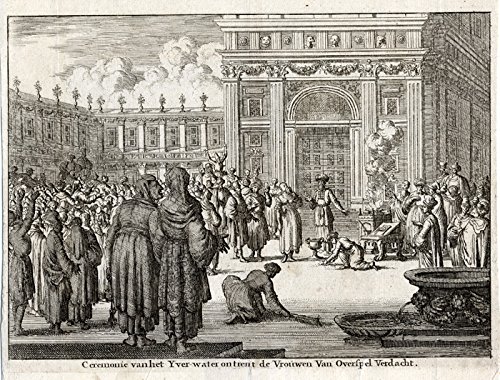
In short, the Torah’s description is like this: the Kohen (priest) writes a curse on a scroll, and then pours water over the scroll to dissolve the ink. The inky water is collected and the suspected wife is given some to drink. If she dies (or suffers greatly, or miscarries; it’s not exactly clear; the text says “latzbot beten velanpil yarekh,” causing her “belly to distend and her thigh to sag”), she was guilty. If she survives the ordeal, she is innocent.

Antique Print-CEREMONY-BITTER WATER-RITUAL SOTAH-ADULTERY-Cunaeus-1682

Now, you probably did not hear about that in Hebrew school. And for sure you have never heard of such a thing practiced by Jews, and there is a good reason for that: it’s barbaric. Nonetheless, the rabbis of the Talmudic period thought it interesting enough that they put together a tractate on it: Massekhet Sotah, in which they detail the process. However, toward the end we discover that the practice had been discontinued some time in the past, although of course they do not know how far back. (Scholars cannot confirm whether or not the ritual was actually ever practiced.) BT Sotah 47a:

משרבו המנאפים פסקו המים המרים

From the time when adulterers proliferated, [the performance of the ritual of] the bitter waters was nullified; [they would not administer the bitter waters to the sotah.]

This is, it seems to me, a rabbinic cop-out. They can’t say, “When they realized that the ritual was cruel and unjust, they stopped performing it.” Rather, they cite the proliferation of adultery as the reason – i.e. there were just too many adulterers for us always to be performing this ceremony. But this is not really a logical conclusion; it is, rather, in line with the traditional rabbinic attempt to mitigate the harsh punishments encoded in Torah law. The Talmud often seeks to lessen the severity of the Torah’s harshest decrees. We do not put people to death for violating Shabbat in public, or for being disobedient children, both of which appear in the Torah as commandments. Likewise, we do not perform cruel punishments like the ritual of the bitter waters. And we likely never have.

But what do we do about passages in the Torah that make us uncomfortable? After all, there are many: the tale of Noah’s drinking and his son Ham’s apparent misbehavior; Lot and his daughters; Amnon’s rape of his half-sister Tamar; the Torah’s apparent condoning of slavery, concubinage, prostitution, etc.*

When I was working on my first master’s degree at Texas A&M University, a very traditional, conservative campus, I would occasionally hear very serious Christians talk about living according to the Bible. My (thought, not spoken) response was, “Aha. So do you check your garments for sha’atnez (mixture of wool and linen forbidden by the Torah)? Do you plan on marrying multiple wives? Should you kill the entire family of somebody who raped your sister?”

The writer AJ Jacobs seized on this idea a few years back in his book, The Year of Living Biblically, in which he describes his attempt to live according to the Torah, literally. What results is an often hilarious series of episodes. But his overarching point is clear: neither Judaism nor Christianity takes the Bible at its word. And we should acknowledge this.

We do not live according to the Torah. We live according to rabbinic interpretation of the Torah, which is colored by centuries of societal development and modifications to account for how we live today.

So what on Earth could be the reason that we still read about the sotah ritual? Can’t we just edit it out? Doesn’t it make us look bad?

I mentioned earlier that Massekhet Sotah (the Talmudic tractate) covers many of the details of the sotah ritual, as if the rabbis discussing it, long after the practice had been abandoned, was meant to be preserved, as if some day, like the Temple sacrifices, it would be reinstated (has veshalom / God forbid!). But the Talmud is not necessarily a linear book, and, as a text devoted to argument, you find within it pieces that comport well with contemporary sensibilities, even when the subject matter is arcane and/or obsolete. Elsewhere in Massekhet Sotah, we read the following (17a):

דריש ר”ע איש ואשה זכו שכינה ביניהן לא זכו אש אוכלתן

Rabbi Akiva taught: When a man and a woman merit it [through their appropriate behavior], the Divine presence stands between them; when they do not, fire consumes them.

I have often used this piece of wisdom at weddings. It plays on the fact that “ish” (man) and “ishah” (woman) share the letters for esh (fire), and the additional letters between them are yod and heh, which spell out Yah, a short name for God. So when you take God out, when you remove the qedushah, the holiness from a sexual relationship, all you have left is fire – empty passion – which will not last, which will consume itself.

So one advantage to studying and re-reading passages that make us uncomfortable is that we might in fact uncover gems of wisdom when we dig deeper. But in order to find those gems, we have to keep reading.

Another lesson we might glean is that our understanding of what it means to be Jewish and to practice Judaism changes. Just as the Talmudic rabbis, living around Baghdad in the 3rd century or so, could not stomach the ritual of the bitter waters (!), so too can we look back on Jewish practices historically and make judgments based on who we are and how we live today. Halakhah, Jewish law, evolves. The world changes, and Judaism changes with it. We treat women and men equally under Jewish law (i.e. egalitarianism). We uphold the values of Shabbat, even as we encourage people to drive to synagogue if they live too far away from the synagogue. We ordain gay men and women as rabbis, and join them in marriage under the huppah (wedding canopy).

At the Tikkun Leyl Shavuot (late-night study session on the first night of the festival of Shavuot) last Saturday night, we read the words of Rabbi Neil Gillman, who taught that our understanding of God, the Torah, and halakhah changes as we change, and these things are shaped by our cultural context. “Halakhah is indispensible,” he wrote, “‘because it is what the Jewish community understands God’s will to be.” Not God’s will, but rather our understanding of God’s will. And that changes.

The final message we might glean here is, you might say, related to the current “#MeToo” moment. The sotah tale sits there in Bemidbar / Numbers to remind us that horrible things have been done by people to other people, and in particular by men to women, throughout history, and that these historical wrongs must be righted. Even if it was never performed, even if the tale found herein is merely to scare women and men away from adultery, the descriptions in the Torah and the Talmud are there as a caution: this is the kind of thing that can happen when we do not count women as equals.

Why is this here? As a reminder that we need to struggle to overcome it. We do not edit the Torah; on the contrary, we edit our behavior to reflect the holiness in all of us.


~

Rabbi Seth Adelson

(Originally delivered at Congregation Beth Shalom, Shabbat morning, 5/26/2018.)

* Given the death of Philip Roth this week, one might ask the same question about Portnoy’s Complaint, and other works in his oeuvre that do not necessarily make the Jews look so good.


Categories
Festivals Sermons Yizkor

Everyone Has a Story – Shavuot Day 2 / Yizkor, 5778

Shavuot is kind of a funny festival. It’s one of the least well-known, mostly because it usually falls after Hebrew schools have concluded for the year. It doesn’t really have all the tactile and gustatory experiences of Sukkot and Pesah, say, or the fun-loving, child-centered holidays of Hanukkah and Purim, or the gravitas of the High Holidays. I don’t think it’s even as familiar as Tu Bishvat, which is not actually a holiday at all.

And yet the story that Shavuot tells is so central to what it means to be Jewish – the celebration of the gift of Torah, and everything that flows from it. Shavuot is the story of the ongoing revelation of our tradition, of how we continue to receive and reinterpret ancient wisdom for our time. As such, it should be the central pillar of the Jewish year, the one holiday that unites everything else we do with our most essential spiritual journey, our lifelong quest for understanding ourselves and our world.

OK, and there’s also cheesecake.

Two weeks ago, we laid to rest a long-time member of Beth Shalom, Ruth Lessing. She was a few months shy of a full century when she passed away.

Whenever I perform a funeral, I meet with the immediate family of the deceased to get the full story: who they were, what they enjoyed doing, what they took pride in, their successes and failures, and so forth. With Ruth, this process was not so easy: she had one son who lived in Wisconsin, and was on hospice care when his mother died; he himself passed away a few days later. So I had to rely on a couple of more distant relatives here in Pittsburgh, and they told me what they knew: they gave me as much of Ruth’s story as they could. Getting that information was not so easy. I eventually heard about Ruth’s parents in Germany, who bribed a whole range of officials to get five of their seven children out of Germany prior to the Sho’ah, but who ultimately perished, along with Ruth’s younger brother, at the hands of the Nazis.

But it reminded me of an essential piece of who we are: that each of us has a story.

Yad Vashem
Yad Vashem

One of the poems included in our Yizkor (memorial service) booklet is “Lekhol Ish Yesh Shem / Everyone Has a Name.” It was written by the Israeli poet Zelda Schneurson Mishkovsky (1914-1984), usually referred to as Zelda:

(Note: Hebrew is a gendered language. Please understand that while Zelda wrote entirely in the masculine, it can be read as “he” or “she”; I have modified the translation to reflect this.)

לכל איש יש שם
שנתן לו אלוהים
ונתנו לו אביו ואמו
לכל איש יש שם
שנתנו לו קומתו ואופן חיוכו
ונתן לו האריג
לכל איש יש שם
שנתנו לו ההרים
ונתנו לו כתליו
לכל איש יש שם
שנתנו לו המזלות
ונתנו לו שכניו
לכל איש יש שם
שנתנו לו חטאיו
ונתנה לו כמיהתו
לכל איש יש שם
שנתנו לו שונאיו
ונתנה לו אהבתו
לכל איש יש שם
שנתנו לו חגיו
ונתנה לו מלאכתו
לכל איש יש שם
שנתנו לו עונות השנה
ונתן לו עיוורונו
לכל איש יש שם
שנתן לו הים
ונתן לו מותו
Everyone has a name
given to him by God
and given to her by her parents
Everyone has a name
given to her by her stature and the way she smiles
and given to him by his clothing
Everyone has a name
given to him by the mountains
and given to her by her walls
Everyone has a name
given to her by the stars
and given to him by his neighbors
Everyone has a name
given to him by his sins
and given to her by her longing
Everyone has a name
given to her by her enemies
and given to him by his love
Everyone has a name
given to him by his feasts
and given to her by her work
Everyone has a name
given to her by the seasons
and given to him by his blindness
Everyone has a name
given to him by the sea
and given to her by her death.
(Translated from Hebrew by Marcia Falk, quoted from “Generations of the Holocaust” by Bergmann and Jugovy)
Zelda stamp
Zelda

Our name is our story; captured within those few words, you might say, is all that we stand for as individuals: our likes and dislikes, our deeds and misdeeds, our family connections, our obligations and characteristics and quirks and reputations.

We live in an increasingly dehumanizing world, one in which our individual stories are less and less relevant to all that we do. I am increasingly concerned that, given the way things are moving, we shall all soon be reduced to a pile of numbers. The new algorithms that suck up our information like water, predicting our behaviors, knowing which product we will buy and which candidate we will vote for even before we have thought about it, are sapping our free will. It’s more than a little creepy, and quite alarming. We will soon have no secrets, nothing that is hidden from the rest of the world. Maybe that’s already the case.

Not long after the news broke about Cambridge Analytica, the election research firm that scooped up personal data on 87 million Facebook users without their knowledge and in violation of Facebook’s terms of service, the New York Times ran a few analysis pieces about the information that Facebook and Google and other big data companies collect and use. The author had downloaded and reviewed all the information. Facebook’s data amounted to 650 megabytes, including all of his Facebook activity (likes, shares, posts, etc.), all of this friends’ contact info, including addresses and phone numbers, and a list of all the companies and organizations that had requested his information for the purposes of advertising on the site. (BTW, I downloaded my own Facebook data after reading this article, and among this latter list was none other than Congregation Beth Shalom, which has purchased a few targeted ads on the site.)

Google and Facebook know a lot more about you than your parents do. Even, by the way, if you do not have a Google account: these companies create files for people that are connected to others who do have accounts. They may not know your name, but they know a lot of things about you, and they assume that some day that info will be useful. Google owns the text of this sermon, by the way; in my own Google drive, there are nearly 6 gigabytes of writings and photos and videos and sermon ideas just sitting there waiting to be delivered.

Your genome, by the way, is small by comparison. Your DNA, the chromosomes found in each of the cells in your body, effectively what makes you you account for about 750 megabytes; it can be further reduced to the essential variations that differentiate individual humans from each other, is maybe only about 125 megabytes, depending on the method of storage.

DNA

But that’s not a story. We are not the sum of our data points, or our clicks or our lists of friends or where we purchased groceries. We are not a set of ones and zeros, or even patterns of genetic nucleotides. We have souls. We have journeys. We have lives. We have names. Everyone has a name, which is shorthand for the life we have lived.

You cannot capture love in a digital file. You cannot describe the palette of human creativity, or the full range of human feelings, or the complexity of interpersonal relations. You cannot record the thrill of watching your daughter perform on stage, or the joy of meaningful conversation, or the exultant abandon of group singing around a campfire. A computer would have no reason to argue with another computer over the meaning of a verse in the Torah, or a Talmudic sugya. Microprocessors do not mourn their parents.

What makes us people, what gives us our names, is the full complement of human experiences that we acquire over years of living. It is learning to walk, and failing at dating. It is hiking in the woods, swimming in the ocean, tasting the most fabulous dessert you’ve ever had. It is staying up all night to write a term paper and getting a mediocre grade. It is scoring the winning point and losing a beloved partner.

I must say that I am slightly concerned over the bold new future, in which companies will reduce us to a pile of numbers, but I am not THAT concerned, because we will always have our souls. Nobody can take that away from you.

And nobody can take away the souls of those whom we have known and lost. We carry them all with us. We carry their names. And we carry their stories.

Lekhol ish yesh shem. Each of us has a name, and each of us has a story.


~

Rabbi Seth Adelson

(Originally delivered at Congregation Beth Shalom, second day of Shavuot, 5/21/2018.)


Categories
Sermons

The Great Unbundling – Aharei Mot-Qedoshim 5778

Last week I was in Chicago for a few days, at the convention of the Rabbinical Assembly, the professional organization of Conservative rabbis. Between sessions on ancient theology, medieval disputes about Jewish law, and the state of contemporary Judaism, we had some free time, so I took the L to the Art Institute of Chicago, and since I had limited time, I went directly to my favorite period, the French Impressionists. I saw a Renoir that brought tears to my eyes, ogled some Seurat, beheld several breathtaking Monets.

The Two Sisters
Pierre-Auguste Renoir, Two Sisters (on the terrace), (1881)
sunday on la grande jatte
Georges Seurat, A Sunday on La Grande Jatte – 1884 (1884/1886)

We read today in the Torah my favorite verse in the entire Torah (Vayiqra / Leviticus 19:2):

קְדֹשִׁים תִּהְיוּ כִּי קָדוֹשׁ, אֲנִי ה’ אֱ-לֹהֵיכֶם

“You shall be holy, for I the Lord your God am holy.”

One of the ways in which we as humans are holy is by acting on the creative impulse within us, the Divine gift of art. When I look at beautiful works of art, I am reminded of the fantastic things that humans are capable of; that despite our many flaws and challenges and vulnerabilities, we often have the potential to create great beauty.

Unfortunately, I did not have time to visit other galleries: the American, African, Indian, Chinese, Japanese, Korean, Textiles, Photography, Prints and Drawings, Greek, Roman, Byzantine, Film, Video, etc., etc. Pity. I paid $25 for entry, just to see the work of a few 19th-century Frenchmen. I could actually see those items on the Art Institute of Chicago’s website for free.

The Petite Creuse River
Claude Monet, The Petite Creuse River (1889)

Nonetheless, I was moved. I am also grateful that this museum has so many things in its collection, among them Renoir and African fertility goddess dolls and ancient Egyptian stelae and Andy Warhol’s pop art. And I probably will not return there for a long time – I’m not in Chicago very often.

But imagine how weak a museum it would be if it only held one of those things. What makes a great museum wonderful is the range, the comprehensive nature of its offerings; the dedication to the entirety of the holiness in human creativity. Even if I could only have paid, let’s say, two dollars to only see the French Impressionists, the extra $23 in my pocket would represent a loss to me – my ability to take advantage of all that the museum offers – and a loss to the museum – its ability to provide all those other things.

The experience was, it occurred to me, relevant to something that I was planning to speak about today, and that is the so-called “unbundling” of Jewish life.

What is meant by “unbundling”? It’s going on all over the place right now. Show of hands: how many of us are still paying for cable? How many of us still buy CDs (or vinyl albums)? How many of us prefer AirBnB to a full-service hotel? We are in the process of unbundling our lives in many ways. Now, if you only want to watch ESPN, you don’t have to pay for CNN and BET and Lifetime. You don’t need to get the whole bundle.

Unbundling is a term that has come to the fore recently by people in the Jewish world who are advocating a different approach to living Jewishly: to separating the offerings of legacy institutions, particularly synagogues, from each other. That is, if you need a rabbi for a funeral, you hire a rabbi. If you want to learn Talmud, you can go online to find a Talmud class. If you have a 13-year-old child, you can rent an event space for a bar mitzvah. Why do we need big, full-service institutions? Can’t we just cobble together a few Jewish things by ourselves, DIY-style, and call it Jewish life?

The idea has been tossed around liberally by both hosts and guests of the Judaism Unbound podcast, which, for the last two years, has been examining the new ways in which people are engaging with Jewish living and learning today. And it also came up at a recent discussion hosted by Rodef Shalom Congregation about the Jewish future. The featured panel consisted of one of the hosts of Judaism Unbound, Dan Libenson, Rabbi Irwin Kula of CLAL: The Center for Learning and Leadership, Rabbi Aaron Bisno of Rodef Shalom, and two members of Beth Shalom: Rabbi Amy Bardack of the Federation, and Danielle Kranjec, the senior Jewish educator at the Hillel Jewish University Center.

It may be that unbundling is the way we are moving as a society. But that presents a kind of dilemma for synagogues. If I only want High Holiday tickets, or I only want my 2-year-old in the ELC, or I only want JJEP, or to celebrate a bar mitzvah, I have to buy the whole membership. I am effectively paying  a lot of money for services that I do not necessarily need or want.

Now, I am a big fan of Judaism Unbound, the podcast and the idea. It has been a forum for many good ideas, some of which I have happily appropriated.

But unbundling is short-sighted. It misses the fact that the synagogue is a home for the community. It’s an extension of your living room. It is, literally, a beit kenesset, a house of gathering, the Hebrew term for the Greek word synagogue. This is a place to gather. Not just for services. Not just for baby namings and dancing with the Torah and Shabbat dinners. It’s also a place where we learn about each other, where we share our stories, where we grow together spiritually as individuals, as families, as a community.

What makes us a qehillah qedoshah, a sacred community, is that we understand that in order to have this gorgeous building, in order to have the staff that keeps it open, the people to send our yahrzeit and birthday notices and new baby announcements, in order to be able to host Shabbat dinners or the Hod veHadar instrumental service that we had last night, we have to support it. Just like you cannot have Impressionists without Diego Rivera, Ai Weiwei, and Botticelli, you also cannot have a bar mitzvah or Ne’ilah without a community or an ark to open.

Still, there are skeptics who will say, “So tell me, Rabbi, what does a synagogue offer? Why do I need it?” (I am, in fact, asked variations on this question quite often.)

The synagogue is the place that offers you all the tools you need to thrive in today’s world. We offer you a framework to help you live a better life: one characterized

  • by tzedakah, charity;
  • by understanding and supporting the others in our midst – our family and friends but also the stranger, the immigrant, the poor, the unprotected;
  • by modeling what it means to be a family and to do familial things together in the context of community and Jewish life;
  • by providing opportunities to gather, not in front of a screen, but in real time with real people across multiple generations and demographics;
  • by bringing people together for a multitude of holy purposes, social, ritual, and otherwise;
  • by highlighting the holy moments in our lives and giving us a framework of gratitude, of celebration, and of grief;
  • by teaching ancient wisdom, translated into today’s context, which will:
    • heighten your relationships,
    • improve your understanding of yourself and the world around you, and
    • make you feel more grounded.

We need this.

I am grateful that the Art Institute of Chicago has a solid collection of Impressionists; I am also grateful for the all the other parts of the museum that I did not take advantage of. But just as you cannot unbundle a museum, so too must the synagogue, as the communal center, include and highlight all the aspects of Jewish life.

As we unbundle ourselves, we grow more isolated; synagogues are on the front lines of fighting that isolation. That’s why we need at least 10 people for a minyan, a prayer quorum, and that sense pervades Jewish life. We are a beit kenesset, a house of gathering. That is what this building, this community is here for. We will continue to improve the model of how we bring people together, to connect our ancient traditions and wisdom with how we live today. And we need you to be a part of it to make it happen, and to help shape our future together.


~
Rabbi Seth Adelson
(Originally delivered at Congregation Beth Shalom, Shabbat morning, 4/28/2018.)