Categories
Sermons

Context Matters – Miqqetz 5784

Context matters. In fact, the way that we understand Judaism – our history, our rituals, and our textual heritage – here in the Conservative movement, is based upon this very principle. We never read our sacred texts or discuss Jewish law or ritual without context, both ancient and modern.

One simple example is the Amidah, the standing, silent prayer mandated by our tradition at least three times each day (four times on Shabbat!). You may know that there is no commandment in the Torah to recite the Amidah. However, when the Romans destroyed our Second Temple in Jerusalem in 70 CE, they put an end to the sacrifices, which ARE described in the Torah. Our rabbis decided that in this new context, daily recitation of the Amidah would take the place of those sacrifices.

And it requires even more context to understand why we invoke not only the Avot of our tradition, the Patriarchs, in the opening line of every Amidah, but also the Imahot, the Matriarchs as well. That is an innovation of the last few decades, an acknowledgment that we also look to the women of our ancient story as well for values and guidance. And it took the context of understanding women and men to be equals in Jewish life for this change to occur.
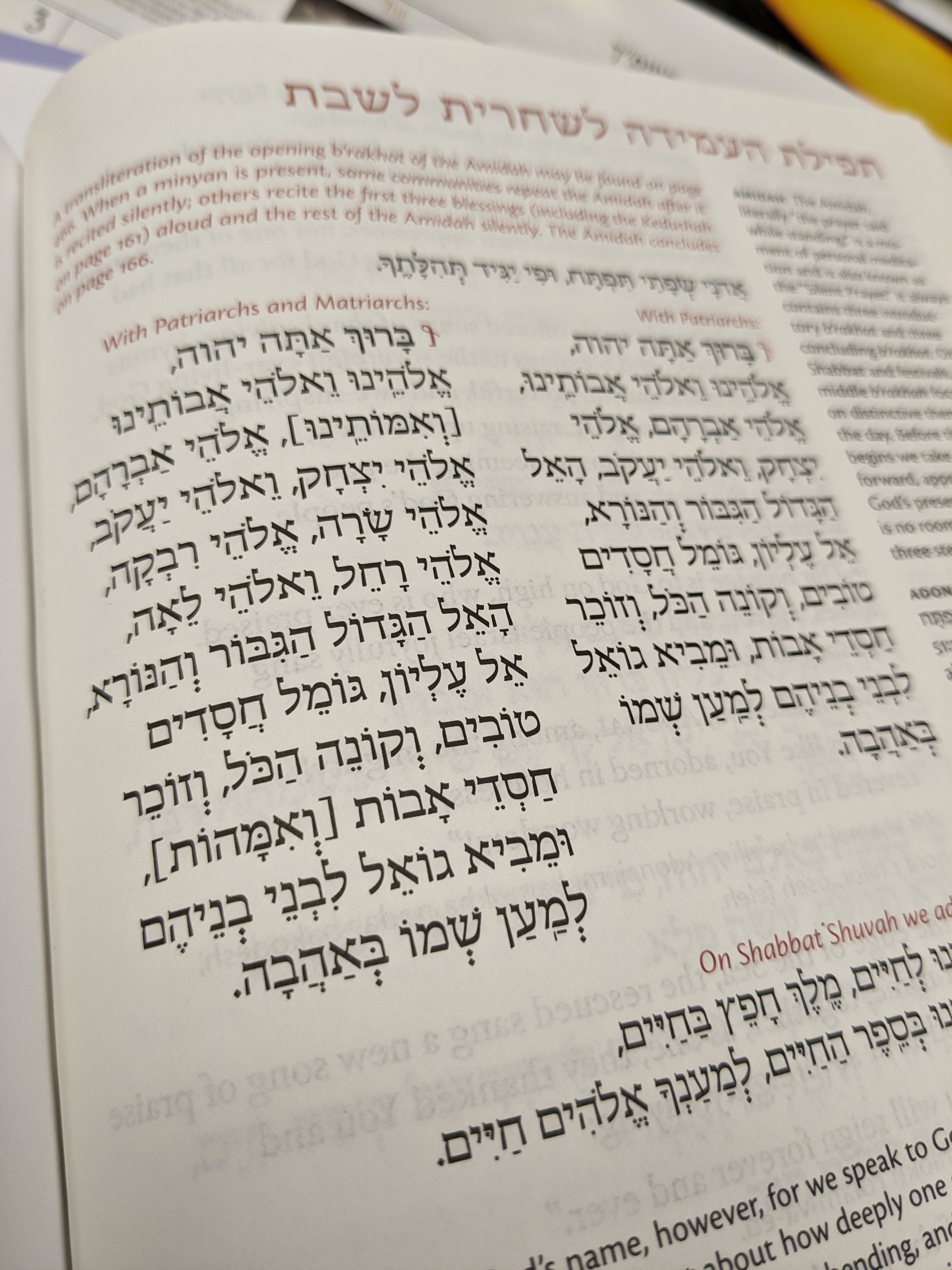
Our tradition has unfolded over thousands of years, and we always read our texts in the context in which they emerged, and our practices today must reflect our current situation.

Academics know that context matters. It is essential to understanding our world, our history, our cultures.

And yet.

There are some times when the invocation of “context” requires context. When presidents of three universities, when pressed on the question of whether protesters chanting certain anti-Israel and anti-Jewish slogans was permissible speech on campus, they deflected with, “It depends on the context.”

***

Ḥevreh, I must say that I’m just not shocked any more – not about the dramatic rise in anti-Semitic incidents in America, not about the insecurity Jewish students are feeling on campus, not about how many Jews feel that they have been abandoned by their political allies, not about how the American media covers the conflict in Israel.

I’m just not shocked any more.

But I am just a tiny bit surprised that the presidents of Harvard, MIT, and Penn publicly failed in unison to concede that language calling for the killing or displacement of Jews meets their campus standards for bullying or harassment.
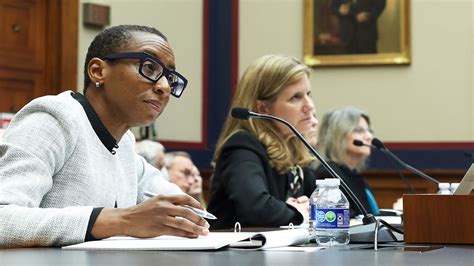
The presidents, who responded with legalese when an honest, personal reckoning with the fact that people screaming “Intifada” are, in actuality, calling for the death of Jews. That is what that word meant when it was happening in Israel two decades ago.

And of course they issued apologies for their poor choice of words after the fact, and one of them is no longer a university president. But in the moment, when the spotlight was on them, they failed. When it really counted, they should have been there with the right answer, which is, “Calling for the killing of Jews is wrong under any circumstances. It does NOT depend on the context.”

And they totally, absolutely missed the point, which is that Jews all over America and the world, but most acutely on university campuses, are feeling the rise in anti-Semitism quite personally. The evident double standard here is that in recent years these campuses have gone far out of their way to accommodate the feelings and sensitivities to language of Black, Hispanic, Native, LGBTQ, Asian students and faculty in various ways. Even the slightest discomfort in this regard has caused university leaders to react vigorously and punitively.

But somehow, when it comes to Jews, our feelings do not matter. Anti-Semitism, in the minds of some, is just not enough of a thing. Jews are apparently too “privileged” for university administrators to bother with. When protesters call for “any means necessary,” which implicitly supports the brutalities of Hamas, is that not an actionable offense? 

Even if, as a recent poll suggests, less than half of those marching for Palestine know which river and which sea they are referring to in one well-known chant, does the implied destruction of the State of Israel not threaten Jews?

Today in Parashat Miqqetz, we read a captivating moment: it occurs when Yosef’s brothers have come before him with their hands out, seeking food, and of course they do not know that they are standing before the brother they sought to kill many years earlier. And they are speaking to each other in Hebrew, and Yosef, who remembers the language of his youth, can understand them, but they are unaware.

We understood loud and clear what these representatives of the most prestigious universities in the United States were saying, and they had no idea. What they were saying, by referencing “context,” was, we are afraid.

We are afraid that if we admit on the record, before Congress, that “From the river to the sea,” or “Intifada” are anti-Jewish statements, that we will be called out by our allies. We are afraid, because while it is OK for Jews to be fearful, to cower in their dorm rooms, to be harassed on campus, it is definitely NOT OK for any member of any other persecuted group, and we definitely don’t want to anger any of those folks.

Ḥevreh, we, the Jews, cannot be afraid. We cannot allow ourselves to be bullied. 

On the contrary, we have to hold our heads up high, to stand proudly with the people and the State of Israel, to stand with and for each other, and to keep doing what Jews have been doing for thousands of years – that is, carrying out the mitzvot / holy opportunities of Jewish life.

Some of you were here last week when Rabbi Mark Goodman taught a couple of Hasidic texts about the pit into which Yosef’s brothers had thrown him, back in Parashat Vayyeshev. One of those texts put forward a fascinating idea, one which we can absolutely draw on today. Rabbi Shemuel Bornsztain, the late 19th-early 20th centure Sochatchover Rebbe, wrote that it is our commitment as Jews to God’s covenant which maintains the presence of the Tzelem Elohim, the Divine Image, within us. When we fail at that covenant, the Tzelem Elohim disappears, and then we are on our own – that is, we are subject to the dangers of the world around us. 

Framed more positively, our fulfillment of Jewish life – ritual, prayer, text learning, the mitzvot which highlight the holiness in our relationships – protects us and insulates us from danger. Our secret to survival is not the Anti-Defamation League, which is only 110 years old, although of course they do very important work. The reason we are still here is that we have maintained our spiritual heritage through millennia of persecution. When we merit the presence of the Tzelem Elohim, we have nothing to fear.

Something else happened nearly two weeks ago, which did not shock me, but certainly made me feel just a wee bit unnerved. Roughly 500 anti-Israel protesters showed up outside a kosher falafel restaurant in Philadelphia to charge the owner of the restaurant, our son of Pittsburgh, Michael Solomonov, with “genocide.” Will all those of us who are supportive of Israel soon be subjected to angry mobs?

I have heard from a friend who works for Hillel International, the center for Jewish life at colleges and universities, that the situation on American campuses for Jews is actually much worse than what you might hear on the news. It’s not necessarily the high-profile anti-Semitic incidents, like the one that happened at Cornell a month ago, but the subtler remarks, the low-level incidents, the constant barrage of anti-Israel language on social media and chanted on campus. It’s the pressure to concede to the pro-Palestinian narrative of Jews as oppressors, of the collective guilt of all Jews.

I am relieved to be able to say that we have not yet arrived at the equivalent of Kristallnacht, in November of 1938, when Nazi thugs across Germany destroyed synagogues and Jewish-owned businesses. Thank God. 

But should we be concerned? Absolutely. Should we be reaching out to our elected officials? Yes, constantly.

And even more so, now is a crucial moment in Jewish life: a mandate to up our game. We need to double down on the formula which has held us together as a community in spite of the Romans, the Babylonians, Antiochus, King Ferdinand and Queen Isabella, and on and on. We must continue gathering in synagogues for prayer. And kindling lights. And teaching our children the words of our ancient tradition, and the contexts in which they emerged. And upholding all of the traditions which have maintained Tzelem Elohim – God’s image – within each of us.

Context matters, and in our current context, the spiritual framework which has guided and nourished and protected our people for the entirety of our history still works. And we need that framework today, more than ever.

~

Rabbi Seth Adelson

(Originally delivered at Congregation Beth Shalom, Pittsburgh, PA, Shabbat morning, 12/16/2023.)

Categories
Sermons

Context Matters – Vayyeshev 5783

Perhaps you heard that the South African comedian Trevor Noah recently stepped down as host of The Daily Show, a satirical news program. On his last show, he delivered a kind of sermon regarding some of his lessons learned during his tenure as host, and it was mostly not funny, but delivered in a serious mode, which is unusual for a comedian. Comedians, of course, are good at pointing out the challenges that we all face, and doing it in a way that brings us joy, that enables us to laugh at ourselves.

In the course of this talk, he said something which, I think, is so important: “Never forget how much context matters.” He explained that we live in a world of limitless information, but we are suffering from a lack of context. We simply are not given the tools to understand our world and everything that we are seeing and experiencing.

All of this context-less information has made us extraordinarily susceptible to manipulation, and it does not bode well for the future of humanity. Video clips circulated online are cut or even altered to disguise what came before or after, just to show you the piece that will provoke you the most. The news that travels the fastest and the farthest is the one that makes you the most angry or the most aggrieved.

Throw in the fact that your computer and your smartphone not only know what you want to see, what will push your buttons, what will get you all anxious and upset, but are also effectively designed to keep putting material like that in front of you. And, given that most of us are looking at these screens all day long, we are primed for manipulation. And the algorithms for manipulation are getting smarter and smarter.

Here is the good news: you can combat this by seeking out the missing context. And, by the way, that is what Jews have always done. One might make the argument that the entirety of the rabbinic enterprise of the last 2,000 years or so is to provide context. We, the Jews, are historically talented at both text AND context. And the goal of seeking context is to be reflective, rather than reflexive, in how we approach life and all of its challenges. 

Let me explain: 

The Torah is a particularly difficult document to understand. To begin with, it was written in a language that nobody has spoken for thousands of years. It is also filled with contradictions, gaps, ambiguities, apparent grammatical errors, and obscure words which can only be understood by speakers of that language (i.e. nobody). (Worth noting here that Israelis, speakers of modern Hebrew, are just as befuddled by the Torah’s language as we are.)

And yet, the Torah is the foundational document of Judaism, the basis for much of our tradition. So the only way we can actually understand it is through context, and in particular, the context given by rabbinic tradition: the Talmud, midrashim, the commentaries of medieval and contemporary rabbis, from Rashi in the 11th century until today. 

What do these commentators do? They place the context alongside the text, to help us see how the terse words of the Torah make us better people. They interpret ancient verses, which we sometimes barely understand, to show us how they apply to us in our day, in our context. They give us perspective.

For example, Parashat Vayyeshev, from which we read this morning, tells the story of our hero Yosef, who, after being sold into slavery and brought to Egypt, ends up in the house of a wealthy man named Potiphar, whose wife takes more than a passing interest in their new, handsome slave. She attempts to seduce Yosef, and there is a moment of hesitation before he rebuffs her. The suggestion is that he is certainly tempted to take her up on her offer.

A midrash, however, tells us that as she takes hold of his clothing with lascivious intent (Bereshit / Genesis 39:12), and Yosef struggles with his conflicting fear and desire, he has a vision of his parents, watching through a window behind Potiphar’s wife. And his father Ya’aqov says to him, “Your brothers’ names will be inscribed on the ephod, the breastplate of the Kohen Gadol [the High Priest in the Temple in Jerusalem, which is at this point in the traditional chronology many centuries in the future]. Do you want your name to appear there with them, or not?” (Babylonian Talmud Sotah 36b) And that is the point when he runs from her.

The point of the midrash is that context matters, that our moment-to-moment decisions should be shaped not by immediacy, not by what is happening exactly right now, but by the past and the future. And of course, that is not always so simple. 

Many other moments in the Yosef narrative require context. Yosef does not see the larger context when he boasts to his brothers about the dreams in which they all bow down to him. The brothers are missing context when they throw him in a pit, and then sell him into slavery, and then lie to their father Ya’aqov about what happened.

All of these moments are, you might say, reflexive choices, made quickly and without considering the consequences. Reflexive, rather than reflective.

When we act impulsively, rather than taking time to reflect on the context, we cause damage and pain. When we respond in the anger of the moment rather than waiting, breathing deeply, and thinking carefully, we usually make things worse. When we pile onto the most hurtful, most anxiety-inducing news or online content with more frustration and more insults and more aggression, the lack of context usually leads everybody down the wrong path.

What makes the Yosef narrative work is learning the complete story. Although none of the characters involved could have known this, every choice along the way, good and bad, ultimately brought Benei Yisrael, the children of Israel / Ya’aqov, down into Egypt, where they would become slaves, and then ultimately become a free nation, destined to receive the Torah and to inherit their own land. And in the context of all of that, the series of reflexive moves is woven into a context which has shaped our people for thousands of years. So in this case, you might say it worked out well.

But we all know by now the corrosive effects of the social media platforms through which we all receive our information about the world. And we all know about the potential of these platforms, and to some extent even legitimate purveyors of news, to rile us up. We have seen their ability to enable the id, the unfiltered, most primitive piece of our psyche, to speak for us, and to easily spread hateful ideas of all sorts. 

I am grateful that the Biden administration gathered a group this past week to discuss strategies on anti-Semitism, chaired by the Second Gentleman, Doug Emhoff. But I am also not too optimistic that such discussions will yield anything productive. Hatred of Jews has been with us far too long, and I lament the fact that it will never go away.

However, what we all can do is to try to move society to a place that is more reflective, rather than reflexive. Labeling people as anti-Semites, or racists or trans-phobes or snowflakes or RINOs or whatever, diminishes the humanity of those with whom we disagree. 

Teaching history, however, and giving context and the opportunity for reflection is the way to go. Jon Stewart, who was Trevor Noah’s predecessor at The Daily Show, has said that hearing anti-Semitism spewed out loud is better, because then it is an opportunity for teaching and providing context, kind of like cleaning a wound by opening it. I am not entirely sure I agree with him, but certainly meeting people and talking with them in-person, especially people with whom you do not necessarily agree, is the way to build bridges, to change minds.

Another observation that Trevor Noah shared in his “sermon” was that “the world is a friendlier place than the Internet wants you to believe.” Perhaps if, when we are tempted to respond in a way that is unhelpful, we remember our parents, and we remember the lessons which they attempted to impart to us about being better people, then we might be more likely to see the humanity, or even the Divine spark, in those who say hateful things. And maybe we have a better chance of allowing that Divine spark to bring that person to a more reflective, more contextual place.

A final thought: One of the best ways to slow things down, to bring context to our lives, to help us become more reflective and less reflexive, is to take one day a week to separate ourselves from the outrage machines of Big Tech. If I had one wish for our society, Jews and non-Jews, it would be to shut down your digital devices for 25 hours every Shabbat, and spend time with your family, your friends, and your Qehilah Qedoshah, your sacred community. I do it; you can too.

Context matters.

חג אורים שמח / Ḥag Urim Sameaḥ! Happy Ḥanukkah.

~

Rabbi Seth Adelson

(Originally delivered at Congregation Beth Shalom, Pittsburgh, PA, Shabbat morning, 12/17/2022.)