Categories
Sermons

Battle for the Soul of America – Vayishlaḥ 5784

You may have noticed that some members of the Jewish community have put up posters of Israelis held hostage by Hamas on multiple utility poles on Murray Avenue. This is to remind us all of the 140 or so hostages remaining in Gaza, and to keep before us an essential principle of halakhah / Jewish law, that redeeming captives is an urgent obligation which pre-empts many other mitzvot.

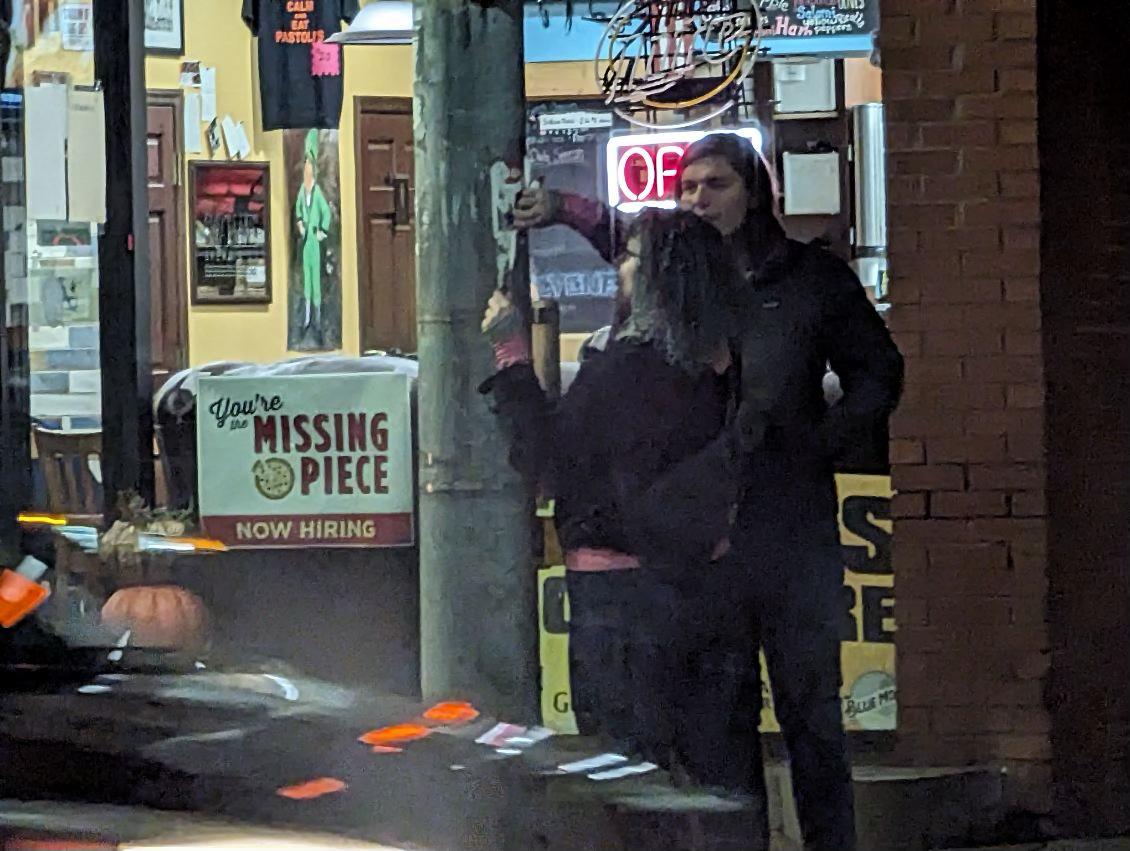
Taking down hostage posters on Murray Ave.

And, there are others in our neighborhood who are regularly removing these posters. Perhaps they do not want people to remember the hostages, or maybe they do not believe that there really are hostages, or perhaps they are so consumed with hatred that any acknowledgement of ongoing Israeli suffering would be humanizing the “oppressors” or legitimizing the existence of the State of Israel and therefore forbidden according to their world-view. This phenomenon is not unique to Squirrel Hill; a striking example is that a few weeks back a New York public defender was caught on video doing so.

Parashat Vayishlaḥ opens with one of the most striking transitional moments in the Torah. As Ya’aqov is about to be reunited with his estranged brother Esav, he encounters an angel, with whom he wrestles all night long. This is the scene in which he receives his new name, Yisrael, which, rabbis love to remind us all, means, “the one who struggles with God.”

And yet I, like many of my colleagues, often leave out the second part of the Torah’s etymology of Yisrael (Bereshit / Genesis 32:29):

וַיֹּ֗אמֶר לֹ֤א יַעֲקֹב֙ יֵאָמֵ֥ר עוֹד֙ שִׁמְךָ֔ כִּ֖י אִם־יִשְׂרָאֵ֑ל כִּֽי־שָׂרִ֧יתָ עִם־אֱ-לֹהִ֛ים וְעִם־אֲנָשִׁ֖ים וַתּוּכָֽל׃

Said [the angel], “Your name shall no longer be Ya’aqov, but Yisrael, for you have striven with beings divine and human, and have prevailed.”

We are not only the people who struggle with God, but we also struggle with humans. Ya’aqov’s spiritual wrestling match is a foreshadowing of Jewish history: we struggle with the concept of God and how we relate to the Divine, but we are, in some sense, grappling eternally as a people with the others around us, and mostly not by our own choosing. We have been forced to do this for thousands of years, and mostly we have prevailed.

We are in this moment engaged in a battle for the soul of America, if not the world.

Ḥevreh, the world has been sold a bill of goods. Somehow the genocidal terrorists of Hamas,  whose stated mission is to destroy the State of Israel and kill Jews wherever they are, whose members torture and rape and murder, who are not bound by the laws of military engagement, has been rebranded as carrying out “resistance,” as “martyrs” who are “freeing Palestine from the river to the sea.” And many Americans, on college campuses, in government offices, on school boards, in media companies, in the performing arts, in think tanks and granting foundations and social service organizations have bought into this lie.

Make no mistake: this is the result of a savvy, coordinated effort to win over the hearts and minds of Americans, whose limited knowledge of history, and in particular Jewish history, has easily enabled it. College students in particular are vulnerable, and many have apparently embraced the narrative of the Jew as oppressor, nonsensically lumping us in with all the other “white supremacists” who must be vanquished in a post-colonial world. 

It is this grave distortion of history which denies Hamas brutality, and thus views the removal of those hostage posters not as a denial of Jewish lives, but rather as some kind of twisted standing-up for the underdog.

How did this happen? How did we lose the hearts and minds of those who see themselves as warriors for social justice? How do they justify dehumanizing murdered Israeli citizens, delegitimizing the nation which provided safe haven for Jews following the Nazi slaughter, and fomenting anti-Semitism worldwide? Well, it started with a plan – actually, a public relations crusade.

Gary Wexler, who teaches at USC’s Annenberg School of Communications and who has been creating advertising campaigns for Jewish organizations since the 1980s, recently wrote a piece for the Jewish Journal of Los Angeles, in which he describes meeting the architect of this PR plan in the mid-1990s in Haifa. His name is Ameer Makhoul, and he was the Executive Director of Itijaa, an Israeli-Arab civil rights organization. Wexler quotes Mr. Makhoul as describing it this way: 

We will create… Palestinian campus activists in America and all over the world. Bigger and better than any Zionist activists. Just like you spent your summers on the kibbutz, we will bring college students to spend their summers in refugee camps and work with our people. Just like you have been part of creating global pro-Israel organizations, we will create global pro-Palestinian organizations. Just like you today help create PR campaigns and events for Israel, so will we, but we will get more coverage than you ever have. 

You wonder how we will make this happen, how we will pay for this? Not with the money from your liberal Jewish organizations who are now funding us. But from the European Union, Arab and Muslim governments, wealthy Arab people and their organizations. Eventually, we will not take another dollar from the Jews.

So if you have found yourself asking aloud in recent weeks, “Why are the people who ostensibly care for every marginalized group of people of every stripe,  suddenly marching for making Palestine Judenfrei?” you are not alone. What you are seeing is decades in the making. “Apartheid Week.” BDS. The platform of the Movement for Black Lives, which incorporated language to equate the Palestinian struggle with that of Black Americans. All of it is part of that plan to change the narrative, to deny the Jews our right to self-determination in the land from which we came.

There was a small piece of news here in Pittsburgh which may have crossed your radar (e.g. on WESA or KDKA) in recent weeks. It was about how the Pittsburgh Public Schools is paying a contractor called Quetzal Educational Consulting to help improve math instruction for Black students. The intention is, of course, commendable. There is a significant achievement gap between Black and white students in math.

But if you go to Quetzal’s website, you are greeted with the words, “Decolonize. Reclaim. Reimagine.” And if you check out their Facebook feed, you will quickly find many posts featuring “Free Palestine,” “End the Occupation,” and even a quote equating Zionism and imperialism.

There is no question that Black students deserve better math outcomes, and our public schools should indeed be working hard to ensure that we achieve better outcomes for all students in math, English, science, and particularly history, and maybe even geography. But why should that come at the expense of the Jewish right to self-determination? And what on Earth does supporting the Palestinian cause have to do with math?

I simply cannot get past the feeling that Jews have been unjustly relegated to the wrong side of history. Despite millennia of oppression, despite the very real genocide of Hitler, the forced conscription and pogroms of the czars, the Expulsion from Spain, and yes, October 7th, we are suddenly the oppressors. We are the imperialists. We are the ethnic cleansers.

[Note: the following paragraph is out of date, although I include it here because at the time that I delivered this sermon I was unaware that the UN Women organization had just released a tepid statement, which can be found here. Coming nearly two months after the attack, this statement seems too little, too late.]

** You may have heard that UN Women, the United Nations entity dedicated to gender equality and the empowerment of women, has refused to even acknowledge the sexual atrocities committed by Hamas terrorists. There is abundant proof that these things occurred; where is the outcry from those who marched for #MeToo? **

At a city council meeting in Oakland, California this week regarding a resolution calling for ceasefire, public comments included denial that the atrocities of Oct. 7 were actually carried out by Hamas at all, instead blaming them on the Israelis themselves. And when speakers mentioned that Israeli women were raped, assembled citizens chanted together “Liar! Liar!” The elected officials not only failed to control the hatred and vitriol, but did nothing to correct the record. It’s beyond comprehension.

We are losing the battle for the soul of the world. And not only that, but the narrative has changed to blaming the victim, where Israel and her supporters are concerned. What happened to, “Believe Women!”

The tyranny of the Shoah, the Nazi Holocaust, is that millions of ordinary people all over Europe stood by as the Jews were systematically taken away and slaughtered. Good, well-meaning people let it happen. They stood by and said nothing, because the ideological groundwork had long since been laid by the Nazi regime. We are seeing the stirrings of this facilitated “bystanderism” once again.

Our eternal struggle is simply to be a free people in the land from which we came, unmolested by terrorists as we recline under our own vine and fig tree. October 7th may have shattered that dream. But even worse is the threat that the world may let the terrorists win, as well-intentioned people turn their heads away from the utter depravity of Islamist jihadists. 

But you can help win this battle. You have a voice. All you have to do is speak the truth. To remember the hostages. To ensure that the story of what really happened on October 7th is told and retold. To foil those who seek to deny or rewrite history. To thank our politicians who continue to stand against terror. To remind the world why Israel must be allowed to take Hamas out.

Somewhat more to the point, the Jewish world needs to unite and craft a coordinated campaign to counter the one created by Ameer Makhoul, who was ultimately convicted of spying for Syria and spent nine years in an Israeli jail. I know we have a few folks in the Jewish world who could coordinate messaging on Israel in the Diaspora, to win back hearts and minds. Just as we cannot abide Hamas on Israel’s border, so too can we not allow their hate-filled rhetoric to dominate the world’s discourse on the conflict.

Ya’aqov survives the wrestling match with the angel, but limps away. We may be injured, but the Jewish spirit is not broken, and pride in being Jewish, in our peoplehood, our history, our traditions, our text, our rituals, is still found throughout the world. And every time you do something Jewish, every time you walk through the world holding that pride and knowledge and ancient wisdom, every time you raise your voice in defense of the truth, you notch up a tiny, little victory in the battle. 

~

Rabbi Seth Adelson

(Originally delivered at Congregation Beth Shalom, Pittsburgh, PA, Shabbat morning, 12/2/2023.)

Categories
Sermons

To Prevent Harassment, Change the Power Dynamic – Vayyishlah 5778

Matt Lauer, Garrison Keillor, Charlie Rose, Louis CK, Al Franken, Kevin Spacey, Harvey Weinstein, Leon Wieseltier, playwright Israel Horovitz, John Hockenberry, etc., etc.

My daughter, who is in 5th grade, asked me a few days ago what “harassment” is. I fumbled through an answer appropriate for a precocious 10-year-old who can’t help but hear what’s going on in the world.

I must say that in the wake of all of the allegations that continue to splash across our collective consciousness, I have had three thoughts bouncing around in my head:

  1. I wish that fewer of the accused were Jewish.
  2. This is not going to stop anytime soon, until people change their behavior such that they do not abuse others based on a power dynamic.
  3. While the inherent sexism in Judaism’s ancient texts might tend to reinforce that power dynamic, we have to ensure that we work to reinterpret our tradition so that it does not.

So I have what may be construed to be some good news on that front: that we at Beth Shalom and the Conservative movement, by standing up for egalitarianism wherever possible, by re-affirming our commitment to the equality of women in all aspects of Jewish life, we are in fact actively working to change the equation. Let me explain.

Let us consider, for example, the Dinah narrative, which is featured today in Parashat Vayyishlah (this week’s Torah reading).

As you may recall from last week in Vayyetze, when Dinah is introduced, unlike all 12 of her brothers, her name is not given an etymology in the Torah. Leah merely gives birth to Dinah (Gen. 30:21), and the event is reported tersely in seven words; no mention of why she is named Dinah; no mention of how Leah rejoiced at giving birth to a girl. Nothing.

What we read today in Vayyishlah then takes it from bad to worse. The passage is downright judgmental; in Gen. 34:1-2, the Torah effectively slurs Dinah as a yatz’anit, which you might translate into English as a “streetwalker”:

א וַתֵּצֵא דִינָה בַּת-לֵאָה, אֲשֶׁר יָלְדָה לְיַעֲקֹב, לִרְאוֹת, בִּבְנוֹת הָאָרֶץ.  ב וַיַּרְא אֹתָהּ שְׁכֶם בֶּן-חֲמוֹר, הַחִוִּי–נְשִׂיא הָאָרֶץ; וַיִּקַּח אֹתָהּ וַיִּשְׁכַּב אֹתָהּ, וַיְעַנֶּהָ.

Now Dinah, the daughter whom Leah had borne to Ya’aqov, went out to visit the daughters of the land. Shekhem son of Hamor the Hivite, chief of the country, saw her, and took her and lay with her by force.

This is undeniably a classic case of “blaming the victim.” And we should read it as exactly that, through 2017 lenses. The Torah sees this case of rape as Dinah’s fault, for going out and visiting with the women of the land. Rashi even worsens the matter, by pointing out that because Dinah is identified here as “bat Leah” (daughter of Leah) but not “bat Ya’aqov,” (daughter of Jacob) it is an indicator that her mother was also a yatz’anit.

From beginning to end, Dinah is not treated equally to her brothers.

But we have an obligation today to learn from this story that while we cannot change the Torah, we can indeed change the dynamic. It is our responsibility, as contemporary Jews, to make sure that we acknowledge the equal measure of qedushah / holiness allotted to every single human being, and that we reinforce at every turn that men and women be treated equally in a Jewish context and in the wider world.

Why? Because if we internalize the notion that men and women are equal, then we have a better shot at maintaining the qedushah in all our relationships; we have a chance of re-affirming respect for all people, despite their intrinsic differences; and we might be able to eliminate the power dynamic that enables harassment of all kinds.

Those of us who are committed to egalitarianism are still fighting that battle. And, given the demographic trends of the Jewish community, in which Orthodoxy is growing and non-Orthodoxy is shrinking (see, e.g. the Pew Study of Jews and Judaism of 2013), we have to keep fighting it.

You may have heard some people in the Jewish world, who perpetuate the halakhic inequity of men and women say that women are not obligated to the positive, time-bound mitzvot (holy opportunities of Jewish life) because they are “on a higher spiritual plane.” That, ladies and gentlemen, is what we call “apologetics.” (Now, I’m not saying that women are NOT more spiritual; I’m just saying that has nothing to do with their being exempt from most of the mitzvot of Jewish life.)

But I have some even more good news: Orthodoxy is moving, ever so slowly, toward an acknowledgment that times have changed, and that women deserve greater roles in Jewish life. Within the past few months, a new demographic study of Modern Orthodox Jews, produced by Orthodox researchers, revealed the following tidbits:

  • 74% of respondents approved of women serving as synagogue presidents
  • 80% support co-ed classes in an Orthodox context
  • 69% support women reciting Qaddish (the memorial prayer) without men
  • 85% support women giving sermons from the bimah
  • 53% believe that women should have the opportunity for such expanded roles as clergy
  • 38% said they strongly or somewhat support women in clergy holding a title of rabbinic authority.

All of this despite the fact that the Orthodox Union, which the largest Orthodox synagogue movement, earlier this year published a report written by seven prominent rabbis, which concluded that women should be prohibited by serving from rabbinic roles. (There are four such women right now serving in Orthodox congregations; about 50 Modern Orthodox rabbis wrote a letter in response asking them not to “expel” these synagogue.)

As a captivating aside, the report also found that:

One third of respondents said their attitudes towards sexuality have changed, most citing an increased acceptance of gay Jews; 58 percent of respondents support synagogues accepting gay members, and 72 percent report being “OK with it.” While support is highest among the liberal factions, significant support exists on the right as well (24 percent of the right-most cohort support gay Jews joining their synagogues).

Two more interesting anecdotes:

I was unable to attend the Yonina concert, produced by Derekh, which, for those of you who have missed it, is Beth Shalom’s new programming rubric, because I was attending a friend’s wedding in Cleveland. About 350 people did attend, and it was a great and joyous success. But a quick glance at the crowd revealed that there were many Orthodox men in attendance, who were openly flouting their communities’ norm of men not being permitted to listen to women’s voices (from the Talmud, Berakhot 24a, where Shemu’el says, “Qol be-ishah ervah,” a woman’s [singing] voice is a sexual prohibition; there have been a range of understandings of this prohibition, and it is entirely discounted in the non-Orthodox world).

Women, Tefillin, and the Orthodox Schism - Paperblog

In another quarter of the Jewish world, I was party to a discussion a week and a half ago at CDS, where a group of 8th-grade girls are not only putting on tefillin (phylacteries*) regularly, but also advocating that the school change its tefillin policy to be more egalitarian. Right now, the school requires that boys in 7th grade wear tefillin during morning tefillot, and teaches the application of tefillin to all, but does not require girls to do so. I am very happy indeed that these discussions are going on, and that our young women are committed not only to the mitzvah of tefillin, but also to the principles of egalitarianism.

We are continuing to right the historical wrongs of Jewish life and living; we are continuing as a people to lead by example, by changing the dynamic.

To those friends and colleagues who maintain a non-egalitarian position, I love and respect you, but I can only say, “Open up the doors! You have nothing to lose except the inequality.” If you are, in fact, committed to modernity, then be modern! Acknowledge that the world has changed; that the judgment of Dinah in the Torah and rabbinic literature is no longer acceptable. Your wives and mothers and daughters are doctors and lawyers and judges and engineers and programmers and professors; why should they be relegated to second-class status in their synagogues?

We’re past this. We have made that change. And you know what, it works. We in the progressive Jewish world are leading by example, challenging the existing power dynamic. And, by the way, there’s room for you in our tent.

As a final note here, we are approaching Hanukkah, arguably the most-misunderstood holiday of the Jewish year**. I am always in Israel during Hanukkah, and the overarching message I hear about the holiday (other than the omnipresence of various kinds of fancy-schmancy sufganiyot (donuts), is that it is a triumph of Jewish culture over Greek culture. That is certainly one historical message of the holiday, which celebrates the rededication of the Beit HaMiqdash (Temple in Jerusalem) following its desecration of the hands of the Hellenized Syrians in the mid-2nd century BCE.

All about Hanukkah - the 8 night Jewish festival of lights ...

But how should we understand Hanukkah today? About light – about spreading light in this oh-so-dark world:

  • Cast some light on the recently-invigorated forces of anti-Semitism, ethnic nationalism, white supremacy, racism, anti-immigrantism, and so forth
  • Cast some light on the political forces that want to build walls, keep us fighting against each other rather than continuing dialogue
  • And cast some light on the cultural forces that want to keep women from being seen as full, respected equals in all corners of society.

Those are the messages of Hanukkah. So as you light those candles, don’t just think about the latkes  potato pancakes) or the sufganiyot, but think about the ways that we can keep moving forward in light and in enlightenment.

Shabbat shalom.

~
Rabbi Seth Adelson
(Originally delivered at Congregation Beth Shalom, Shabbat morning, 12/1/2017.)


* Nobody actually knows what “phylacteries” are. Tefillin are boxes containing hand-written portions of the Torah that are bound by leather straps to the forehead and the arm during morning prayers by traditional Jews.

** It’s actually something of a stretch to call Hanukkah a holiday – it’s a minor, post-biblical commemoration that is minimal in customs and traditions in comparison to holidays like Shabbat, Passover, Sukkot, Yom Kippur, etc. It has become elevated today primarily due to its proximity to Christmas.

Categories
Sermons

Dancing in the Hard Rain – Vayishlah 5777

I think I know where Bob Dylan is.

I’m sure that you have all heard that Mr. Dylan, aka Robert Zimmerman, joined the most elite club in the world this year: he won the Nobel Prize for Literature. And it seemed for some time that he was avoiding the honor. The Nobel committee had a hard time finding him. He did not return phone calls. It seemed that he was not interested in claiming the prize. (Perhaps, unlike many Nobel laureates, Dylan doesn’t really need the money or the kavod / honor.)

Although he eventually agreed to accept the prize, Mr. Dylan seemingly snubbed the Nobel institution by skipping the award ceremony, citing “pre-existing commitments.” A New York Times reporter tried to discover what, exactly, Mr. Dylan’s commitments were; he was not performing that night anywhere in the world, and he did not seem to be at any of his various residences (at least the ones that the reporter was able to check).

I suppose this is not too surprising for a performer who has always seemed to alternately loathe and love his audience. He may be best known for angering fans at the Newport Folk Festival in 1965 by pulling out an electric guitar, a deliberate affront to the folk scene of the time. His performances have been unfortunately erratic; you never know when you see Dylan which Dylan you’re going to get.

Regardless, looking back over his 50+ years of music, there is no question that (a) he deserved this award, and (b) his lyrics are essentially timeless. They are as incisive today as they were a half-century ago.

Bob Dylan, in the beginning - CNN.com

So it seems that the Jews have yet another Nobel laureate among our ranks (some count our tribe’s prizes at an impressive 20%, although that requires casting a wide net of the ever-contentious definition of “Who is a Jew?” I’m sure Mrs. Zimmerman is very proud, wherever she is.

But I think I know where Bob Dylan is. He’s in mourning. He’s deeply, deeply embarrassed. He’s nursing his wounds. Actually, our wounds.

When I heard Patti Smith singing “A Hard Rain’s a-Gonna Fall” for the Nobel award ceremony, it hit me. I think I know why Bob didn’t show up.  Bob was not there not because he had another engagement but because his heart is broken. I think that Bob simply cannot handle today’s reality.

Never mind that the CIA believes that Russia hacked our election. Forget that a climate-change skeptic has been nominated to head the EPA, an oil executive with ties to Russia to head the State Department, and to head the Department of Energy a man who once said that if he were president, he would eliminate the Department of Energy. Never mind the chief strategist who used to run the premier website dedicated to peddling racism, sexism, anti-Semitism and conspiracy theories.

Leave all that aside for a moment, if you can. The biggest casualty of the current moment is the truth. What has come to the fore in 2016 is that many of us (with, by the way, diverse political views) have been deceived by fake news stories and distracted by social-media’s unquenchable desire for ever more clicks on ever-more-sensational items. When we become committed to false narratives and outright lies that are retweeted by authority figures, when folks in dire straights are so desperate that they are willing to swallow campaign promises that are so obviously far-fetched, I am very concerned for the future of our society. Truth has been compromised, and trust is being eroded.

As a non-political example, try to change the mind of somebody who has accepted the idea that vaccination against measles is dangerous. Although the concerns regarding autism have been debunked, and it is abundantly clear that the benefits of vaccination outweigh any perceived risks, it’s a lie – a fake news story that simply will not go away.

In rabbinic literature, the truth is understandably very important – so important, in fact, that there are multiple passages in our textual tradition about witnesses, people called on to testify to the truth. Witnesses in Jewish law have a whole host of restrictions and expectations. Rabbi Hanina (Babylonian Talmud, Shabbat 55a) tells us that the Hebrew word for truth, emet, is the personal seal of God. We come to kedushah / holiness through truth.

The founding fathers forged this nation on the basis of a handful of simple truths. How will we know the truth, when there is so much falsehood? How will our rights remain unalienable, if those truths are no longer self-evident?

Oh, what did you see, my blue-eyed son?
Oh, what did you see, my darling young one?
I saw a newborn baby with wild wolves all around it
I saw a highway of diamonds with nobody on it
I saw a black branch with blood that kept drippin’
I saw a room full of men with their hammers a-bleedin’
I saw a white ladder all covered with water
I saw ten thousand talkers whose tongues were all broken
I saw guns and sharp swords in the hands of young children
And it’s a hard, and it’s a hard, it’s a hard, it’s a hard
And it’s a hard rain’s a-gonna fall

Bob’s blue-eyed son has traveled the world, observing the depth and breadth of Creation and humanity. His innocence is long gone. His youthful idealism has long since been trampled by the truth. And in the song, the son is a witness to truths that must be told.

I learned from Rabbi Wikipedia that Bob’s Hebrew name is Shabtai Zisl ben Avraham (Wikipedia neglected to mention his mother’s Hebrew name; if he ever shows up here and Milt gives him an aliyah, I guess we’ll find out.)

Bob wrestled with his Judaism for many years. He even toyed with Christianity, but he came back to us.

And meanwhile, this is the week of Yisrael. We who wrestle with God. And the character that assigns this new name to Ya’aqov is the angel with whom he wrestles in Parashat Vayishlah.

The commentators go different ways on who, exactly, the angel is. Rashi cites a midrash (BT Menahot 42a) suggesting that this is his brother Esav’s ministering angel. I have always preferred the beautiful notion, echoed by the Gerrer Rebbe (aka the Sefat Emet, the “lip of truth”), that Ya’aqov is actually struggling with himself.

But rather than focusing on the angel, I’d rather consider the struggle. This is not wrestling, I think. Rather, they are dancing — locked against each other all night long, neither willing to forfeit the lead.

We are all engaged in some kind of holy dance — with ourselves, with our community, with our work, with our leaders, with our family, and so forth.

This delicate dance — the waltz of ages, you might call it — is an attempt to move forward with our lives even as we acknowledge and try to manage some of the brokenness around us. We cling to our mystical partner for dear life, hoping that the ground does not give way, that we don’t trip or stumble. Just like Ya’aqov and the mysterious heavenly visitor. We dance with the truth.

Oh, what’ll you do now, my blue-eyed son?
Oh, what’ll you do now, my darling young one?
I’m a-goin’ back out ’fore the rain starts a-fallin’
I’ll walk to the depths of the deepest black forest
Where the people are many and their hands are all empty
Where the pellets of poison are flooding their waters
Where the home in the valley meets the damp dirty prison
Where the executioner’s face is always well hidden
Where hunger is ugly, where souls are forgotten
Where black is the color, where none is the number
And I’ll tell it and think it and speak it and breathe it
And reflect it from the mountain so all souls can see it
Then I’ll stand on the ocean until I start sinkin’
But I’ll know my song well before I start singin’
And it’s a hard, it’s a hard, it’s a hard, it’s a hard
It’s a hard rain’s a-gonna fall

Dylan ends with a hopeful note: those of us who are committed to the truth can help repair the world.

The hard rain has begun. It will be up to us to continue to dance through the rain, to take on the struggles that come, to stand up for the many people whose hands are all empty, to illuminate the face of the hidden executioner, to safeguard our waters, to make sure that souls are not forgotten.

Wherever we are headed as a society, I hope that our people will always be able to stand for the truth, even when it hurts. Truth matters more than partisanship. It matters more than victory. Truth outweighs budgets and process and matters of diplomacy. It is the essential check in the system of checks and balances.

As we approach Hanukkah, the holiday wherein we recall our duty to spread light in an otherwise dark world, the optimistic take-away may be that our tradition continues to mandate the pursuit of light and truth: that we as a people will always be compelled to lift up the downtrodden, clothe the naked, take in the homeless, and feed the hungry.

Shabtai Zisl ben Avraham, if you’re listening, please know that hiding from the truth is not what we Jews have ever done. In fact, we stand up for the truth, for the facts on the ground, for what is right for humanity. And we need you now as much as we did in 1962 when you first told us about that hard rain.

Return to us, all of us here on the dance floor as we continue this waltz of ages.

~

Rabbi Seth Adelson

(Originally delivered at Congregation Beth Shalom, Shabbat morning, 12/17/2016.)