Categories
Sermons

Responding to Evil with Presence – Toledot 5784

When I was in seventh grade, I read Lord of the Flies by William Golding. In case you have not read it, you should know that it is about a group of English schoolboys who survive a plane crash and are stranded on a desert island with no adults. What soon happens is that, in their attempts to govern themselves, their civility wears away, and the result is tribalism, cruelty, and ultimately murder.

That may have been the first book I read that saw the great potential for evil in the human spirit; that the yetzer hatov, inclination to do good, which we usually display as we go through our lives only masks the yetzer hara, the evil inclination which is just beneath the surface. 

It was, for me, a blunt awakening to the realities of humanity. Golding was no stranger to the horrors of war, having landed at Normandy in 1944, and when he wrote Lord of the Flies a decade later, he was also to some extent reflecting on the Cold War and the threat of conflict between nuclear superpowers.

Ḥevreh, I witnessed evil two weeks ago. Evil exists in the human soul, and the Jewish people have very real enemies. When I was in Israel, I saw firsthand the aftermath of their bloody pursuits.

Masorti rabbis witnessing the destruction at Kibbutz Kfar Aza, 11/7/2023.

And I also saw good. I saw people taking care of other people. I saw people who, despite the huge amount of pain that they are carrying, stand up to tell their story, to attempt to help others understand, to step forward as volunteers to bring food and clothing and shelter and comfort in a place where none will be sufficient. I saw people supporting each other – standing together in anguish to hold and hug and give comfort to one another. In the midst of the desolation of destruction and loss and incomparable grief, I also saw togetherness and hope.

“Hostage Square” in Tel Aviv, 11/6/2023.

On Tuesday, Nov. 28th at 7:30 PM at Beth Shalom, I will present a travelogue of my trip, including stories, photos, the deeply unsettling details and the potentially inspiring responses.

***

Something which occurs up front in Parashat Toledot is the following (Bereshit / Genesis 25:21):

וַיֶּעְתַּ֨ר יִצְחָ֤ק לַֽה֙’ לְנֹ֣כַח אִשְׁתּ֔וֹ כִּ֥י עֲקָרָ֖ה הִ֑וא וַיֵּעָ֤תֶר לוֹ֙ ה’ וַתַּ֖הַר רִבְקָ֥ה אִשְׁתּֽוֹ׃

Isaac pleaded with God on behalf of his wife, because she was barren; and God responded to his plea, and his wife Rivqah conceived.

The translation of the term לְנֹ֣כַח אִשְׁתּ֔וֹ / lenokhaḥ ishto, found in your ḥumash as Yitzḥaq praying to God “on behalf of his wife,” glosses something much more complex. נֹ֣כַח / nokhaḥ actually means “present.” That is, Yitzḥaq is praying not only in the presence of his wife Rivqah, but also for her presence.

The 16th century Italian commentator, Rabbi Ovadiah Seforno, wrote the following about this: 

לנכח אשתו. אף על פי שהובטח על הזרע שיירש, התפלל לאל ית’ שיתן לו אותו הזרע מזאת ההגונה הנצבת נכחו:

“Even though he had been given an assurance from God that he would produce descendants, he prayed to God that these descendants would be meritorious, of the caliber of Rivkah who was present and standing opposite him.”

What Seforno is saying is that the verse tells us not only that Rivqah is standing there as Yitzḥaq prays for his wife, but also that, in being present with her, those children and their offspring would be worthy of all of Rivqah’s many strengths: her values, her modesty, her steadfastness, her tenacity, her wisdom, her character. By being fully present in body and soul at this moment, both Yitzḥaq and Rivqah are setting up the expectation that the Jewish people will reflect those values in their presence eternally.

There is great merit in presence. In being there. “The first act of Jewish peoplehood,” according to an email I received this week from the Shalom Hartman Institute, “is showing up. Jewish Peoplehood is not an abstract concept but an obligation, especially in times of crisis.”

We show up for each other. We are there for each other in times of joy – weddings, benei mitzvah, as we celebrate at this moment, beritot milah and baby namings – and also in times of grief. We are there for each other for funerals and shiv’ah and yizkor / remembrance. And we are there for each other in times of prayer, of pleading for atonement, of rejoicing on holidays.

Some Christians speak of the “ministry of presence” – that is, just being there for others, particularly in times of grief, even when there are no words which might penetrate the depths of pain. That idea is baked fundamentally into Jewish life, such that I do not think that there is even a term for it. The principle in a shiv’ah house, for example, is that you should not speak to the avel, the mourner, until she or he speaks to you. Sometimes sitting in silence, as uncomfortable as it is, is actually the right thing to do when a friend is in pain.

Something that a Hebrew school teacher told me when I was in second grade has stayed with me. She said, “When Jews are in hot water, they stick together.” Now, as a seven-year-old, I had no idea what she meant, and I was left puzzled with images of Jews in a hot bathtub, clinging to one another as if magnetized.

But I witnessed this phenomenon this week, as I traveled with more than 500 members of the Pittsburgh Jewish community, including somewhere around 50 folks from Beth Shalom, to gather on the Mall in Washington, DC with nearly 300,000 others from around our nation. There were people from across the many spectra of the Jewish community – politically left and right, Orthodox, Conservative, Reform, Reconstructionist, secular, Ashkenazi and Sepharadi – as well as non-Jewish allies. It was a powerful moment, which some are claiming as the largest gathering of Jews ever in America.

Washington, DC, November 14, 2023

And we were all there to be present, to be counted. To stand with Israel and with each other. To pray, to sing, to listen to the words of leaders, to hope together that God will help us find our way from darkness to light. And that felt powerful.

Lurking behind the strength of presence was, of course, the need for security. I know that the Jewish Federations of North America spent millions of dollars on trying to ensure the safety of participants. And I saw the need for security when, as we were walking to the Mall along with many others, we were shocked to see a middle-aged man in a car stop in the middle of the street, block traffic, roll down his windows and yell at a group of day school students, in a Middle Eastern accent, “You are terrorists! You are killers! We will overthrow you! We will kick you out!”

I do not know this for a fact, but I am guessing that when there are anti-Israel rallies, at which protesters call Israel an “apartheid” state and claim that she is committing “genocide” and other such falsehoods, those folks do not have to bother with security. One day after 300,000 people gathered peacefully on the Mall to stand with Israel, 150 protesters, members of the anti-Zionist Jewish group IfNotNow engaged in violent clashes with police outside the Democratic National Committee headquarters. 

But we, who stand for the memory of innocent civilians who were murdered, for those who were taken hostage and their families, who stand against a cult of death and destruction, we need protection. 

Perhaps you heard about Vivian Silver, the Canadian-Israeli peace activist who had been presumed to be a hostage taken from Kibbutz Be’eri until her remains were identified this past week. Ms. Silver had a long and illustrious history of working toward peace and understanding between Jews and Arabs. She founded and ran organizations with this mission. She fought for gender equality in Israel, having worked on a Knesset subcommittee on the subject. She even led tours on the Israel-Gaza border to raise awareness of the plight of Gaza’s citizens. Just three days before she was brutally murdered, she helped organize a peace rally in Jerusalem which gathered 1500 Israeli and Palestinian women.

Vivian Silver

And on October 7th, she was reduced to just one more victim of terror, her life’s work gone in a flash, her breath taken from her by some of those she sought to empower.

True evil does not distinguish between Jew and Muslim, hawk or dove, women, men, children, soldiers, babies, octogenarians. True evil kills, and then points to a “humanitarian crisis” which it has created. True evil hides behind innocent people caught in a war zone, in hospitals and schools and mosques and apartment buildings, to maximize the death toll.

In an Arabic-language interview with Russia Today, a Hamas official was asked why they built 300 miles of tunnels instead of bomb shelters for Gazan civilians. He replied, “We have built the tunnels because we have no other way of protecting ourselves from being targeted and killed. These tunnels are meant to protect us from the airplanes. We are fighting from inside the tunnels. Everybody knows that 75% of the people in Gaza are refugees, and it is the responsibility of the UN to protect them.”

In other words, Hamas sees its job to attack Israel and kill Jews, not to protect the citizens of Gaza when Israel inevitably returns fire. This is evil. This is the cult of death that Hamas has created.

The Torah teaches us that evil is not an abstraction. It is real, and it is found in this world.

And we must respond to evil with presence. By showing up for each other. By standing up and being counted. By emphasizing our values: life, compassion, gratitude, generosity, the steadfastness of peoplehood, mercy and understanding. By sitting in silence with those in pain, and by crying out for justice for those who are held captive.

Adonai oz le’amo yiten; adonai yevarekh et amo bashalom. May God grant strength to God’s people; may God bless God’s people with peace (Tehillim / Psalms 29:11).
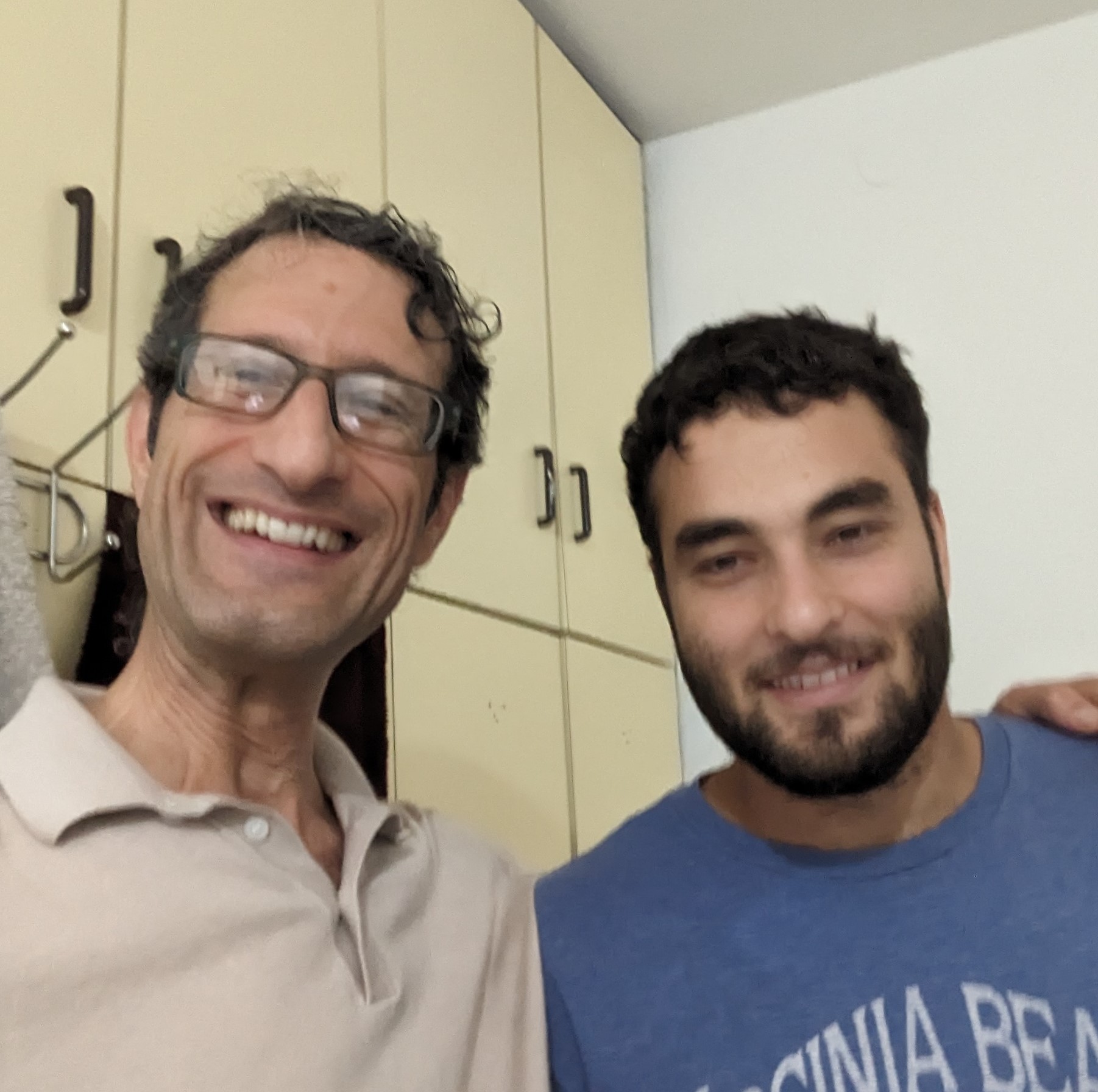
Oryah and I at Kibbutz Ein Gev, 11/8/2023

~

Rabbi Seth Adelson

(Originally delivered at Congregation Beth Shalom, Shabbat morning, 11/19/2023.)

Categories
Sermons

Less Stuff, More Compassion – Vayyishlah 5782

A funny thing happened to me this week.

The older of our two cars, a 2007 Toyota, was parked in front of our home in Squirrel Hill on Tuesday night. Judy went out on Wednesday morning, started up the car, and was absolutely freaked out by a fearful roar of the engine. It sounded like the muffler had fallen off. 

But no. As it turns out, some enterprising thief or thieves had gotten underneath the car and stolen the catalytic converter, which is apparently a 10-minute job that is worth it for the expensive metals, particularly platinum, found inside of it.

Catalytic converter

OK, so this is annoying for a whole bunch of reasons, as I am sure you can imagine. But let’s face it: a car, while essential for getting from place to place, is an expensive hunk of metal. Despite the fact that this vehicle was my first major purchase after completing rabbinical school, I do not have any particular affection or nostalgia for it. At some point, I’ll probably have to replace it with something that will look and feel a lot nicer, at least for a little while. I consider myself fortunate in that I can afford two cars.

But I had a fairly spartan childhood, growing up in rural New England. In my family, we almost never received Ḥanukkah gifts – for us, gift-giving was something that non-Jews did in December, and there was a clear, almost rabbinic opinion in my family that Ḥanukkah had nothing to do with Christmas, and that “giving in” to gift-giving was like celebrating Christmas. It just did not feel appropriate. 

So I suffered in resentful silence as my friends (virtually all of whom were not Jewish) received the newest, coolest toys, and all I got was a few pieces of chocolate wrapped in gold foil, and, if we were lucky, a few homemade latkes served with applesauce.

Truth is, my parents were experts at not buying stuff. We were all skilled in the art of re-using and recycling, way before it was cool, and turning the junk of others into our own treasure. Here is some true Adelson Family folklore:

Where we grew up, there was no municipal garbage pickup. We had to drive our garbage to the landfill (known affectionately as “the dump”) and actually toss it onto the pile, where it would soon be covered with soil. I’ll never forget the smell, which was not pleasant. 

Williamstown, Massachusetts, where I grew up

But the dump was fun in other ways – there was a recycling area where you could pick through the discarded periodicals of others, and also a spot where you could find large items that some considered garbage; but for us it was an opportunity to find slightly imperfect appliances and furniture at a VERY reasonable cost. So sometimes we came back from the dump with more stuff.

When my mother sensed that a critical mass of our household refuse had amassed in the garage, she would say, “Lennie, it’s time to go to the dump.” And my father would say, “Why? Whaddaya need?”

Now, with the anti-materialist deprivations of my childhood far behind me, I feel like I have too much stuff. I’ve got a whole house full of it. And, as I am sure is the case with many of you as well, most of it we almost never use.

As a society, of course, we think a lot about buying stuff at this time of year: the sales, the holiday pitches, family get-togethers, etc. Black Friday, the day when retail businesses go into the black, is coming up this week. And let’s face it: right now, supply-chain issues aside, the US economy needs a boost. (And perhaps some booster shots, as well!)

So it caught my eye that in Parashat Vayyishlaḥ, there is a particularly significant episode of gift-giving. Our hero Ya’aqov, preparing for being reunited with his brother Esav 20 years after effectively stealing their father Yitzḥaq’s blessing and fleeing, is expecting the worst. He assumes that Esav is still angry, and he has heard that Esav is coming with 400 men. So what does Ya’aqov do to attempt to head off a potentially deadly confrontation? He sends gifts: 550 animals – goats, sheep, camels, and even donkeys.

His reasoning is stated in the Torah (Bereshit / Genesis 32:21):

אֲכַפְּרָ֣ה פָנָ֗יו בַּמִּנְחָה֙ הַהֹלֶ֣כֶת לְפָנָ֔י וְאַחֲרֵי־כֵן֙ אֶרְאֶ֣ה פָנָ֔יו אוּלַ֖י יִשָּׂ֥א פָנָֽי׃

If I propitiate him with presents in advance, and then face him; perhaps he will show me favor.

This is very interesting verse for a number of reasons:

  1. The use of term minḥah, which we think of as meaning, “the afternoon service,” although here we reveal its original meaning, “offering.” (When the Temple was functioning in Jerusalem, prior to its second and final destruction by the Romans in the year 70 CE, the minḥah sacrifice was the daily offering in the afternoon.)
  2. There are four idioms containing the root peh-nun-yod, meaning “face,” which is clearly a leitwort / thematic word of this chapter. The root also appears in the place name Peni-el, literally “face of God,” where Ya’aqov has the wrestling match with the angel.
  3. One of those idioms is akhapperah fanav baminḥah, which is hard to translate. Our translation says, “If I propitiate him with presents,” although the verb here is to atone. Ya’aqov seeks to “atone to his face,” or something similar.

Ya’aqov knows, as we all do, that people like gifts. Giving a gift tells the recipient, I care.  I love you. I am concerned with your welfare. Or, in this case, I’m sorry for what I did to you 20 years ago. I am atoning to your face.

But gifts can also be a kind of shortcut, an attempt to say something meaningful without actually saying it! 

In recent years, since there is so much more shopping that happens online, we have not heard about the Black Friday debacles that have happened in the past: people lining up all night, and stampeding when stores open, to get to the heavily discounted holiday gift items. You may recall that there was a Walmart employee who was trampled to death on Long Island about a decade ago. So thank God that sort of thing isn’t happening right now.

We like having stuff!  Ya’aqov liked stuff too – he left his father-in-law Laban’s house with all the best animals. The offspring of that hand-picked herd, the unnaturally-selected cream of the woolly crop, was delivered to Esav to ameliorate him, because Ya’aqov assumed that his brother also liked having new stuff.

But really, the problem here is that gifts do not necessarily resolve long-standing estrangements. Gifts do not even solve simple disputes. They might make the recipient more willing to talk to the giver, and perhaps lighten the mood. But the issues are still there.

Perhaps Ya’aqov made his offering under the misguided notion that it would right past wrongs.  Perhaps he feared Esav so much that he was unable to “atone to his face” verbally, to ask for forgiveness, to apologize, to try to make amends.  So he gave him a whole pasture-full of ruminants.

And the plan may not have even worked! When the brothers meet, in the following chapter, Esav runs to greet Ya’aqov, kisses him, and immediately declines the gifts. “יֶשׁ־לִ֣י רָ֑ב אָחִ֕י יְהִ֥י לְךָ֖ אֲשֶׁר־לָֽךְ׃,” says Esav. “I have enough, my brother; let what you have remain yours.” I don’t need your charity.

Radaq, Rabbi David Qimḥi, writing in Provence in the 12th-13th c., says that Esav realizes in that moment that he has abased himself, and is filled with compassion for Ya’aqov and genuinely forgave his brother. Rabbi Ovadiah Seforno, 15th-16th c. Italy, tells us that this change happens when Esav sees his brother; it is only when they see each other face-to-face that all is forgiven.

Ya’aqov fails the key test: instead of actually seeking forgiveness through reaching out to his brother, he tries to buy him off with gifts. Ironically, the true hero in this case is Esav; he is filled with compassion, not moved by gifts. He didn’t need more stuff.

What is more valuable than material goods? Genuine, true expressions of love. Honesty, compassion, sympathy, and earnest attempts to forgive those from whom we are estranged. Showing our faces.

We read in the Talmud, Massekhet Shabbat,

These are the things which people may do and thus enjoy their fruits in this world, while the principal of the investment remains for the world to come: honoring one’s parents, the practice of loving deeds, and making peace between people, and the study of the Torah surpasses them all.

The most valuable gifts we can give are not tangible; they are expressions of love and compassion. Material goods might make us momentarily happy; but personal investment in our relationships and knowledge will pay off throughout this lifetime, and the next.

So don’t worry about the supply-chain issues. What your family and friends and maybe even estranged relatives need is for you to reach out and tell them how much you love them, how much you appreciate them, and how much you care. They don’t need more stuff; they need to see your face. They need you.

Wassily Kandinsky – Unstable Compensation, 1930

A joyous Thanksgiving to you and yours, and may you have a happy, illuminating Ḥanukkah!

~

Rabbi Seth Adelson

(Originally delivered at Congregation Beth Shalom, Pittsburgh, PA, Shabbat morning, 11/20/2021.)

Categories
Sermons

What Do Rabbis Do? – Vayyetze 5782

What does a rabbi do?

Are we teachers? Service leaders? Pastors? 

Am I employed by Beth Shalom to perform (God forbid!) your mother’s funeral? Or to help your daughter give a devar Torah for her bat mitzvah?

Do rabbis give advice? Pray for healing? Lead by being symbolic exemplars? Counsel people going through divorce or grieving a loss or celebrating a joyful moment? Plan and execute Purim, Simḥat Torah, Tu Bishvat, Tish’ah BeAv, and so forth? Work with people converting to Judaism, or teach in the Hebrew school? Do they serve a public role in the community as representatives and advocates? Serve on committees tasked with administrative duties for our qehillah (congregation)? Help members of our community deepen their connection to Judaism?

The answer to all of those questions is of course, yes. Rabbis do all of those things, and many more.

But if you had to encapsulate what rabbis do in one sentence, what would it be?

Not so easy to answer, right? 

I have some good news: Congregation Beth Shalom is now officially engaged in the process of hiring an Assistant Rabbi. This is very good news for you, because many of you know that I am stretched very thin (…), and the congregation as a whole will benefit if we have two people working in the rabbinic trenches. Our committee met for the first time this week, and we hope to be interviewing candidates as early as December. (Watch for upcoming info on two open forums in which you can participate.)

Surely some of you are thinking, “But how will we pay for another rabbi? Don’t we have a bunch of other rabbis around? Why do we need another one?”

First, I would like you to invite you to direct all questions regarding financing to our President, Alan Kopolow, and he will be happy to answer them.

But please know that Rabbi Mark Goodman, our interim Director of Derekh and Youth Tefillah, will hand off his responsibilities to the Assistant Rabbi when his term comes to an end in June. Additionally, the new Assistant Rabbi will be my partner in doing many of the things that I do from day to day and week to week. The other rabbis on staff (Rabbi Shugerman, Rabbi Freedman) have other areas of responsibility, and usually do not share in my tasks, particularly the pastoral and adult education roles. 

Hiring an Assistant Rabbi will allow us to deepen our rabbinic relationships with the community. It will ensure that you, a healthy-sized congregation of 600 families, are better served for all of the pulpit and pastoral responsibilities that are right now only attended to by yours truly. I’ll come back to this thought in a moment, but first a word from our sponsor this week, Parashat Vayyetze.

Vayyetze contains, right up front, one of my favorite scenes from the Torah. (Yes, I know I have a number of these, but this one is definitely in the Top 5.)

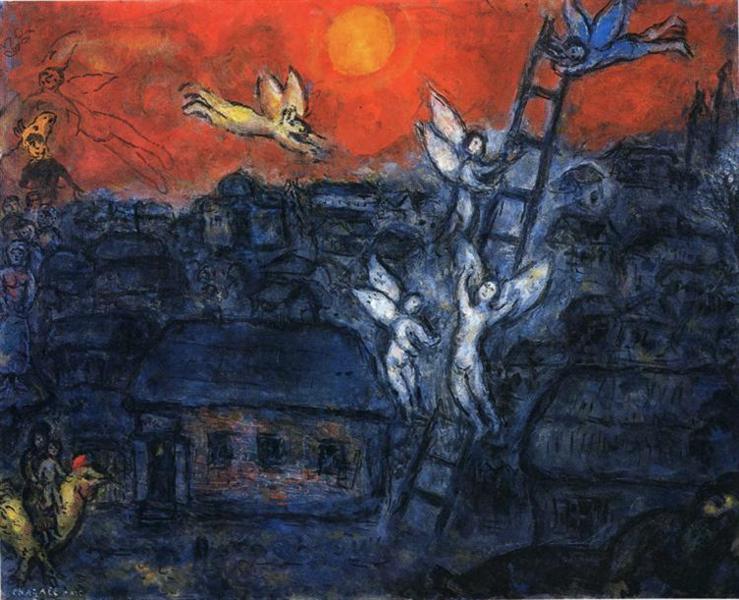
Our hero, Ya’aqov, is fleeing his brother Esav, and he stops for the night to have a schluff. While asleep, he has a vision of angels going up and down a ladder, and upon waking, he realizes that he is in a holy place, and exclaims (Bereshit / Genesis 28:16-17),

אָכֵן֙ יֵ֣שׁ ה’ בַּמָּק֖וֹם הַזֶּ֑ה וְאָנֹכִ֖י לֹ֥א יָדָֽעְתִּי׃ וַיִּירָא֙ וַיֹּאמַ֔ר מַה־נּוֹרָ֖א הַמָּק֣וֹם הַזֶּ֑ה אֵ֣ין זֶ֗ה כִּ֚י אִם־בֵּ֣ית אֱ-לֹהִ֔ים וְזֶ֖ה שַׁ֥עַר הַשָּׁמָֽיִם׃ 

“Surely the LORD is present in this place, and I did not know it! … How awesome is this place! This is none other than the abode of God, and that is the gateway to heaven.”

Has anybody here ever had a revelatory moment quite like that?

Marc Chagall, Jacob’s Ladder (1973)

It is a striking statement. Ya’aqov had not thought that there was anything special about this place, or this particular time, and yet he is suddenly aware of God’s presence, of the holiness of this single point in the spacetime continuum.

One thing that we might learn from this is that sometimes extraordinary things happen in otherwise ordinary circumstances. That is, you never know when the miraculous might occur, and you may not even realize that you are in the middle of a miracle until after the fact.  

And so it might very well be a good idea to expect it! The 15th-16th c. Italian commentator R. Ovadiah Seforno says that after the fact, Ya’aqov regretted not being ready for this moment:

ואנכי לא ידעתי שאלו ידעתי הייתי מכין עצמי לנבואה ולא כן עשיתי

And I did not know it. That if I had known [that God is present in this place], I would have prepared myself for prophecy; but I did not.

In retrospect, Ya’aqov realized that he missed his chance. He gets another one four chapters later, when he wrestles with an angel and is bestowed the name Yisrael. But here, he was not ready. God showed up – a miraculous moment – and Ya’aqov was caught off guard.

Do not think, ladies and gentlemen, that the synagogue is the only place where qedushah / holiness happens. On the contrary: what we learn from this passage is that holy moments can happen anywhere.

I might frame my job as a rabbi to be to remind you to connect the dots between what we learn from the Jewish bookshelf, here in the synagogue and elsewhere, with what we do with the rest of our lives. That is, the rabbi’s job is to deepen your understanding and appreciation for our tradition, so that it will stick with you; that you will remember the lessons taught by Avraham and Sarah, Rivqah and Yitzḥaq, Ya’aqov and Leah and Raḥel; that these pieces of ancient wisdom will be there when you need them, wherever you are in your Jewish journey. 

We need to be ready – ready for nevu’ah / prophecy, as Seforno suggests, or maybe ready just for the opportunity to raise the general level of qedushah / holiness in our midst: by making the right choices for ourselves and for others; by greeting another person with a smile; by being a better, more respectful neighbor; by seeking to understand before we criticize; by committing to learn an inch deeper, an centimeter wider. (The Talmudic text that I taught earlier suggests that all that it takes to get the yetzer hara off of somebody’s back is to drag them into the Beit Midrash!)

That is the value of our tradition. And the role of the rabbi is to help you find the wisdom, and to be ready, because you don’t want to miss that holy moment when it comes. 

I was asked recently by one of the members of our current Intro to Judaism class what the biggest challenge to contemporary Judaism is. And, lamentably, the answer is apathy. Indifference to our tradition.

And the survey data that we collect about ourselves (e.g. the recent Pew study) reinforces this: we see a gradual hardening on the far theological right, and everybody else, from Modern Orthodoxy leftward, is gradually drifting away. You know this from the realities of your own family members. Assimilation and disinterest continue to take their toll.

My primary role as a rabbi is not only to endeavor to inspire those who may be drifting away, but also to inspire you who are not, you who are still showing up for Jewish life, to deepen your commitment, to be role models for contemporary Jewish engagement, to demonstrate your appreciation and love of Jewish text, Jewish ritual, Jewish living. My primary goal is to make you care – to show you the value in our tradition, and how it can improve your life and our world. That is, to be ready for all holy moments that come your way; to recognize that God is always in the place where you are. 

And the same will be true of our new Assistant Rabbi. Ladies and gentlemen, as we embark on this process, please know that foremost in my mind is that the successful candidate will inspire you to think about our tradition not only on Shabbat morning or at a Lunch and Learn or a shiv’ah house, but in every waking moment, and sometimes when, like Ya’aqov, when and where you sleep as well.

What do rabbis do? They help us to be ready for the holy moments, the times when God is in this place, and God knows we need more inspiration to do so.

~

Rabbi Seth Adelson

(Originally delivered at Congregation Beth Shalom, Pittsburgh, PA, Shabbat morning, 11/13/2021.)