Categories
Sermons

Jewish Unity, Past and Present – Yitro 5784

The Jews are a notoriously fractious people, and the Torah makes clear that this was the case from our very inception. When did the Jews start complaining? Right after they escaped from Pharaoh’s army, having crossed the Sea of Reeds on dry land, no longer slaves but as free people, last week in Parashat Beshalla. They are already grumbling about why they followed Moshe and Aharon out into the desert (Shemot / Exodus 16:3). 

וַיֹּאמְר֨וּ אֲלֵהֶ֜ם בְּנֵ֣י יִשְׂרָאֵ֗ל מִֽי־יִתֵּ֨ן מוּתֵ֤נוּ בְיַד־ה֙’ בְּאֶ֣רֶץ מִצְרַ֔יִם בְּשִׁבְתֵּ֙נוּ֙ עַל־סִ֣יר הַבָּשָׂ֔ר בְּאׇכְלֵ֥נוּ לֶ֖חֶם לָשֹׂ֑בַע כִּֽי־הוֹצֵאתֶ֤ם אֹתָ֙נוּ֙ אֶל־הַמִּדְבָּ֣ר הַזֶּ֔ה לְהָמִ֛ית אֶת־כׇּל־הַקָּהָ֥ל הַזֶּ֖ה בָּרָעָֽב׃  

“If only we had died by the hand of God in the land of Egypt, when we sat by the fleshpots, when we ate our fill of bread! For you have brought us out into this wilderness to starve this whole congregation to death.”

One might make the case that the only time that the Israelites, or the Jewish people, spoke in one voice is the moment that we read today in Parashat Yitro (Shemot 19:8): 

וַיַּעֲנ֨וּ כׇל־הָעָ֤ם יַחְדָּו֙ וַיֹּ֣אמְר֔וּ כֹּ֛ל אֲשֶׁר־דִּבֶּ֥ר ה’ נַעֲשֶׂ֑ה

All those assembled answered as one, saying, “All that God has spoken we will do!” 
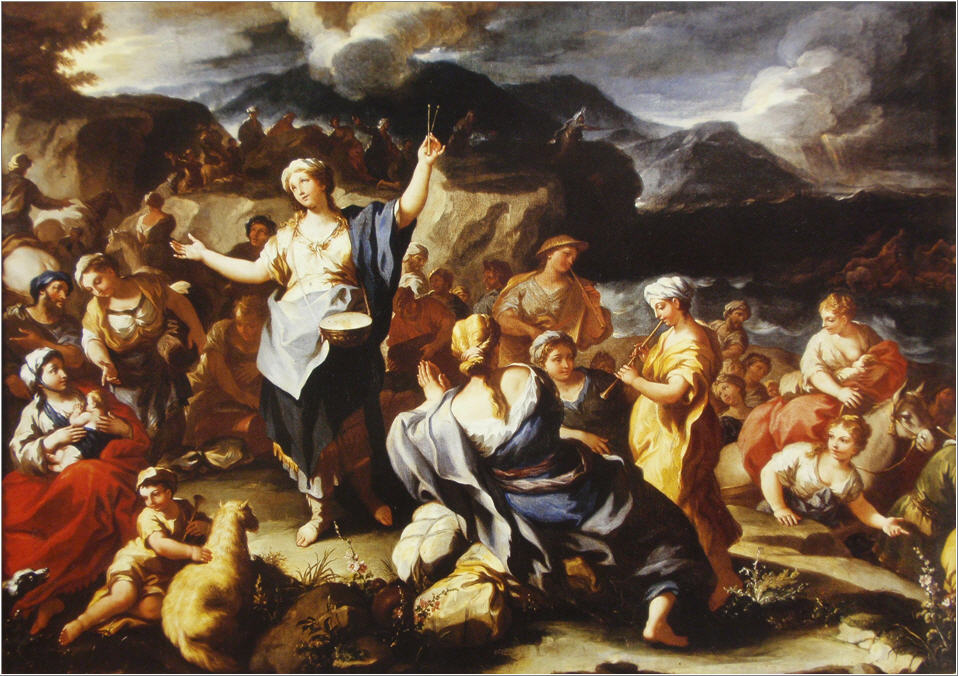
The Israelites accept the Sinai covenant, even before they have heard the words of Aseret HaDibberot / the “Ten Commandments,” יַחְדָּו֙, as one, in one voice. That has never happened since. I have even made the argument in this space that our inclination to disagree with each other, particularly over the meaning of our ancient texts, is the reason that we are still here. The Romans did us a favor, nearly two millennia ago, by destroying the Beit haMiqdash / Temple in Jerusalem and forcing us to make our tradition portable and democratic, rather than centralized and hierarchical. Hence the disagreement.

Detail from the Arch of TItus, showing Romans carrying Temple implements from Jerusalem

A curious thing happened after October 7th: suddenly, it seemed that the whole Jewish world was united against Hamas. And how could we not be? The Jewish people were attacked, brutally; an area within Israel’s boundaries was occupied by terrorists. More Jewish people were killed that day than on any day since World War II. As horrific as the details and magnitude of what happened are, I fear we will not grasp the full scope of the horror for years.

For a moment or two, we spoke with one voice. The sovereign, democratic State of Israel must defend itself against terrorism. Full stop. The unity in Israel and with Diaspora Jews was unbelievable. When I was in Israel in November, the statement of this unity which I saw and heard everywhere – on billboards, as the lead-in to radio advertisements, projected onto the sides of buildings – was יחד ננצח. Together, we will win.

When Israel called up its reserve soldiers, 150% of those called showed up for duty – something which never happens. Israelis who were trekking through Thailand and Bolivia got on the first plane home. Jews all over the world, including some in Pittsburgh, rounded up needed supplies to send to Israel. Perhaps most remarkably, many Ḥaredim (I’ve heard as many as 4,000) signed up to serve in the IDF, something which they have historically not done in great numbers.

In January, I spent two days with HaZamir, the International Youth Teen Choir, in New Jersey. The HaZamir environment is one of the last places in the (non-Orthodox) Jewish world that is still unquestionably, proudly, unapologetically Zionist. And that is a particularly satisfying feeling for me, because it features Jewish teens singing Hebrew choral music, which I love.

But of course, four months into this war, we are now seeing cracks in the Jewish unity which followed October 7th. In Israel, frustration over the fact that there are still 100+ hostages is boiling over, and anger at Prime Minister Benjamin Netanyahu, which seems to now be carrying over from the pro-democracy protests of last year, is palpable. 

We are still seeing plenty of anti-Israel activism around the world. South Africa’s charging Israel with genocide in the UN’s highest court is a prime example. And of course there are Jewish groups (Jewish Voice for Peace, IfNotNow) who are calling for an unconditional ceasefire, something which merely hands Hamas both victory and opportunity to re-arm.

I think it is difficult to argue with the fact that Hamas has succeeded in its diabolical plot far beyond its own expectations. Not only did they excel at murder and hostage-taking, but also, knowing that Israel’s response would be devastating and deadly for the people of Gaza, in soon turning world public opinion, including that of some Jews, against Israel. 

evreh, it is absolutely abhorrent that somewhere around 26,000 Gazans have died in this war. And yes, that number is courtesy of Hamas, but there is no disputing that thousands of civilians have died in a war due to Hamas’ cynical use of their people as human shields. There is no question that we should be seeking a peaceful solution to find a way to preserve human life throughout the region. But in light of what happened at the International Court of Justice a week ago, we should remember a few important things:

  1. That figure of 26,000 includes about 10,000 Hamas fighters. I rarely see an American news outlet even mention that. Furthermore, Hamas likely overestimates the number of children who have been killed.
  2. Remember that Hamas is still firing rockets into Israel, and of course returning fire on advancing Israeli troops, and all of this fighting is taking place in one of the most densely-populated places in the world.
  3. The current tumult about UNRWA, the UN organization which provides humanitarian aid, running schools and hospitals in Gaza and elsewhere, is not surprising to anybody who has been paying attention. The fact that UNRWA employees are not only giving cover and aid to Hamas, and indeed even participated in the attack of October 7th, is deeply problematic.
  4. Netanyahu’s approval rating in Israel right now is somewhere around 26%. If elections were held tomorrow, Likud would lose dramatically. He and his far-right allies are now leaning into their base to try to drum up support for horrible ideas, like re-occupying Gaza, or worse. We should look past this inflammatory rhetoric to the day when he is no longer in power, and that day should be coming soon.

When Theodor Herzl wrote, in his 1902 book Altneuland (“Old-new land”), Im tirtzu, ein zo agadah (“If you will it, it is no dream”), he was, in fact, creating a new idea in Jewish life: that people did not have to wait for God to make the first move in establishing a home for the Jewish people. Decades before the rise of Nazism, Herzl knew that the safety and security of Jews in the Diaspora would wax and wane but never be completely stable, and that the only realistic solution for the Jewish future would be self-determination in the land from which we came.

Herzl could not have predicted the challenge of Hamas, although he was certainly aware that the Zionist idea would not be universally accepted, even by Jews, from the outset. 

However, I must say that even though I have thrown my lot with the Diaspora (at least for now), Herzl was right. America, as wonderful as it has been for the Jews, will never be entirely safe. We in Pittsburgh know this all too well. And all the more so many of the other places where Jews have lived. 

The Israeli singer Gali Atari made famous the song lyric, “Ein li eretz aeret.” I have no other land. And as much as we would like to think that we have succeeded here and elsewhere, I still believe in Herzl’s dream: “Lihyot am ḥofshi be-artzeinu.” To be a free people in our land.

And I must add that while I am a loyal American, grateful to this nation for the safe haven it offered my great-grandparents more than a century ago, I am feeling a lot less safe in this country than I used to. And there are plenty of Jews around the world who live in places that are far less safe and stable.

I do not imagine that we will see the unity of October 8th again any time soon. But I think it is essential for us to hold onto certain principles as we move forward:

The hostages must come home before there will be any ceasefire agreement.

Likewise, Hamas must surrender. The ongoing existence of this terror group is a demonstrable threat to the safety of Israeli citizens as well as Palestinians, and to some extent Jewish people the world over.

The people of Israel need our support. We may not achieve full and complete unity, but we must stand with the nearly 10 million people of that nation, Jews and non-Jews, in their quest to remain a safe, democratic haven in a decidedly non-democratic region.

This war is deeply painful for millions of people across the region, and that pain has, to some extent, impacted Jewish unity. The opening line of Beshalla (Shemot/Exodus 13:17) last week actually spoke to the challenge of war. Instead of sending the Israelites out of Egypt the easy way,  to return to Israel on the seaside route, which would have taken just a few weeks, the Torah reports that God sent them the long way, the 40-years-in-the-desert route, because God was concerned that when they saw war (e.g. with the Amalekites, the Philistines, the Canaanites, etc.), they would have a change of heart and return back to Egypt.

In the context of war, it is easy to say, “Let’s go back to Egypt,” Although we all know that would be much, much worse. We should rather recommit to Israel, to commit to the longer, harder journey, if not to the unity we once had.

~

Rabbi Seth Adelson

(Originally delivered at Congregation Beth Shalom, Pittsburgh, PA, Shabbat morning, 2/3/2024.)

Categories
Sermons

Battle for the Soul of America – Vayishlaḥ 5784

You may have noticed that some members of the Jewish community have put up posters of Israelis held hostage by Hamas on multiple utility poles on Murray Avenue. This is to remind us all of the 140 or so hostages remaining in Gaza, and to keep before us an essential principle of halakhah / Jewish law, that redeeming captives is an urgent obligation which pre-empts many other mitzvot.

Taking down hostage posters on Murray Ave.

And, there are others in our neighborhood who are regularly removing these posters. Perhaps they do not want people to remember the hostages, or maybe they do not believe that there really are hostages, or perhaps they are so consumed with hatred that any acknowledgement of ongoing Israeli suffering would be humanizing the “oppressors” or legitimizing the existence of the State of Israel and therefore forbidden according to their world-view. This phenomenon is not unique to Squirrel Hill; a striking example is that a few weeks back a New York public defender was caught on video doing so.

Parashat Vayishlaḥ opens with one of the most striking transitional moments in the Torah. As Ya’aqov is about to be reunited with his estranged brother Esav, he encounters an angel, with whom he wrestles all night long. This is the scene in which he receives his new name, Yisrael, which, rabbis love to remind us all, means, “the one who struggles with God.”

And yet I, like many of my colleagues, often leave out the second part of the Torah’s etymology of Yisrael (Bereshit / Genesis 32:29):

וַיֹּ֗אמֶר לֹ֤א יַעֲקֹב֙ יֵאָמֵ֥ר עוֹד֙ שִׁמְךָ֔ כִּ֖י אִם־יִשְׂרָאֵ֑ל כִּֽי־שָׂרִ֧יתָ עִם־אֱ-לֹהִ֛ים וְעִם־אֲנָשִׁ֖ים וַתּוּכָֽל׃

Said [the angel], “Your name shall no longer be Ya’aqov, but Yisrael, for you have striven with beings divine and human, and have prevailed.”

We are not only the people who struggle with God, but we also struggle with humans. Ya’aqov’s spiritual wrestling match is a foreshadowing of Jewish history: we struggle with the concept of God and how we relate to the Divine, but we are, in some sense, grappling eternally as a people with the others around us, and mostly not by our own choosing. We have been forced to do this for thousands of years, and mostly we have prevailed.

We are in this moment engaged in a battle for the soul of America, if not the world.

Ḥevreh, the world has been sold a bill of goods. Somehow the genocidal terrorists of Hamas,  whose stated mission is to destroy the State of Israel and kill Jews wherever they are, whose members torture and rape and murder, who are not bound by the laws of military engagement, has been rebranded as carrying out “resistance,” as “martyrs” who are “freeing Palestine from the river to the sea.” And many Americans, on college campuses, in government offices, on school boards, in media companies, in the performing arts, in think tanks and granting foundations and social service organizations have bought into this lie.

Make no mistake: this is the result of a savvy, coordinated effort to win over the hearts and minds of Americans, whose limited knowledge of history, and in particular Jewish history, has easily enabled it. College students in particular are vulnerable, and many have apparently embraced the narrative of the Jew as oppressor, nonsensically lumping us in with all the other “white supremacists” who must be vanquished in a post-colonial world. 

It is this grave distortion of history which denies Hamas brutality, and thus views the removal of those hostage posters not as a denial of Jewish lives, but rather as some kind of twisted standing-up for the underdog.

How did this happen? How did we lose the hearts and minds of those who see themselves as warriors for social justice? How do they justify dehumanizing murdered Israeli citizens, delegitimizing the nation which provided safe haven for Jews following the Nazi slaughter, and fomenting anti-Semitism worldwide? Well, it started with a plan – actually, a public relations crusade.

Gary Wexler, who teaches at USC’s Annenberg School of Communications and who has been creating advertising campaigns for Jewish organizations since the 1980s, recently wrote a piece for the Jewish Journal of Los Angeles, in which he describes meeting the architect of this PR plan in the mid-1990s in Haifa. His name is Ameer Makhoul, and he was the Executive Director of Itijaa, an Israeli-Arab civil rights organization. Wexler quotes Mr. Makhoul as describing it this way: 

We will create… Palestinian campus activists in America and all over the world. Bigger and better than any Zionist activists. Just like you spent your summers on the kibbutz, we will bring college students to spend their summers in refugee camps and work with our people. Just like you have been part of creating global pro-Israel organizations, we will create global pro-Palestinian organizations. Just like you today help create PR campaigns and events for Israel, so will we, but we will get more coverage than you ever have. 

You wonder how we will make this happen, how we will pay for this? Not with the money from your liberal Jewish organizations who are now funding us. But from the European Union, Arab and Muslim governments, wealthy Arab people and their organizations. Eventually, we will not take another dollar from the Jews.

So if you have found yourself asking aloud in recent weeks, “Why are the people who ostensibly care for every marginalized group of people of every stripe,  suddenly marching for making Palestine Judenfrei?” you are not alone. What you are seeing is decades in the making. “Apartheid Week.” BDS. The platform of the Movement for Black Lives, which incorporated language to equate the Palestinian struggle with that of Black Americans. All of it is part of that plan to change the narrative, to deny the Jews our right to self-determination in the land from which we came.

There was a small piece of news here in Pittsburgh which may have crossed your radar (e.g. on WESA or KDKA) in recent weeks. It was about how the Pittsburgh Public Schools is paying a contractor called Quetzal Educational Consulting to help improve math instruction for Black students. The intention is, of course, commendable. There is a significant achievement gap between Black and white students in math.

But if you go to Quetzal’s website, you are greeted with the words, “Decolonize. Reclaim. Reimagine.” And if you check out their Facebook feed, you will quickly find many posts featuring “Free Palestine,” “End the Occupation,” and even a quote equating Zionism and imperialism.

There is no question that Black students deserve better math outcomes, and our public schools should indeed be working hard to ensure that we achieve better outcomes for all students in math, English, science, and particularly history, and maybe even geography. But why should that come at the expense of the Jewish right to self-determination? And what on Earth does supporting the Palestinian cause have to do with math?

I simply cannot get past the feeling that Jews have been unjustly relegated to the wrong side of history. Despite millennia of oppression, despite the very real genocide of Hitler, the forced conscription and pogroms of the czars, the Expulsion from Spain, and yes, October 7th, we are suddenly the oppressors. We are the imperialists. We are the ethnic cleansers.

[Note: the following paragraph is out of date, although I include it here because at the time that I delivered this sermon I was unaware that the UN Women organization had just released a tepid statement, which can be found here. Coming nearly two months after the attack, this statement seems too little, too late.]

** You may have heard that UN Women, the United Nations entity dedicated to gender equality and the empowerment of women, has refused to even acknowledge the sexual atrocities committed by Hamas terrorists. There is abundant proof that these things occurred; where is the outcry from those who marched for #MeToo? **

At a city council meeting in Oakland, California this week regarding a resolution calling for ceasefire, public comments included denial that the atrocities of Oct. 7 were actually carried out by Hamas at all, instead blaming them on the Israelis themselves. And when speakers mentioned that Israeli women were raped, assembled citizens chanted together “Liar! Liar!” The elected officials not only failed to control the hatred and vitriol, but did nothing to correct the record. It’s beyond comprehension.

We are losing the battle for the soul of the world. And not only that, but the narrative has changed to blaming the victim, where Israel and her supporters are concerned. What happened to, “Believe Women!”

The tyranny of the Shoah, the Nazi Holocaust, is that millions of ordinary people all over Europe stood by as the Jews were systematically taken away and slaughtered. Good, well-meaning people let it happen. They stood by and said nothing, because the ideological groundwork had long since been laid by the Nazi regime. We are seeing the stirrings of this facilitated “bystanderism” once again.

Our eternal struggle is simply to be a free people in the land from which we came, unmolested by terrorists as we recline under our own vine and fig tree. October 7th may have shattered that dream. But even worse is the threat that the world may let the terrorists win, as well-intentioned people turn their heads away from the utter depravity of Islamist jihadists. 

But you can help win this battle. You have a voice. All you have to do is speak the truth. To remember the hostages. To ensure that the story of what really happened on October 7th is told and retold. To foil those who seek to deny or rewrite history. To thank our politicians who continue to stand against terror. To remind the world why Israel must be allowed to take Hamas out.

Somewhat more to the point, the Jewish world needs to unite and craft a coordinated campaign to counter the one created by Ameer Makhoul, who was ultimately convicted of spying for Syria and spent nine years in an Israeli jail. I know we have a few folks in the Jewish world who could coordinate messaging on Israel in the Diaspora, to win back hearts and minds. Just as we cannot abide Hamas on Israel’s border, so too can we not allow their hate-filled rhetoric to dominate the world’s discourse on the conflict.

Ya’aqov survives the wrestling match with the angel, but limps away. We may be injured, but the Jewish spirit is not broken, and pride in being Jewish, in our peoplehood, our history, our traditions, our text, our rituals, is still found throughout the world. And every time you do something Jewish, every time you walk through the world holding that pride and knowledge and ancient wisdom, every time you raise your voice in defense of the truth, you notch up a tiny, little victory in the battle. 

~

Rabbi Seth Adelson

(Originally delivered at Congregation Beth Shalom, Pittsburgh, PA, Shabbat morning, 12/2/2023.)

Categories
Sermons

Don’t Take Down Your Mezuzah – Vayyera 5784

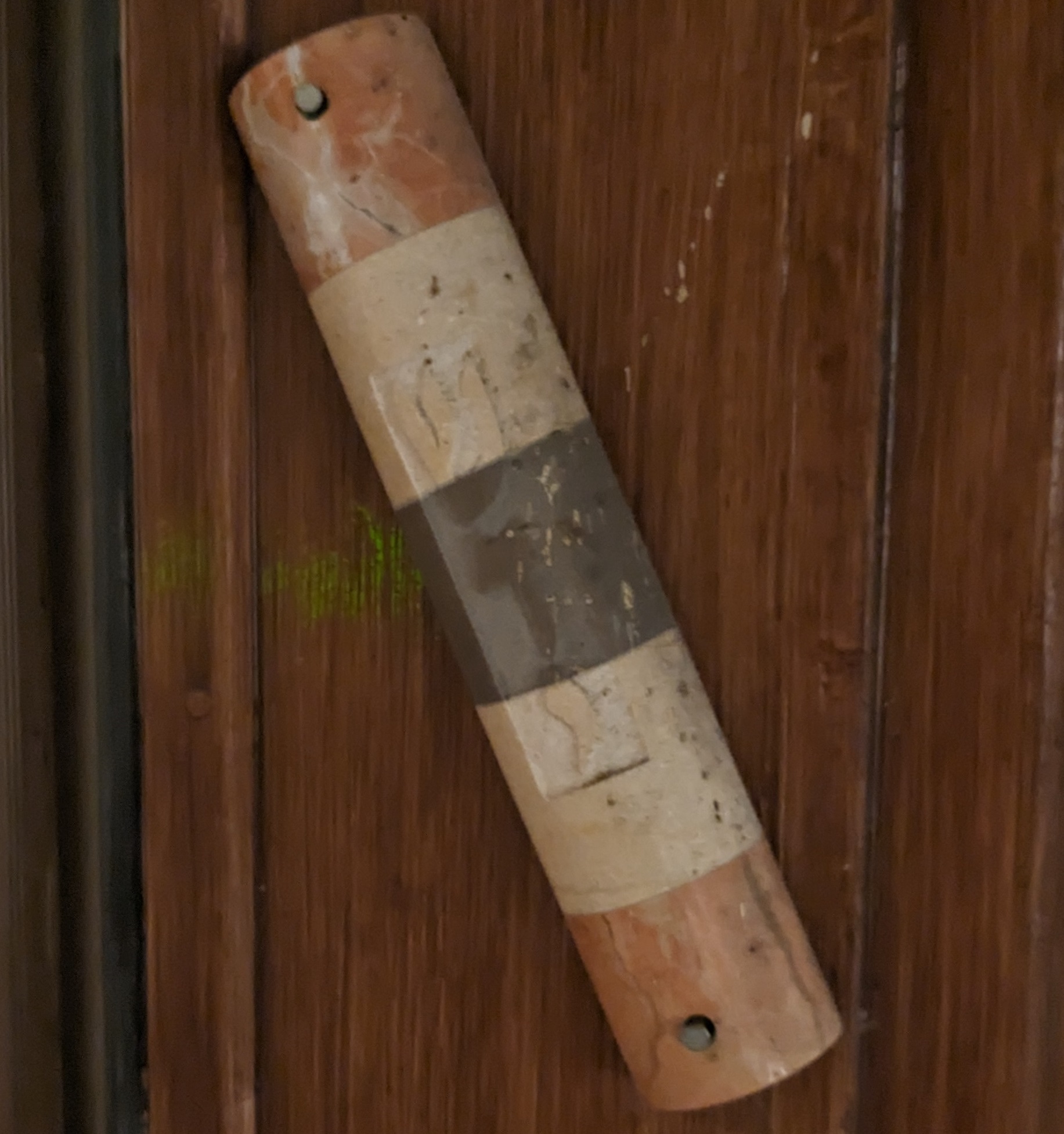
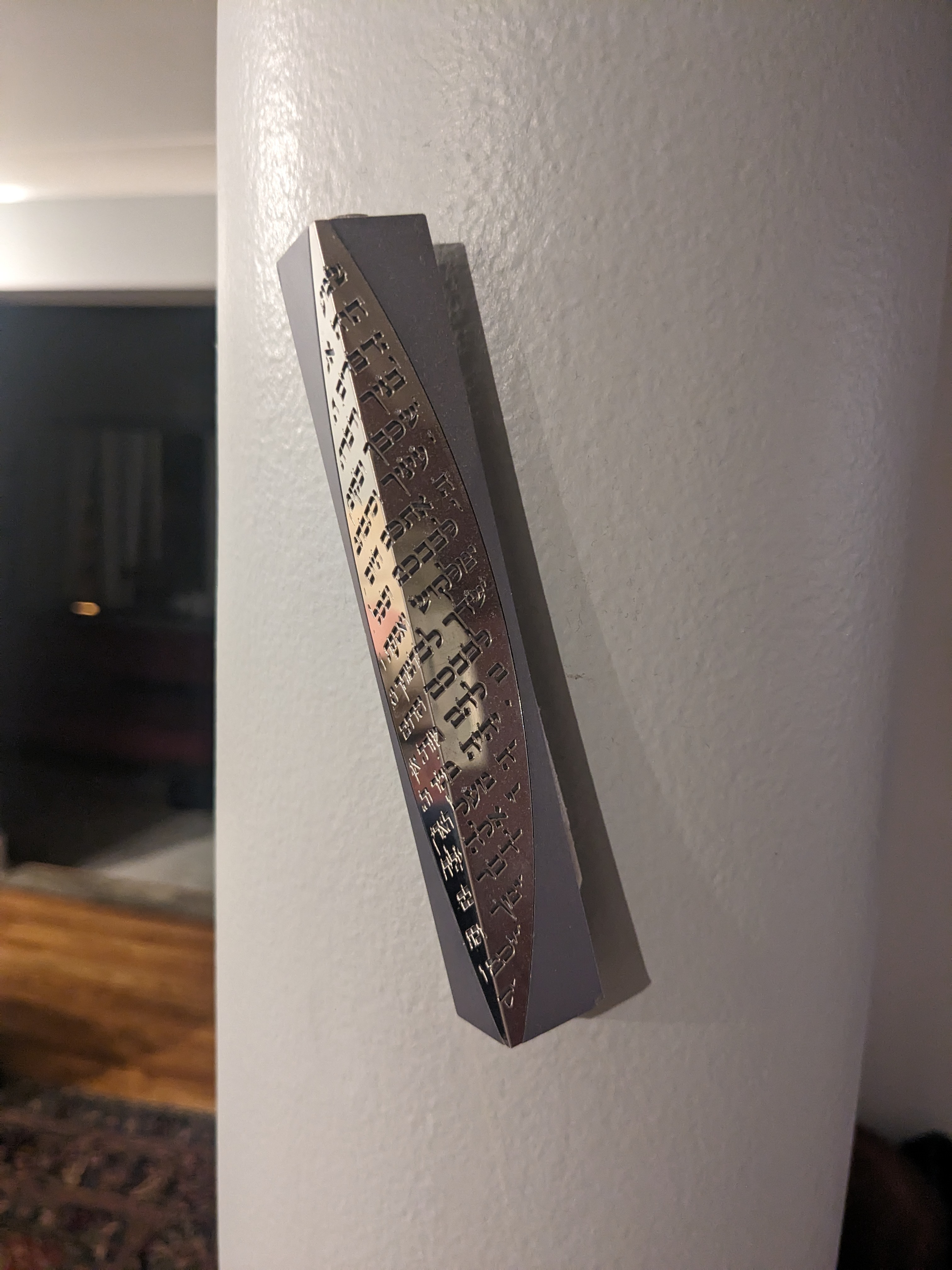
Here is a piece of advice for the current moment: Do not take your mezuzot down from your doorposts.

Our patriarch Avraham, the first monotheist and the father of Judaism, Christianity, and Islam, is described in Parashat Vayyera as hospitable; he welcomed guests into his tent. A midrash suggests that this tent was open on four sides, which leads to a very, very important question: were there four mezuzot on the exterior doors of Abraham’s tent?

Now, you might say that question is clearly ridiculous. According to traditional chronology, Moshe receives the Torah on Mt. Sinai nearly 500 years after Avraham walked the Earth, so how could Avraham have known to put mezuzot on his doorposts? The commandment to inscribe the words of the Shema on our doors had not yet been given. But there is another tradition that tells us that the Avot, the patriarchs, and by extension the Imahot/matriarchs as well, kept the entire Torah, even before Mt. Sinai. 

So of course Avraham had mezuzot on his tent doors!

I’ll come back to that.

Meanwhile, I’m getting asked quite frequently how I am doing, and in general, as is customary, I answer, “OK.” That is also how my son, who is still in the north of Israel at an artillery position, behind a large gun aimed at Hizbullah, answers when he is asked. I am grateful that he is not on the ground in Gaza, although you may know that we have multiple children of this congregation who are there right now, and we are praying for them all.

But I must say that I am not feeling too good about the world right now. In the coming week we will observe the 85th anniversary of Kristallnacht, the Night of Broken Glass, when Nazi-aligned thugs across Germany, Austria, and the Sudetenland destroyed 267 synagogues, 7,000 Jewish businesses, and murdered at least 91 Jews. 

In the wake of Kristallnacht. Fasanenstrasse Synagogue, Berlin, 1938.

What we are seeing around the world right now – on European streets, on American college campuses, and even in our own neighborhood – is tremendously unsettling, even though, thank God, we are not yet seeing a reprise of 1938. 

Nonetheless, in Paris, vandals are painting Jewish stars on Jewish-owned buildings. On TikTok, Jewish content creators have been subjected to an avalanche of hatred. At Tulane University, a student was punched in the face for standing with Israel.

I loved the four years I spent on the campus of Cornell University, studying chemical engineering, singing in an a capella group, and occasionally dining at what was at the time a brand-new kosher dining hall. 

That kosher dining hall was deserted a week ago, its regular diners too scared to leave their dorm rooms, as threats to the physical safety of Jewish students at Cornell were posted online. Thank God, the police have found the alleged perpetrator. But for those students who felt that their lives were threatened, I do not see how there can be any real comfort right now.

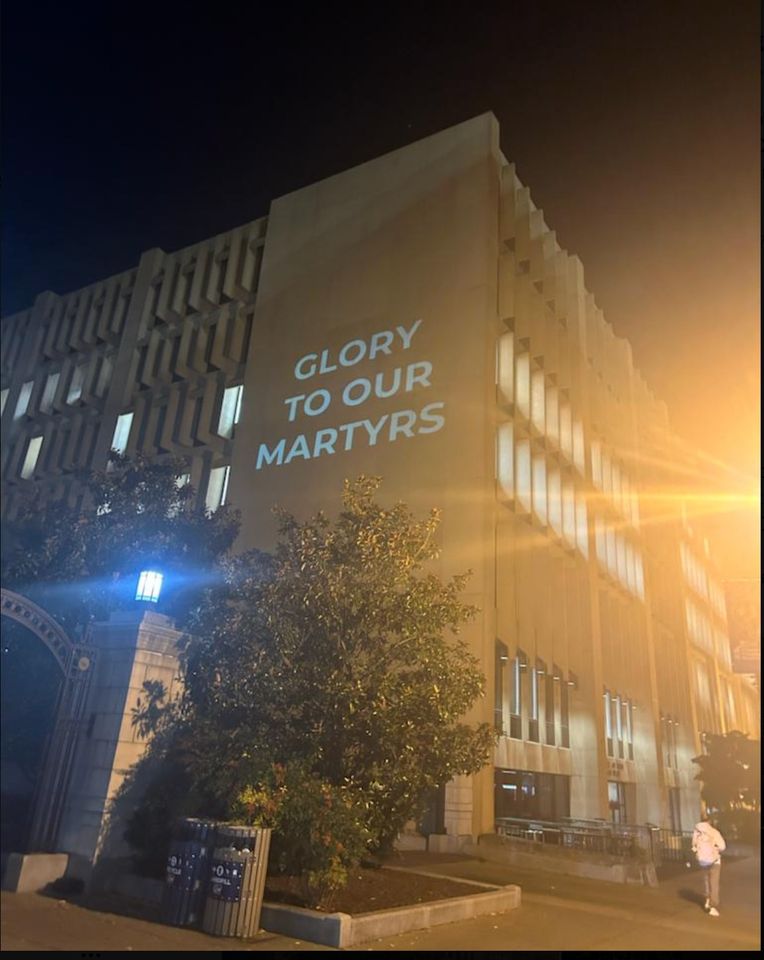
Nor for the students at Columbia who held a press conference to plead for protection from the university from the constant harassment they face from anti-Israel activists. Nor is there comfort for the students at George Washington University, where the slogan, “Glory to the Martyrs” was projected on a building. To be clear, the “martyrs” being glorified here are Hamas terrorists who infiltrated Israel and executed barbarous atrocities too graphic to speak of in a house of worship.

Ladies and gentlemen, Hamas has successfully pulled the wool over the eyes of the world. In a sinister turn, the world’s attention has turned to the humanitarian catastrophe in Gaza, which is undeniably real, and truly awful. But let us be clear: this catastrophe was not created by Israel.

Billions of dollars in aid have been given to Gaza by international organizations. Did Hamas pour that money into infrastructure that would sustain its people? No. They built hundreds of miles of tunnels and more powerful rockets with which to carry out what they cynically call “resistance” to the “Israeli occupation.” They built their headquarters under the main hospital in Gaza City, rather than improving the capacity or care of that hospital.

And so there have been huge demonstrations on college campuses where students and faculty are actually praising Hamas! This past week, more than 100 Columbia professors signed a letter that sought to “recontextualize” the conflict, calling the brutal and horrific attack of October 7 a “military action,” and supporting those students who defend the actions of Hamas.

Here is a question that we might ponder: When Russia invaded Ukraine, at first in 2014 and then escalating in 2022, were there campus protests supporting Vladimir Putin, or “recontextualizing” the Russian invasion? I wonder why not?

The Syrian civil war has been going on now for 12 years, and the UN estimates that over 300,000 Syrians have been killed. Where are those marching for justice in Syria?

Even less well-known is the civil war in Yemen, which, by the way, apparently just declared war on Israel. Somewhere near 400,000 Yemeni civilians have been killed; 85,000 children have died of starvation since 2014. Where are the voices calling for humanitarian aid in Yemen? Where are the calls for “ceasefire now”?

You know where the world’s largest refugee camp is? Bangladesh, where over a million Rohingya Muslims have fled actual genocide at the hands of the military leadership of Myanmar. Where is the outrage? Where are the projections on campus buildings, the graffiti?

So what’s the difference between the action on the ground in Gaza and all of those other situations? Jews. The world simply cannot stand with the Jews. 

And though there is always legitimacy, necessity even, to criticizing governments and policies, since Oct. 7, it is apparent that, lurking behind much of the current criticism is the sneaky specter of anti-Semitism. The ADL calculated that the number of anti-Semitic attacks over the first two weeks following Oct. 7 was up 388% from the same period last year. There is a little irony here: anti-Jewish attacks beget more anti-Jewish attacks.

There are even Jews who cannot stand with the Jews. Groups like Jewish Voice for Peace and IfNotNow, who think that they are supporting the Palestinian people by labeling the death of innocent civilians who are being used as human shields as a “genocide,” and by calling for a ceasefire. They are delusional; they are, in fact, supporting terrorists who seek only to destroy.

I know it is very tempting to say, just stop. The idea of a ceasefire is appealing. The problem with calling for “Ceasefire now,” is that a ceasefire benefits ONLY Hamas. Hilary Clinton – not exactly a military hawk – said exactly that this past week. 

By the way, there was a ceasefire in place up until October 6th. Who broke it? And what happened? And if there is a ceasefire now, what will inevitably follow? Hamas will regroup, strengthen itself, acquire better rockets and training from Iran, and then attack Israeli civilians again. And again. And again. And the Palestinian people gain nothing – only more death and destruction and sorrow.

In 1946, Lutheran Pastor Martin Niemöller gave a confessional speech in Germany, in which he famously admitted his own guilt, and the guilt of all well-meaning people in Germany, for the murder of 6 million Jews. Although the original text was lost to history, it is often rendered this way:

First they came for the socialists, and I did not speak out—
Because I was not a socialist.

Then they came for the trade unionists, and I did not speak out—
Because I was not a trade unionist.

Then they came for the Jews, and I did not speak out—
Because I was not a Jew.

Then they came for me—and there was no one left to speak for me.

Now is the time for those who care about all that is good and righteous and hopeful for the future to stand up and speak up for the safety of Jewish people, in Israel and around the world. Now is not the time for a ceasefire. Now is the time to do what should have been done long ago: to remove Hamas from power and to give the Palestinian people a government that will work for their benefit. 

That is a wee bit too easy to say, I know. But remember also that I have a son who wears the uniform of the Israel Defense Forces, and is standing in the line of terrorist fire, and in some sense, all of us do so as well.

And if nobody else stands up for the Jews, we must stand up for ourselves – for our heritage, history, culture, wisdom, and tradition of discernment. Edmond Fleg was a French Jewish writer, who in 1927 wrote a short treatise called, “Pourquoi je suis Juif.” Why I am a Jew. In it, he said the following:

I am a Jew because the faith of Israel demands no abdication of the mind.

I am a Jew because the faith of Israel demands all the devotion of my soul.

I am a Jew because in all places where there are tears and suffering the Jew weeps…

I am a Jew because the promise of Israel is a universal promise.

I am a Jew because for Israel the world is not finished; men will complete it.

I am a Jew because for Israel man is not yet completed; men are completing him…

I am a Jew because in every age when the cry of despair is heard the Jew hopes.

In completing the world, in weeping and hoping, we must stand one and all with Israel as she engages – we hope, carefully and cautiously and with a minimum loss of life – to do the right thing for humanity.

And we must stand up for ourselves: being loudly and proudly Jewish. And maybe, just maybe, some of our friends and neighbors will stand with us.

So don’t take down your mezuzah. Because if there is one thing that people who hate Jews detest even more than Jewish people, it’s Jewish people who are not afraid to be Jewish.

And I have some good news! Our friend Rev. Canon Natalie Hall told me this week that she is embarking on a mezuzah project with her community, and we hope that it will spread even further. Given the attacks on Jews, the anti-Semitic graffiti, the fear in our very neighborhood, she is going to order a whole bunch of mezuzot boxes (not with scrolls inside) for our non-Jewish neighbors to put on their doors, so anybody seeking out a Jewish house to do harm will not know which ones are actually inhabited by Jews.

It’s a small gesture of solidarity, but I hope it will be tremendously meaningful.

Adonai oz le’amo yiten; adonai yevarekh et amo bashalom. May God grant strength to God’s people; may God bless God’s people with peace.

~

Rabbi Seth Adelson

(Originally delivered at Congregation Beth Shalom, Pittsburgh, PA, Shabbat morning, 11/4/2023.)

Categories
Sermons

If I Am Not For Myself – Lekh Lekha 5784

I have always been a peacenik, and I suspect that many of us here are fellow travelers in that regard. Not a lot of jingoists here at Beth Shalom, I think.

Let me say this right up front, so that this message does not get lost in what follows:

  • I believe that the only sustainable path for Israel, once the war is over, is to continue to pursue the two-state solution.
  • I believe that all Israelis, Jewish, Muslim, Christian, Druze, Circassians, deserve to live in peace, unmolested by terror. 
  • I also believe that Palestinians deserve to live in peace as well, in their own democratic nation, governed by legitimately elected, non-corrupt leaders.
  • And I believe that this can only happen if the terrorist group Hamas is dismantled. There is no co-existence with Hamas.  

***

The birkon (which some refer to by the Yiddish word “bencher” – the little book that contains a few prayers and songs used at mealtimes) that we use at our home includes the following addition in Birkat HaMazon, the so-called “Grace after Meals”:

הרחמן הוא ישים שלום בין בני שרה לבין בני הגר

May the Merciful One bring peace between the children of Sarah and the children of Hagar.

You remember Hagar, right? We met her today in Lekh Lekha. She is Sarah’s handmaid, and as Sarah has difficulty conceiving, she allows her husband Avraham and Hagar to have a son together, whose name is Yishma’el. In next week’s parashah, Vayyera, Hagar and Yishma’el will be sent out of Avraham’s house, albeit with the blessing that Yishma’el will be the father of a great nation, which both the Torah and the Qur’an read as the Arab peoples.

So that line in the birkon is a request for peace between the Jewish world and the Arab world – the children of Sarah and the children of Hagar.

I have always tried to remind myself, in times of war in Israel, that our tradition sees the Arabs as our cousins, that our struggles over the Land of Israel are in some sense a manifestation of an ancient family rift that is hard-wired into Middle Eastern culture and politics, a postulate of the region. 

And, as a spiritual leader for the Jews, I also have to remind myself that my primary allegiance is to the Jewish people. Maimonides speaks of concentric circles of responsibility; we are responsible for those closest to us first beginning with ourselves, then our immediate family with the circles expanding outward. And the Jews are the people closest to me. 

No matter how much I like to see myself as a citizen of the world, as one who cares deeply about all the people around me who are not members of our tribe, I am proud of my Jewish heritage, honored to be a tiny link in a chain which stretches back millennia, and steadfast in my belief that the Jews bring light and wisdom and peace into this world. The Torah narrative follows Avraham’s second son, Yitzḥaq, not Yishma’el, and so my first responsibility is for us.

At this moment, when the whole world seems to be screaming about Israel’s misdeeds, it is extraordinarily important to remember who we are and where our commitments lie. We need to be forthright in standing together as a people, and to stand in particular with our people in Israel.

And standing with Israel does not mean that we are permitted to be indifferent to the suffering of innocent people in Gaza who have been placed in harm’s way by Hamas. Very much to the contrary. But given that the world has historically denied the Jews a place in the hierarchy of nations, I must ask, in the words of Pirqei Avot, the 2nd century collection of rabbinic wisdom (1:14), “Im ein ani li, mi li?” If I am not for myself, then who will be for me?

My relationship with Israel spans my whole life. I am grateful every day that I live in a world in which the Jews have a place to call home, a haven, the doors of which will always be open to us. Our ancestors did not have this for nearly 2,000 years, and some of us in this room even remember that time. I will do everything that I can to maintain that; to protect the people of the State of Israel. 

Oryah and I playing in the snow on Mt. Hermon, 2016

In the coming weeks and months, you are going to hear all sorts of language that will be very upsetting. You will hear constant reminders of the body count in Gaza, and the humanitarian crisis there. You will hear falsehoods dismissing Israel as an “apartheid” or “settler colonialist” state, of practicing “genocide” or “ethnic cleansing.” You will hear descriptions of Palestinian “resistance,” calling for the destruction of Israel with chants of “Free Palestine” and the ever-popular “From the river to the sea, Palestine will be free.” You will hear terrorists who were trained and instructed to do horrible, horrible things to innocent Jewish civilians glorified as “martyrs.”

These are not the words of people who seek peace; this is not language of treaties and democratic governments living side-by-side. This is rather the language of terror, of destruction, of denying Jewish people the right to be, as we sing in Hatiqvah, Israel’s national anthem, “Am ofshi be-artzeinu.” A free people in our land.

And yet these words and ideas, the language of terrorism, has saturated our public discourse, not just online, but in print and on air and in the hearts of college students and even faculty who have been misled to believe that they are supporting freedom fighters in Gaza.

I learned this week that the Brandeis University Student Union Senate initially failed to pass a resolution condemning Hamas and calling for the return of hostages. The student senator who introduced the resolution claimed that his aim was to support “Jewish, Israeli, Palestinian, and Muslim students,” and to promote “empathy, tolerance, and informed discussion.” 

Nevertheless, on Sunday, the vote was 6 in favor of condemning Hamas, 10 against, and 5 abstentions. Four days later, after much outcry, a new attempt apparently passed. 

At Brandeis University, founded by Jews, for Jews, my sister’s alma mater, students could not muster the courage to condemn Hamas.

And that is a far cry from what has transpired at George Washington University, my brother’s alma mater, where events on campus have literally celebrated terrorism. The messages, “Glory To Our Martyrs,” “Divestment From Zionist Genocide Now,” and “Free Palestine From The River To The Sea” were projected onto the side of the Gelman Library on campus for two hours. 

The newest wave in the ongoing gut-wrenching pain of the ordeal which we have faced since October 7 is not only the failure to condemn what is evil, but also the ideological assault on the very legitimacy of the Jewish state, the retelling of history which declares Israel to be the evil and glorifies terror. Perhaps we have lost the hearts and minds of the youth of America. Perhaps we should lament this, and be outraged. But outrage is not a strategy.

Rather, we have to take the long, reasoned view here. There are many obstacles to pursuing the two-state solution, but the primary irritant is Hamas, Islamic Jihad, Hizbullah, and of course the money and training which flows from Iran. This network of anti-Jewish terror does not want peace, nor would they be capable of creating a just, democratic state for the Palestinian people. 

So what does this long path forward look like? I am not a policy expert, nor a military strategist, but I do have a fantasy:

Would this not be a great time for the international community, the West and the Arab world, to help Israel bring the hostages home, neutralize Hamas and help the Palestinians achieve a respectable solution? Israel cannot shoulder this burden alone.

On Thursday, I attended a unique event at Pitt hosted by our bar mitzvah’s mother Dr. Jennifer Murtazashvili, and her colleague Dr. Abdesalam Soudi. In the room were Jews and Muslims and people of other faiths, students and faculty. Such a gathering is particularly challenging in the current moment, when everybody is inflamed. But the point of the session was to find compassion for each other by telling stories, by sharing wisdom and music and yearnings.

Drs. Murtazashvili and Soudi discussing compassion with Pitt students and faculty (and me)

It was a special moment in time, when people who might have found themselves in opposition to each other struggled to find compassion. It was also a reminder that the best way to change hearts and minds is by personal interaction, not through the intermediary of a screen.

If another generation of Israelis and Palestinians grow up without the realization of a two-state solution, empathy and compassion will be the greatest casualty.

Maimonides’ concept of concentric circles necessitates that we first demand the release of the captives. Im ein ani li mi li? If I am not for myself, then who will be for me?

And then we must stand up for Israel by making the case that the only way to make the democratic Palestinian state a reality – a compassionate reality – is by convincing our misguided friends and neighbors that Hamas is the enemy, not the standard-bearer of the Palestinian cause. Ukhshe-ani le’atzmi, mah ani? If I am only for myself, what am I?

Back in Parashat Lekh Lekha, when Hagar realizes that she is pregnant, she flees from her mistress Sarah, fearing Sarah’s mistreatment due to jealousy. And Hagar turns to God, to whom she refers as El Roi, meaning “God is my Shepherd.” God instructs her to return, and this moment in the Torah reminds us that God is pastor to all of God’s flock, particularly those who are in need of comfort and protection. God’s compassion for Hagar is palpable.

Judaism is a culture of life, not death. We do not rejoice at the death of our enemies. We remove wine from our cups at the Passover seder every year to remind ourselves of the Egyptian suffering created by our redemption from slavery. We continue to seek the peace between benei Sarah and benei Hagar, even as we are in pain, even as we mourn the dead and grieve for the hostages and lament the abhorrent cruelty of the attack on Israelis.

Adonai oz le’amo yiten; adonai yevarekh et amo vashalom. May God grant strength to God’s people; may God bless God’s people with peace.

~

Rabbi Seth Adelson

(Originally delivered at Congregation Beth Shalom, Pittsburgh, PA, Shabbat morning, 10/28/2023.)

Categories
Sermons

Sanity, Not Cynicism – Bemidbar 5781

(Note: This sermon was delivered during the 11 days in May, 2021, in which Hamas rockets rained down on Israel by the thousands, and Israel responded with airstrikes on Hamas targets in Gaza. Although a cease-fire was announced on 5/20, the message here still applies.)

We knew this would happen again. We knew that there would be instigations in Jerusalem. We knew that the rockets would fly from Gaza, causing Israelis to flee to bomb shelters at all hours. We knew that there would be reprisals. We knew that there would be an asymmetrical body count. We knew this, because nothing has changed since 2014, the last time this happened.

Nothing has changed.

Nobody is talking to each other. There is no round table, no smoke-filled room. Rather, there is cynicism all around. Cynics who have declared the peace process dead. Cynics who say, “They don’t care about peace.” Cynics who say, “This is our land, not theirs.” Cynics who say, “The other side only understands violence.”

Granted, talking is hard. This is the most intractable diplomatic challenge in the world. The Israelis believe that they have no reliable partner with whom to talk. The Palestinians are concerned that talking with the Israelis will only inflame the Palestinian street. Anxiety leads to cynicism leads to war.

And yet, something has changed for me. This time things are a little different than they were seven years ago. 

What has changed? My 20-year-old son, Oryah, is now serving in חיל התותחנים / Ḥeil haTotḥanim, the IDF’s artillery corps. He was recruited for his mandatory army service last summer, two weeks before my daughter Hannah’s bat mitzvah. At this moment, he is serving in the West Bank.

I am breathing OK for now. But I must say that being the father of a soldier in an active armed conflict is an experience that I have never desired, even if it is for a country that I love. I am praying more fervently now for all Israelis in the line of fire, but all the more so that those who defend Israel from terrorists can do so speedily and securely and with minimal loss of life. 

Ladies and gentlemen, I will remind you once again that I am a proud Zionist. I have lived in Israel; I have been a diligent student of Israeli history and the Modern Hebrew language; I adore Israeli pop music, Israeli food and culture; I am grateful for the modern miracle that is the Jewish state. I am grateful that Israel is a thriving, multi-ethnic, multi-religious society, a bustling democracy in a region that is not known for its strong adherence to democratic principles. I am proud of Israel’s success in education, in high-tech industries, in public health. 

I am also proud, and nervous, to have a son serving in the IDF.

But I am also anxious about Israel’s current state. Consider the following:

  • Israel has had four national elections in two years, and is still unable to form a governing coalition. The political chaos has left it rudderless for some time. This is not a healthy situation.
  • Palestinian elections were supposed to take place in the West Bank, but were canceled, perhaps due to the Palestinian Authority’s concern that they would lose. The PA is, sadly, widely seen as corrupt and ineffective by the Palestinian population.
  • The confluence of the end of Ramadan and Yom Yerushalayim, the Israeli holiday celebrating the reunification of Jerusalem following the Six Day War in 1967, created even more political and religious tension in the holiest city in the world.
  • Add to this the real estate dispute in the Sheikh Jarrah neighborhood in East Jerusalem. As you know, every square centimeter in the Holy Land, and particularly the Holy City, has the potential to be a flash point. The opportunity surrounding this for instigation by activists on opposite sides was simply too great not to take advantage of, and suddenly there was a serious tinder-box situation.

Israel attempted to lower tensions by putting off the Sheikh Jarrah court decision and by canceling the Jerusalem Day parade. But this was not enough; Jerusalem was already heating up, with rock-throwing and demonstrations and police and worshippers injured in horrible clashes on the Temple Mount. 

Hamas, in an extraordinarily cynical and murderous move, decided that in order to “defend Al-Aqsa,” the mosque on the Temple Mount, they must actually shoot missiles into Israel, including into the Jerusalem area, where Al-Aqsa is located. Their calculus in doing so is that of being perceived on the Arab street as being the true defenders of the Palestinian cause compared to the powerlessness of the PA.

The thousands of rockets which Hamas has sent over have not only put Israelis in danger, but also put Israel in the unfortunate position of having to respond by seeking out and destroying the terrorist infrastructure in Gaza.

Again.

Please remember that, as in the past, Israel does everything it can to minimize civilian casualties, including warning shots, leaflets, calls to cell phones, and so forth. Hamas typically urges Gazans not to leave, so that the body count is higher. It is truly heartbreaking.

An even more unfortunate development, something that has never happened before, is the civil unrest that has broken out in Israeli cities with mixed Arab and Jewish populations. Border troops were deployed in Lod, where a synagogue was burned. A presumably Israeli Arab man was beaten by a Jewish mob in Bat Yam. A group of Arab protesters seriously injured a Jewish resident of Akko. This is a gravely upsetting situation that will breed further mistrust and will tear at Israel’s social fabric for years to come.

I hope that the Jewish Israelis who are participating in these riots understand what an embarrassment and a tragedy it is to see our people stooping to such a horrible low point. We have to be above thuggish behavior; if not, we are no better than the terrorists. Let us act on the Jewish value of kevod haberiyot, respect for all of God’s creatures, including those who hate us, and not on the base principles of revenge.

What is the definition of insanity? Doing the same thing over and over again, and expecting a different outcome. We (and I mean all of us) have been working on finding a solution for decades now, and we have, it seems, lost the will to proceed. We are not talking to each other. And people are dying. Again.

Back in my final year of rabbinical school, before they gave us a JTS tallit and kicked us out into the world, senior rabbinical and cantorial students were required to read a book by Rabbi Edwin Friedman, who was also a family therapist, called, Generation to Generation: Family Process in Church and Synagogue. The book was written for clergy, to help them work with families and congregants, and I learned from Rabbi Friedman some valuable lessons about the principles behind family therapy. Family therapy is an area within psychology that treats families as systems, taking into account how all the members of the family unit interact with each other.

One of those principles is the difference between stasis and equilibrium. Equilibrium occurs when all of the individuals within a family system are functioning together harmoniously, when they are all connected to each other and there are no breakdowns between people. It is a family system in balance. That is what we all seek in our own lives, within our own families; it is a healthy situation.

Stasis means that there is a dysfunction in the family system – breakdowns between people, failure to communicate, acting out by some individuals, and so forth. When a family is in stasis, nothing is changing, but the system is not in balance. Until the underlying problems that are the source of toxicity are revealed and addressed, a family in stasis cannot move forward, and certainly cannot be in equilibrium.

All the stakeholders: the Israeli government, the Palestinian Authority, their respective citizens, the international community, the nearby Arab governments, the Western powers, and yes, even Hamas, are all in a family system together, and it is a system that has been in stasis, not in balance, not healthy, for a long time, and that is having a pernicious effect on all parties. Nobody wants to address the underlying problems, because there will be a political cost. Nobody wants to stick their neck out, because the task seems insurmountable.

Peace is hard. You don’t make peace with your friends. Finding solutions to where lines are drawn, how governments cooperate, who is in charge of what, who can travel where, who provides electricity and water to whom – these are all extraordinary challenges. But it certainly beats having to run into bomb shelters, or to have your building destroyed, or your fields set on fire, or civil unrest in your city, or God forbid to lose a child.

True leadership is not driven by fear or anxiety or the possibility of losing your prime ministership or even your life. True leadership happens when, while being in touch with all the relevant stakeholders, you make a decision to move forward. True leadership is bravery. And we need the kind of bravery Anwar Sadat and Menachem Begin showed the world in the 1970s. We should all be praying for such leadership to emerge.

Good, brave leadership, both within Israel and outside, would find a way to talk rather than to launch rockets.

Ladies and gentlemen, we have ancient marching orders here from on high. These are the words of Psalm 122:

שַׁ֭אֲלוּ שְׁל֣וֹם יְרוּשָׁלִָ֑ם יִ֝שְׁלָ֗יוּ אֹהֲבָֽיִךְ׃
יְהִֽי־שָׁל֥וֹם בְּחֵילֵ֑ךְ שַׁ֝לְוָ֗ה בְּאַרְמְנוֹתָֽיִךְ׃ 
לְ֭מַעַן אַחַ֣י וְרֵעָ֑י אֲדַבְּרָה־נָּ֖א שָׁל֣וֹם בָּֽךְ׃
לְ֭מַעַן בֵּית־ה’ אֱ-לֹהֵ֑ינוּ אֲבַקְשָׁ֖ה ט֣וֹב לָֽךְ׃ 

Pray for the well-being of Jerusalem; “May those who love you be at peace.
May there be well-being within your ramparts, peace in your citadels.”
For the sake of my sisters and brothers and fellow humans, I pray for your well-being;
for the sake of the house of the LORD our God, I seek your good. 

I do not know, any better than you do, or PM Netanyahu, or PM Abbas, or any of the other relevant leaders, how to solve the very, very deep problems here. But I do know this: if we do nothing, if we do not talk to each other, at best, nothing will change; at worst, bloodshed will continue. We will be in the same place in another few years. And that is tragically, indeed, homicidally cynical.

Let us pray for Jerusalem, and for all its inhabitants; that we seek God’s imperative for good, for well-being.

Let us pray for Israel, and for the entire region, that those who live there, between the Jordan and the Mediterranean, should live in peace.

Let us pray that all the stakeholders seek equilibrium, and emerge from this dreadful stasis.

Let us pray for sanity over cynicism.

~

Rabbi Seth Adelson

(Originally delivered at Congregation Beth Shalom, Pittsburgh, PA, Shabbat morning, 5/15/2021.)