Categories
Sermons

Responding to Evil with Presence – Toledot 5784

When I was in seventh grade, I read Lord of the Flies by William Golding. In case you have not read it, you should know that it is about a group of English schoolboys who survive a plane crash and are stranded on a desert island with no adults. What soon happens is that, in their attempts to govern themselves, their civility wears away, and the result is tribalism, cruelty, and ultimately murder.

That may have been the first book I read that saw the great potential for evil in the human spirit; that the yetzer hatov, inclination to do good, which we usually display as we go through our lives only masks the yetzer hara, the evil inclination which is just beneath the surface. 

It was, for me, a blunt awakening to the realities of humanity. Golding was no stranger to the horrors of war, having landed at Normandy in 1944, and when he wrote Lord of the Flies a decade later, he was also to some extent reflecting on the Cold War and the threat of conflict between nuclear superpowers.

Ḥevreh, I witnessed evil two weeks ago. Evil exists in the human soul, and the Jewish people have very real enemies. When I was in Israel, I saw firsthand the aftermath of their bloody pursuits.

Masorti rabbis witnessing the destruction at Kibbutz Kfar Aza, 11/7/2023.

And I also saw good. I saw people taking care of other people. I saw people who, despite the huge amount of pain that they are carrying, stand up to tell their story, to attempt to help others understand, to step forward as volunteers to bring food and clothing and shelter and comfort in a place where none will be sufficient. I saw people supporting each other – standing together in anguish to hold and hug and give comfort to one another. In the midst of the desolation of destruction and loss and incomparable grief, I also saw togetherness and hope.

“Hostage Square” in Tel Aviv, 11/6/2023.

On Tuesday, Nov. 28th at 7:30 PM at Beth Shalom, I will present a travelogue of my trip, including stories, photos, the deeply unsettling details and the potentially inspiring responses.

***

Something which occurs up front in Parashat Toledot is the following (Bereshit / Genesis 25:21):

וַיֶּעְתַּ֨ר יִצְחָ֤ק לַֽה֙’ לְנֹ֣כַח אִשְׁתּ֔וֹ כִּ֥י עֲקָרָ֖ה הִ֑וא וַיֵּעָ֤תֶר לוֹ֙ ה’ וַתַּ֖הַר רִבְקָ֥ה אִשְׁתּֽוֹ׃

Isaac pleaded with God on behalf of his wife, because she was barren; and God responded to his plea, and his wife Rivqah conceived.

The translation of the term לְנֹ֣כַח אִשְׁתּ֔וֹ / lenokhaḥ ishto, found in your ḥumash as Yitzḥaq praying to God “on behalf of his wife,” glosses something much more complex. נֹ֣כַח / nokhaḥ actually means “present.” That is, Yitzḥaq is praying not only in the presence of his wife Rivqah, but also for her presence.

The 16th century Italian commentator, Rabbi Ovadiah Seforno, wrote the following about this: 

לנכח אשתו. אף על פי שהובטח על הזרע שיירש, התפלל לאל ית’ שיתן לו אותו הזרע מזאת ההגונה הנצבת נכחו:

“Even though he had been given an assurance from God that he would produce descendants, he prayed to God that these descendants would be meritorious, of the caliber of Rivkah who was present and standing opposite him.”

What Seforno is saying is that the verse tells us not only that Rivqah is standing there as Yitzḥaq prays for his wife, but also that, in being present with her, those children and their offspring would be worthy of all of Rivqah’s many strengths: her values, her modesty, her steadfastness, her tenacity, her wisdom, her character. By being fully present in body and soul at this moment, both Yitzḥaq and Rivqah are setting up the expectation that the Jewish people will reflect those values in their presence eternally.

There is great merit in presence. In being there. “The first act of Jewish peoplehood,” according to an email I received this week from the Shalom Hartman Institute, “is showing up. Jewish Peoplehood is not an abstract concept but an obligation, especially in times of crisis.”

We show up for each other. We are there for each other in times of joy – weddings, benei mitzvah, as we celebrate at this moment, beritot milah and baby namings – and also in times of grief. We are there for each other for funerals and shiv’ah and yizkor / remembrance. And we are there for each other in times of prayer, of pleading for atonement, of rejoicing on holidays.

Some Christians speak of the “ministry of presence” – that is, just being there for others, particularly in times of grief, even when there are no words which might penetrate the depths of pain. That idea is baked fundamentally into Jewish life, such that I do not think that there is even a term for it. The principle in a shiv’ah house, for example, is that you should not speak to the avel, the mourner, until she or he speaks to you. Sometimes sitting in silence, as uncomfortable as it is, is actually the right thing to do when a friend is in pain.

Something that a Hebrew school teacher told me when I was in second grade has stayed with me. She said, “When Jews are in hot water, they stick together.” Now, as a seven-year-old, I had no idea what she meant, and I was left puzzled with images of Jews in a hot bathtub, clinging to one another as if magnetized.

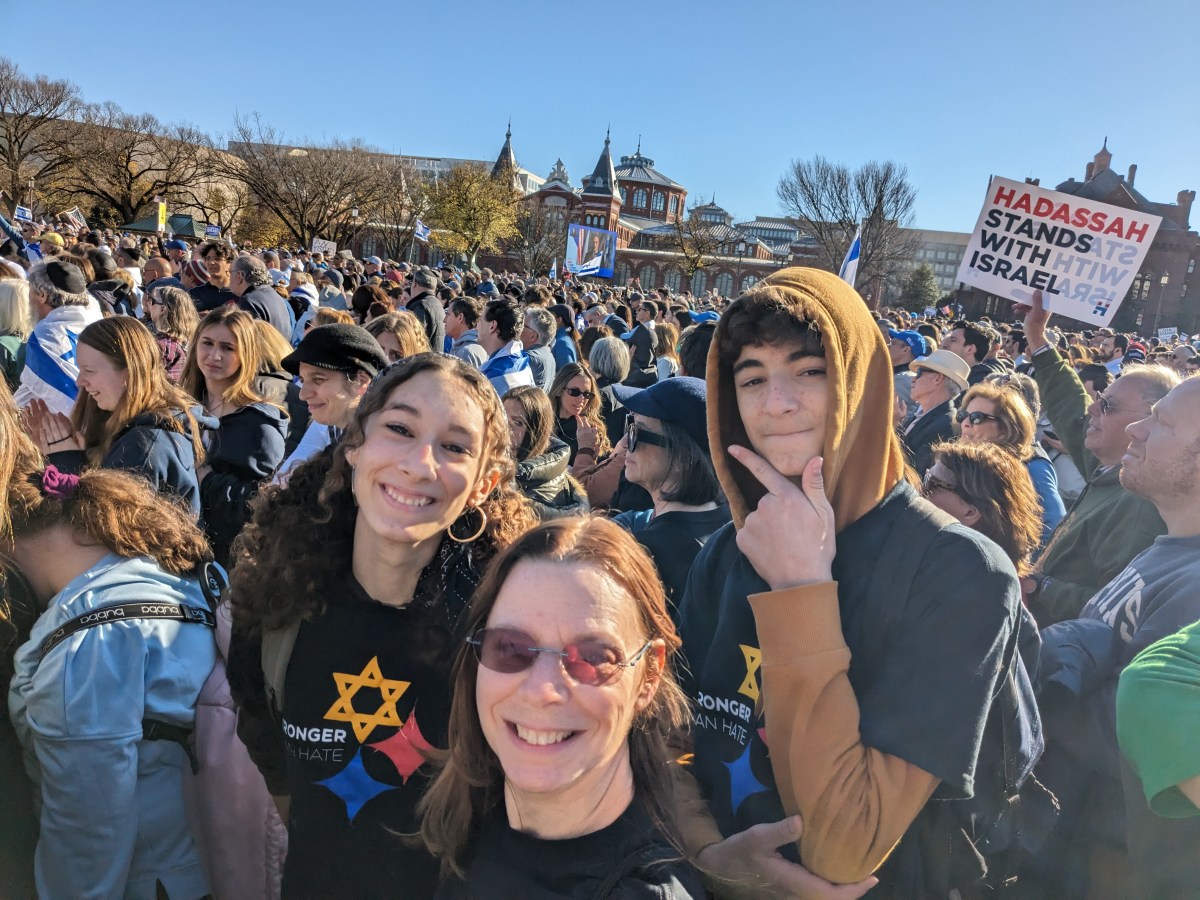
But I witnessed this phenomenon this week, as I traveled with more than 500 members of the Pittsburgh Jewish community, including somewhere around 50 folks from Beth Shalom, to gather on the Mall in Washington, DC with nearly 300,000 others from around our nation. There were people from across the many spectra of the Jewish community – politically left and right, Orthodox, Conservative, Reform, Reconstructionist, secular, Ashkenazi and Sepharadi – as well as non-Jewish allies. It was a powerful moment, which some are claiming as the largest gathering of Jews ever in America.

Washington, DC, November 14, 2023

And we were all there to be present, to be counted. To stand with Israel and with each other. To pray, to sing, to listen to the words of leaders, to hope together that God will help us find our way from darkness to light. And that felt powerful.

Lurking behind the strength of presence was, of course, the need for security. I know that the Jewish Federations of North America spent millions of dollars on trying to ensure the safety of participants. And I saw the need for security when, as we were walking to the Mall along with many others, we were shocked to see a middle-aged man in a car stop in the middle of the street, block traffic, roll down his windows and yell at a group of day school students, in a Middle Eastern accent, “You are terrorists! You are killers! We will overthrow you! We will kick you out!”

I do not know this for a fact, but I am guessing that when there are anti-Israel rallies, at which protesters call Israel an “apartheid” state and claim that she is committing “genocide” and other such falsehoods, those folks do not have to bother with security. One day after 300,000 people gathered peacefully on the Mall to stand with Israel, 150 protesters, members of the anti-Zionist Jewish group IfNotNow engaged in violent clashes with police outside the Democratic National Committee headquarters. 

But we, who stand for the memory of innocent civilians who were murdered, for those who were taken hostage and their families, who stand against a cult of death and destruction, we need protection. 

Perhaps you heard about Vivian Silver, the Canadian-Israeli peace activist who had been presumed to be a hostage taken from Kibbutz Be’eri until her remains were identified this past week. Ms. Silver had a long and illustrious history of working toward peace and understanding between Jews and Arabs. She founded and ran organizations with this mission. She fought for gender equality in Israel, having worked on a Knesset subcommittee on the subject. She even led tours on the Israel-Gaza border to raise awareness of the plight of Gaza’s citizens. Just three days before she was brutally murdered, she helped organize a peace rally in Jerusalem which gathered 1500 Israeli and Palestinian women.

Vivian Silver

And on October 7th, she was reduced to just one more victim of terror, her life’s work gone in a flash, her breath taken from her by some of those she sought to empower.

True evil does not distinguish between Jew and Muslim, hawk or dove, women, men, children, soldiers, babies, octogenarians. True evil kills, and then points to a “humanitarian crisis” which it has created. True evil hides behind innocent people caught in a war zone, in hospitals and schools and mosques and apartment buildings, to maximize the death toll.

In an Arabic-language interview with Russia Today, a Hamas official was asked why they built 300 miles of tunnels instead of bomb shelters for Gazan civilians. He replied, “We have built the tunnels because we have no other way of protecting ourselves from being targeted and killed. These tunnels are meant to protect us from the airplanes. We are fighting from inside the tunnels. Everybody knows that 75% of the people in Gaza are refugees, and it is the responsibility of the UN to protect them.”

In other words, Hamas sees its job to attack Israel and kill Jews, not to protect the citizens of Gaza when Israel inevitably returns fire. This is evil. This is the cult of death that Hamas has created.

The Torah teaches us that evil is not an abstraction. It is real, and it is found in this world.

And we must respond to evil with presence. By showing up for each other. By standing up and being counted. By emphasizing our values: life, compassion, gratitude, generosity, the steadfastness of peoplehood, mercy and understanding. By sitting in silence with those in pain, and by crying out for justice for those who are held captive.

Adonai oz le’amo yiten; adonai yevarekh et amo bashalom. May God grant strength to God’s people; may God bless God’s people with peace (Tehillim / Psalms 29:11).
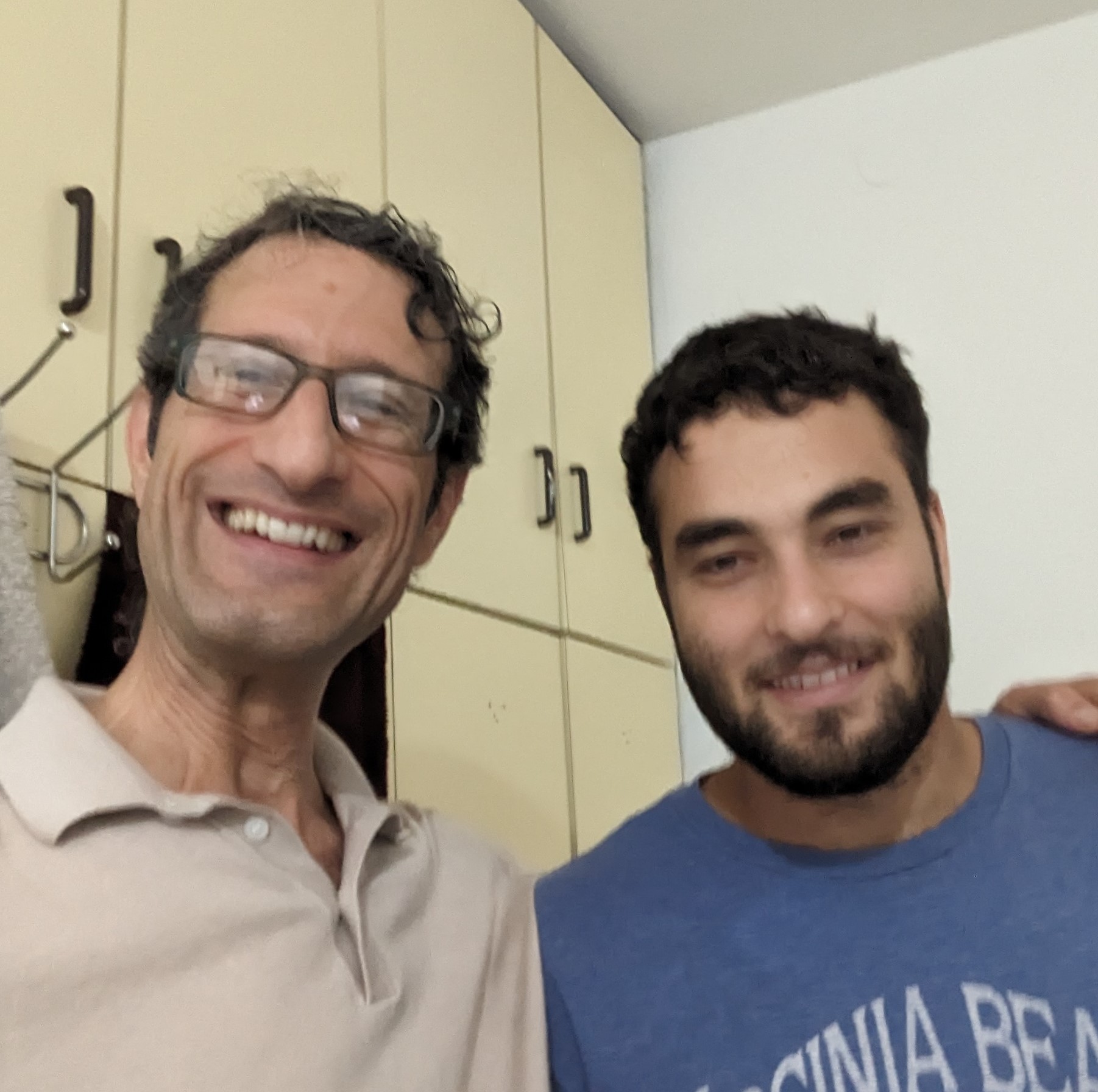
Oryah and I at Kibbutz Ein Gev, 11/8/2023

~

Rabbi Seth Adelson

(Originally delivered at Congregation Beth Shalom, Shabbat morning, 11/19/2023.)

Categories
Sermons

Don’t Take Down Your Mezuzah – Vayyera 5784

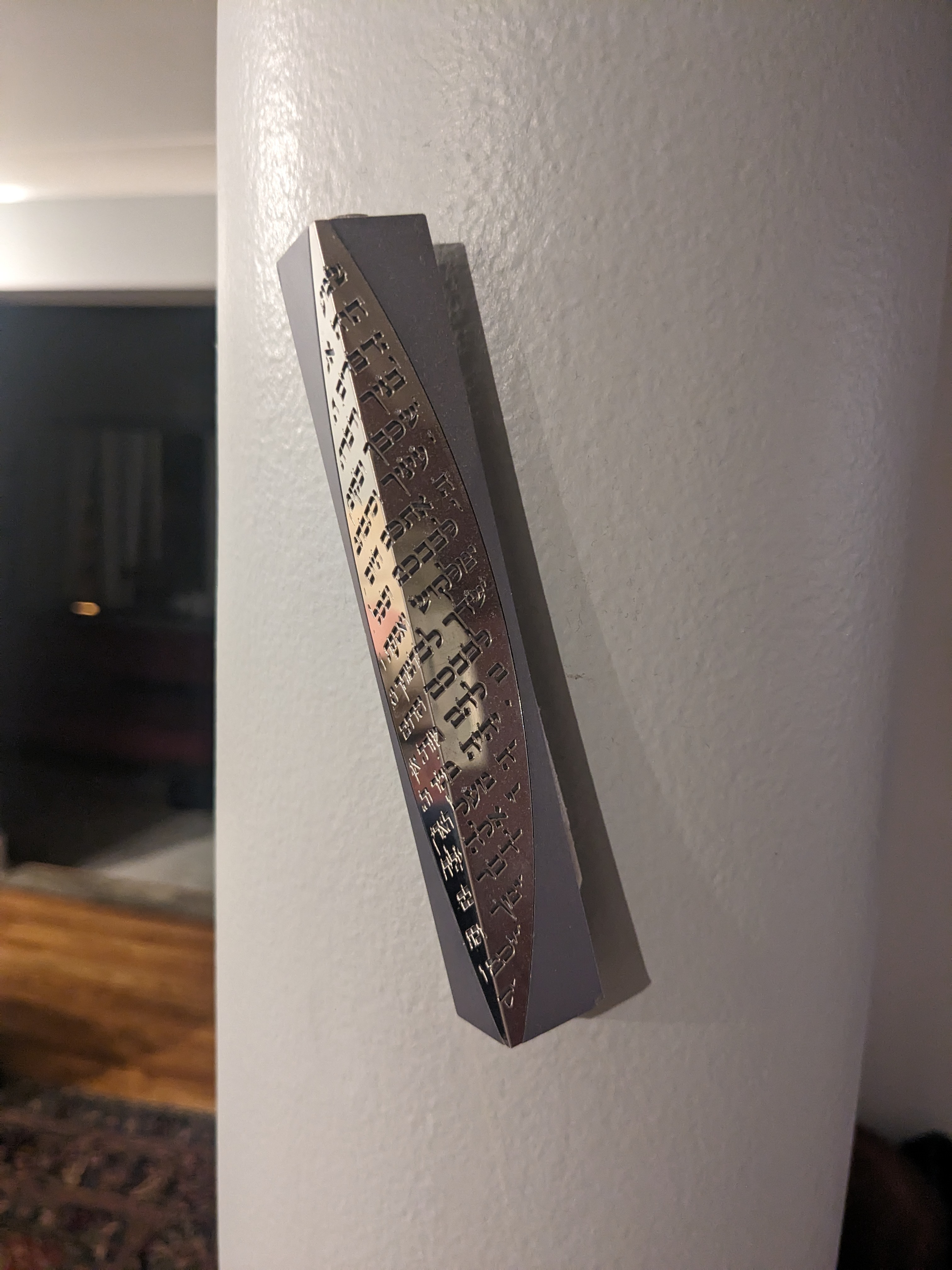
Here is a piece of advice for the current moment: Do not take your mezuzot down from your doorposts.

Our patriarch Avraham, the first monotheist and the father of Judaism, Christianity, and Islam, is described in Parashat Vayyera as hospitable; he welcomed guests into his tent. A midrash suggests that this tent was open on four sides, which leads to a very, very important question: were there four mezuzot on the exterior doors of Abraham’s tent?

Now, you might say that question is clearly ridiculous. According to traditional chronology, Moshe receives the Torah on Mt. Sinai nearly 500 years after Avraham walked the Earth, so how could Avraham have known to put mezuzot on his doorposts? The commandment to inscribe the words of the Shema on our doors had not yet been given. But there is another tradition that tells us that the Avot, the patriarchs, and by extension the Imahot/matriarchs as well, kept the entire Torah, even before Mt. Sinai. 

So of course Avraham had mezuzot on his tent doors!

I’ll come back to that.

Meanwhile, I’m getting asked quite frequently how I am doing, and in general, as is customary, I answer, “OK.” That is also how my son, who is still in the north of Israel at an artillery position, behind a large gun aimed at Hizbullah, answers when he is asked. I am grateful that he is not on the ground in Gaza, although you may know that we have multiple children of this congregation who are there right now, and we are praying for them all.

But I must say that I am not feeling too good about the world right now. In the coming week we will observe the 85th anniversary of Kristallnacht, the Night of Broken Glass, when Nazi-aligned thugs across Germany, Austria, and the Sudetenland destroyed 267 synagogues, 7,000 Jewish businesses, and murdered at least 91 Jews. 

In the wake of Kristallnacht. Fasanenstrasse Synagogue, Berlin, 1938.

What we are seeing around the world right now – on European streets, on American college campuses, and even in our own neighborhood – is tremendously unsettling, even though, thank God, we are not yet seeing a reprise of 1938. 

Nonetheless, in Paris, vandals are painting Jewish stars on Jewish-owned buildings. On TikTok, Jewish content creators have been subjected to an avalanche of hatred. At Tulane University, a student was punched in the face for standing with Israel.

I loved the four years I spent on the campus of Cornell University, studying chemical engineering, singing in an a capella group, and occasionally dining at what was at the time a brand-new kosher dining hall. 

That kosher dining hall was deserted a week ago, its regular diners too scared to leave their dorm rooms, as threats to the physical safety of Jewish students at Cornell were posted online. Thank God, the police have found the alleged perpetrator. But for those students who felt that their lives were threatened, I do not see how there can be any real comfort right now.

Nor for the students at Columbia who held a press conference to plead for protection from the university from the constant harassment they face from anti-Israel activists. Nor is there comfort for the students at George Washington University, where the slogan, “Glory to the Martyrs” was projected on a building. To be clear, the “martyrs” being glorified here are Hamas terrorists who infiltrated Israel and executed barbarous atrocities too graphic to speak of in a house of worship.

Ladies and gentlemen, Hamas has successfully pulled the wool over the eyes of the world. In a sinister turn, the world’s attention has turned to the humanitarian catastrophe in Gaza, which is undeniably real, and truly awful. But let us be clear: this catastrophe was not created by Israel.

Billions of dollars in aid have been given to Gaza by international organizations. Did Hamas pour that money into infrastructure that would sustain its people? No. They built hundreds of miles of tunnels and more powerful rockets with which to carry out what they cynically call “resistance” to the “Israeli occupation.” They built their headquarters under the main hospital in Gaza City, rather than improving the capacity or care of that hospital.

And so there have been huge demonstrations on college campuses where students and faculty are actually praising Hamas! This past week, more than 100 Columbia professors signed a letter that sought to “recontextualize” the conflict, calling the brutal and horrific attack of October 7 a “military action,” and supporting those students who defend the actions of Hamas.

Here is a question that we might ponder: When Russia invaded Ukraine, at first in 2014 and then escalating in 2022, were there campus protests supporting Vladimir Putin, or “recontextualizing” the Russian invasion? I wonder why not?

The Syrian civil war has been going on now for 12 years, and the UN estimates that over 300,000 Syrians have been killed. Where are those marching for justice in Syria?

Even less well-known is the civil war in Yemen, which, by the way, apparently just declared war on Israel. Somewhere near 400,000 Yemeni civilians have been killed; 85,000 children have died of starvation since 2014. Where are the voices calling for humanitarian aid in Yemen? Where are the calls for “ceasefire now”?

You know where the world’s largest refugee camp is? Bangladesh, where over a million Rohingya Muslims have fled actual genocide at the hands of the military leadership of Myanmar. Where is the outrage? Where are the projections on campus buildings, the graffiti?

So what’s the difference between the action on the ground in Gaza and all of those other situations? Jews. The world simply cannot stand with the Jews. 

And though there is always legitimacy, necessity even, to criticizing governments and policies, since Oct. 7, it is apparent that, lurking behind much of the current criticism is the sneaky specter of anti-Semitism. The ADL calculated that the number of anti-Semitic attacks over the first two weeks following Oct. 7 was up 388% from the same period last year. There is a little irony here: anti-Jewish attacks beget more anti-Jewish attacks.

There are even Jews who cannot stand with the Jews. Groups like Jewish Voice for Peace and IfNotNow, who think that they are supporting the Palestinian people by labeling the death of innocent civilians who are being used as human shields as a “genocide,” and by calling for a ceasefire. They are delusional; they are, in fact, supporting terrorists who seek only to destroy.

I know it is very tempting to say, just stop. The idea of a ceasefire is appealing. The problem with calling for “Ceasefire now,” is that a ceasefire benefits ONLY Hamas. Hilary Clinton – not exactly a military hawk – said exactly that this past week. 

By the way, there was a ceasefire in place up until October 6th. Who broke it? And what happened? And if there is a ceasefire now, what will inevitably follow? Hamas will regroup, strengthen itself, acquire better rockets and training from Iran, and then attack Israeli civilians again. And again. And again. And the Palestinian people gain nothing – only more death and destruction and sorrow.

In 1946, Lutheran Pastor Martin Niemöller gave a confessional speech in Germany, in which he famously admitted his own guilt, and the guilt of all well-meaning people in Germany, for the murder of 6 million Jews. Although the original text was lost to history, it is often rendered this way:

First they came for the socialists, and I did not speak out—
Because I was not a socialist.

Then they came for the trade unionists, and I did not speak out—
Because I was not a trade unionist.

Then they came for the Jews, and I did not speak out—
Because I was not a Jew.

Then they came for me—and there was no one left to speak for me.

Now is the time for those who care about all that is good and righteous and hopeful for the future to stand up and speak up for the safety of Jewish people, in Israel and around the world. Now is not the time for a ceasefire. Now is the time to do what should have been done long ago: to remove Hamas from power and to give the Palestinian people a government that will work for their benefit. 

That is a wee bit too easy to say, I know. But remember also that I have a son who wears the uniform of the Israel Defense Forces, and is standing in the line of terrorist fire, and in some sense, all of us do so as well.

And if nobody else stands up for the Jews, we must stand up for ourselves – for our heritage, history, culture, wisdom, and tradition of discernment. Edmond Fleg was a French Jewish writer, who in 1927 wrote a short treatise called, “Pourquoi je suis Juif.” Why I am a Jew. In it, he said the following:

I am a Jew because the faith of Israel demands no abdication of the mind.

I am a Jew because the faith of Israel demands all the devotion of my soul.

I am a Jew because in all places where there are tears and suffering the Jew weeps…

I am a Jew because the promise of Israel is a universal promise.

I am a Jew because for Israel the world is not finished; men will complete it.

I am a Jew because for Israel man is not yet completed; men are completing him…

I am a Jew because in every age when the cry of despair is heard the Jew hopes.

In completing the world, in weeping and hoping, we must stand one and all with Israel as she engages – we hope, carefully and cautiously and with a minimum loss of life – to do the right thing for humanity.

And we must stand up for ourselves: being loudly and proudly Jewish. And maybe, just maybe, some of our friends and neighbors will stand with us.

So don’t take down your mezuzah. Because if there is one thing that people who hate Jews detest even more than Jewish people, it’s Jewish people who are not afraid to be Jewish.

And I have some good news! Our friend Rev. Canon Natalie Hall told me this week that she is embarking on a mezuzah project with her community, and we hope that it will spread even further. Given the attacks on Jews, the anti-Semitic graffiti, the fear in our very neighborhood, she is going to order a whole bunch of mezuzot boxes (not with scrolls inside) for our non-Jewish neighbors to put on their doors, so anybody seeking out a Jewish house to do harm will not know which ones are actually inhabited by Jews.

It’s a small gesture of solidarity, but I hope it will be tremendously meaningful.

Adonai oz le’amo yiten; adonai yevarekh et amo bashalom. May God grant strength to God’s people; may God bless God’s people with peace.

~

Rabbi Seth Adelson

(Originally delivered at Congregation Beth Shalom, Pittsburgh, PA, Shabbat morning, 11/4/2023.)